Schoolgirls at War: French Propaganda Posters from World War I

In a surprising move during the final year of World War I, the French government turned to Parisian schoolgirls to create propaganda posters directed at the general public. Up until this time, the country’s posters had been relatively colorless, focusing on the sacrifices being made by soldiers for the protection of women and children. By 1918, however, the weary and bereft French people had become increasingly jaded, and much less likely to be swayed by such guilt-inducing messaging. Since the beginning of the war in August 1914, half of its male population between the ages of 15 and 30 had been killed and more than 1.1 million children had been orphaned. Crippling shortages of food and materials, combined with the loss of income from men in service, meant that most families were struggling to survive. As many mothers now had to work, essential goods were obtained by children tasked with standing in lines for hours before presenting ration cards to shopkeepers in return for their families’ meager allotments. Further, strikes (often led by women workers) protesting the rising cost of living disrupted major French cities. The government had to find a new way to inspire solidarity among its citizens. 

In June of 1917, Victor Boret, the minister of provisions, saw an exhibition of children’s prints on themes of war. Recognizing the potential of these images, he suggested to the government that posters made by young people might be the most effective way to encourage the French population to conserve resources. By early 1918, the Comité National de Prévoyance et d’Économies (National Committee for Foresight and Thrift) announced a student competition in Paris: the strongest designs on the theme of voluntary rationing would be printed and distributed throughout France. While hundreds of images were submitted, only 16 posters were finally printed—all drawn by girls between the ages of 13 and 16. At a time when young women were generally seen as no more than “future housewives,” and, in France, did not obtain the right to vote until 1944, the project represented a radical amplification of female voices. 

The posters were a runaway success. The press celebrated their role in the apparent renewal of patriotic fervor in the adult population. Hundreds of thousands of the posters were printed and displayed in shop windows and post offices throughout Paris and the countryside, and many were sent to France’s allies for further distribution. Impressions on fine paper were also offered for sale in order to fund the war effort. These designs—some printed in seven colors—were costly to produce and received more fanfare and government promotion than almost any other official posters. During an era when a minuscule percentage of professional poster designers were women, this collection comprises the most significant number of female artists in the field. It also represents one of the most widely circulated French propaganda campaigns of the period.  

Unless otherwise noted, all posters come from the Poster House Permanent Collection. 
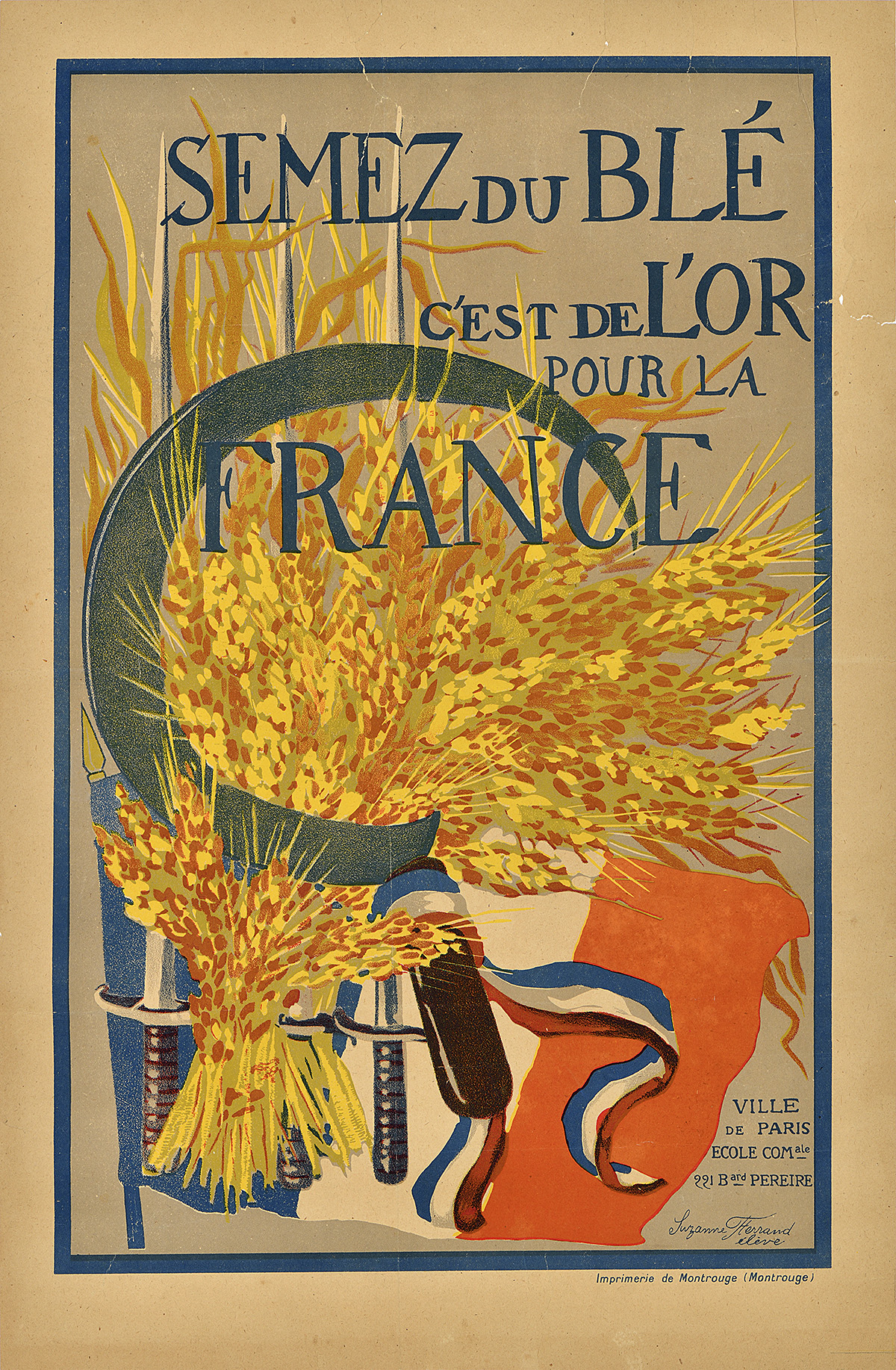
A lithographic poster of a bushel of wheat surrounded by a French flag.

Du Blé, 1918

Suzanne Ferrand, 16 years old

Poster House Permanent Collection

  • With most able-bodied men conscripted into service, farm labor fell to women, children, and the elderly, often without the aid of the domesticated animals that were also being used by the military. Due to poor harvests and the fact that more than sixty thousand farms were abandoned during the war, there was a notable deficit in French agricultural output. 
  • Here, the artist depicts the handles of three bayonets piercing sheaves of wheat and emerging as the tines of a pitchfork. This creative design underscores the message in the caption: “Sow wheat, it’s gold for France.” More food would contribute to the building of a stronger army—and ultimately to victory.

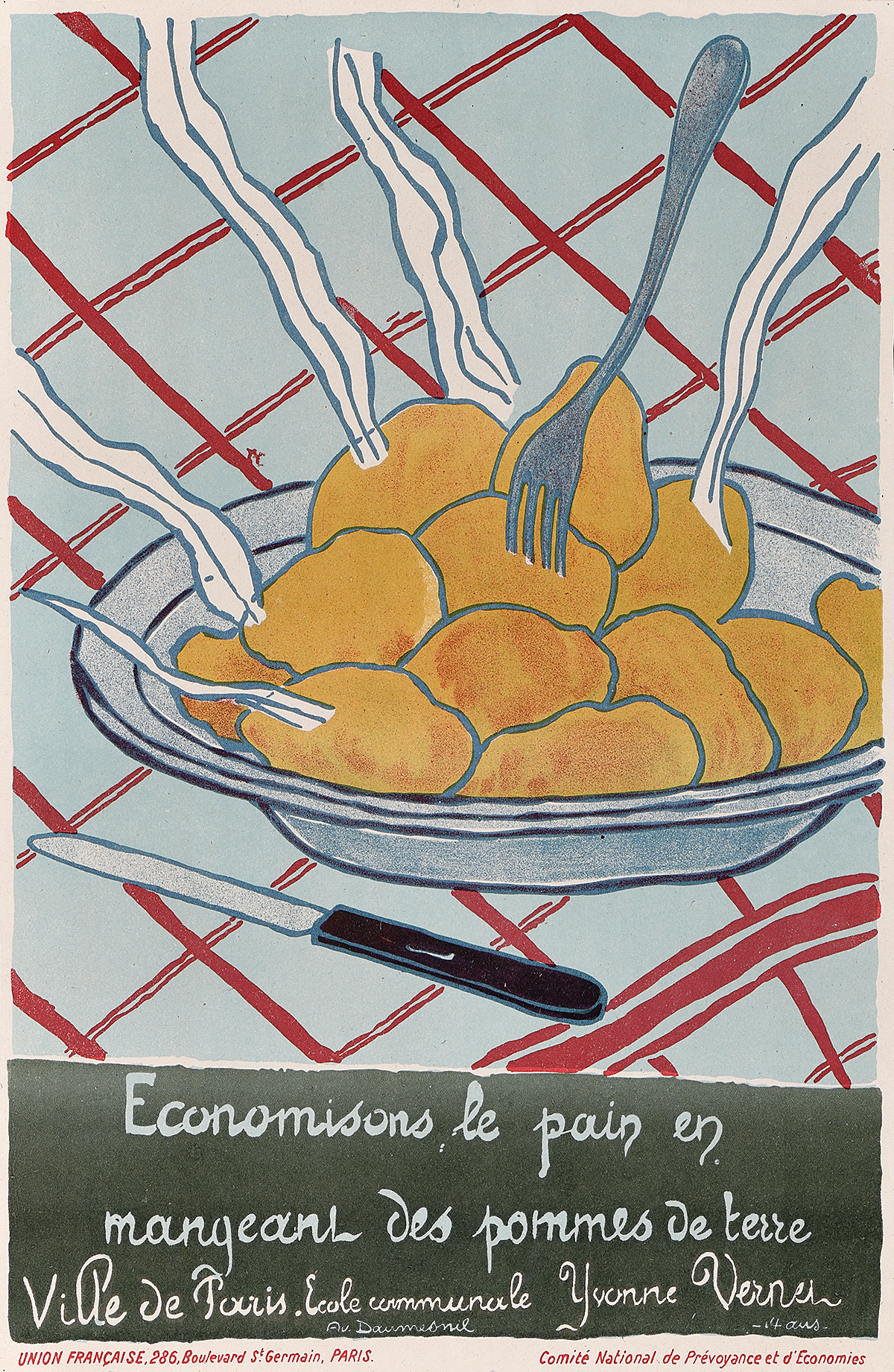
A lithographic poster of a steamy plate of potatoes on a criss crossed tablecloth.

Des Pommes de Terre, 1918

Yvonne Vernet, 14 years old

Gift of Peter A. Blatz, Poster House Permanent Collection

  • Since wheat, and therefore bread, were in increasingly short supply, the government promoted potatoes as a suitable replacement. As the young artist recommended here, the people of France should “economize on bread by eating potatoes.”
  • In 1917, rationing allowed a single person to receive five pounds of potatoes per week; however, a dramatic increase in the price of potatoes at the same time meant that, while it was officially permitted, most people could not afford to buy them in this kind of quantity.

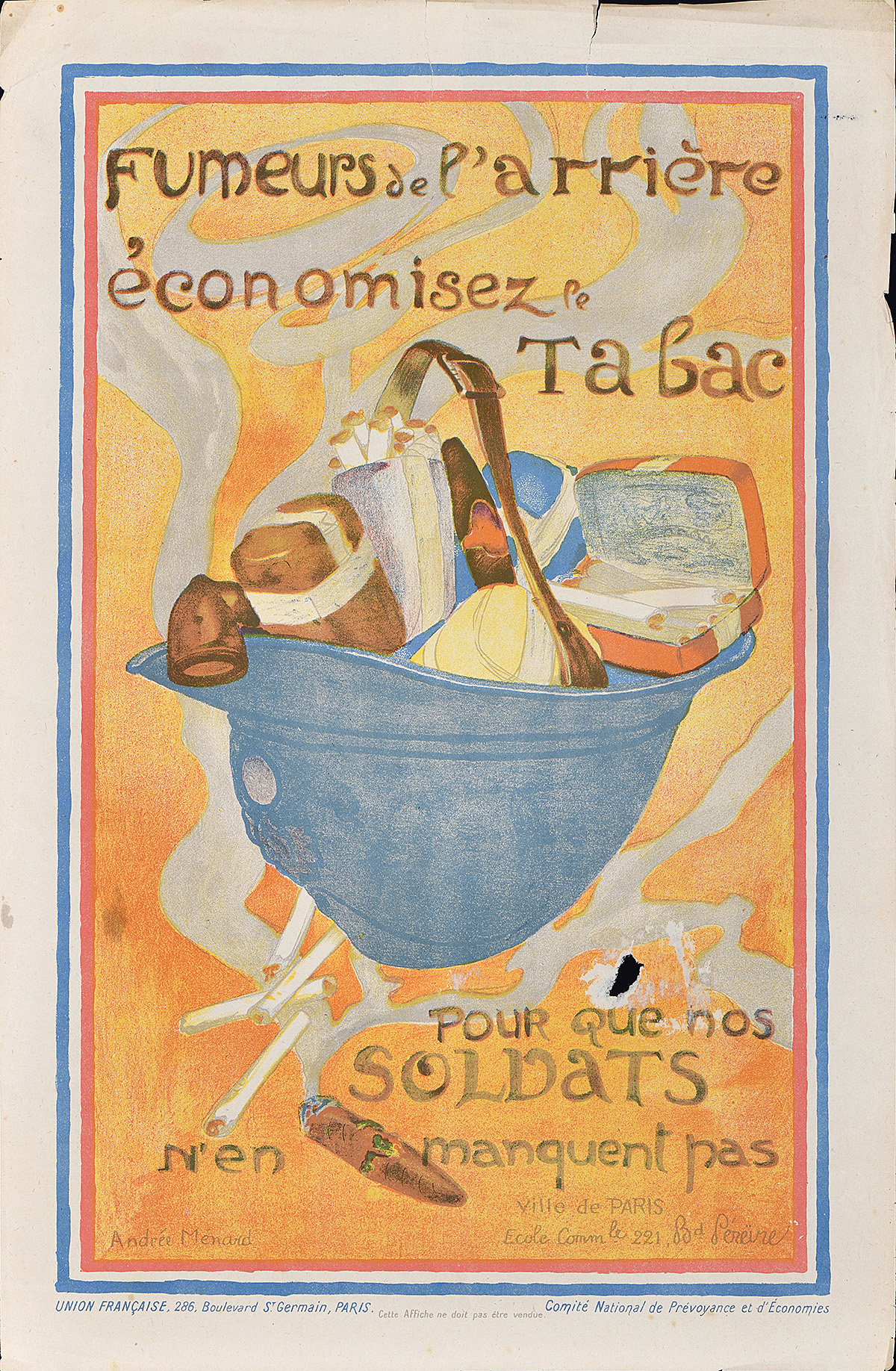
A lithographic poster of food in a basket shaped like a soldier's hat.

Le Tabac, 1918

Andrée Ménard (Age Unknown)

Poster House Permanent Collection

  • In 1917, France faced numerous mutinies within the army as thousands of broken and shell-shocked soldiers deserted their units or simply refused to fight. That summer, the government focused on repairing morale among the troops, which included providing extra comforts like tobacco. 
  • The poster urges “Smokers who are left behind [to] economize with tobacco so that our soldiers don’t miss out.” 
  • At the center of the image is an M15 Adrian, the first modern steel helmet in France, adopted by the army in 1915. Prior to this, French soldiers had worn the cloth “kepi” cap, which offered no protection against shrapnel.

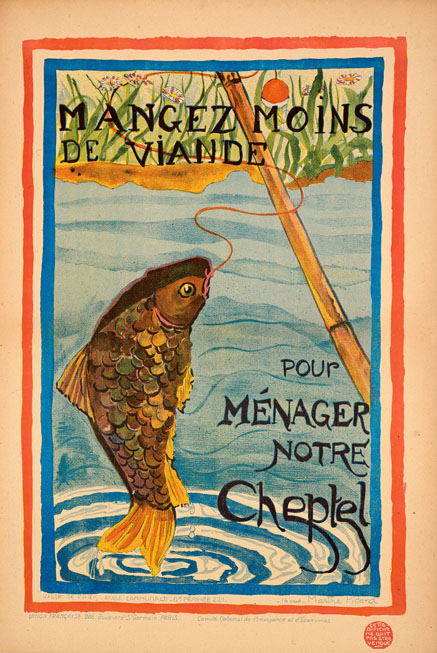
A lithographic poster of a fishing pole catching a fish just out of the water.

De Viande, 1918

Marthe Picard, 16 years old

Gift of Peter A. Blatz, Poster House Permanent Collection

  • Starting in May 1917, the government introduced two meatless days per week, forbidding its sale, encouraging people not to eat it, and threatening further rationing should these measures not be taken seriously. Meatless days were extended to three times a week the following year, at the same time as an astronomical increase in the price of meat. 
  • Here, the artist asks the viewer to “eat less meat to manage our livestock,” presenting a fish as a fine alternative.

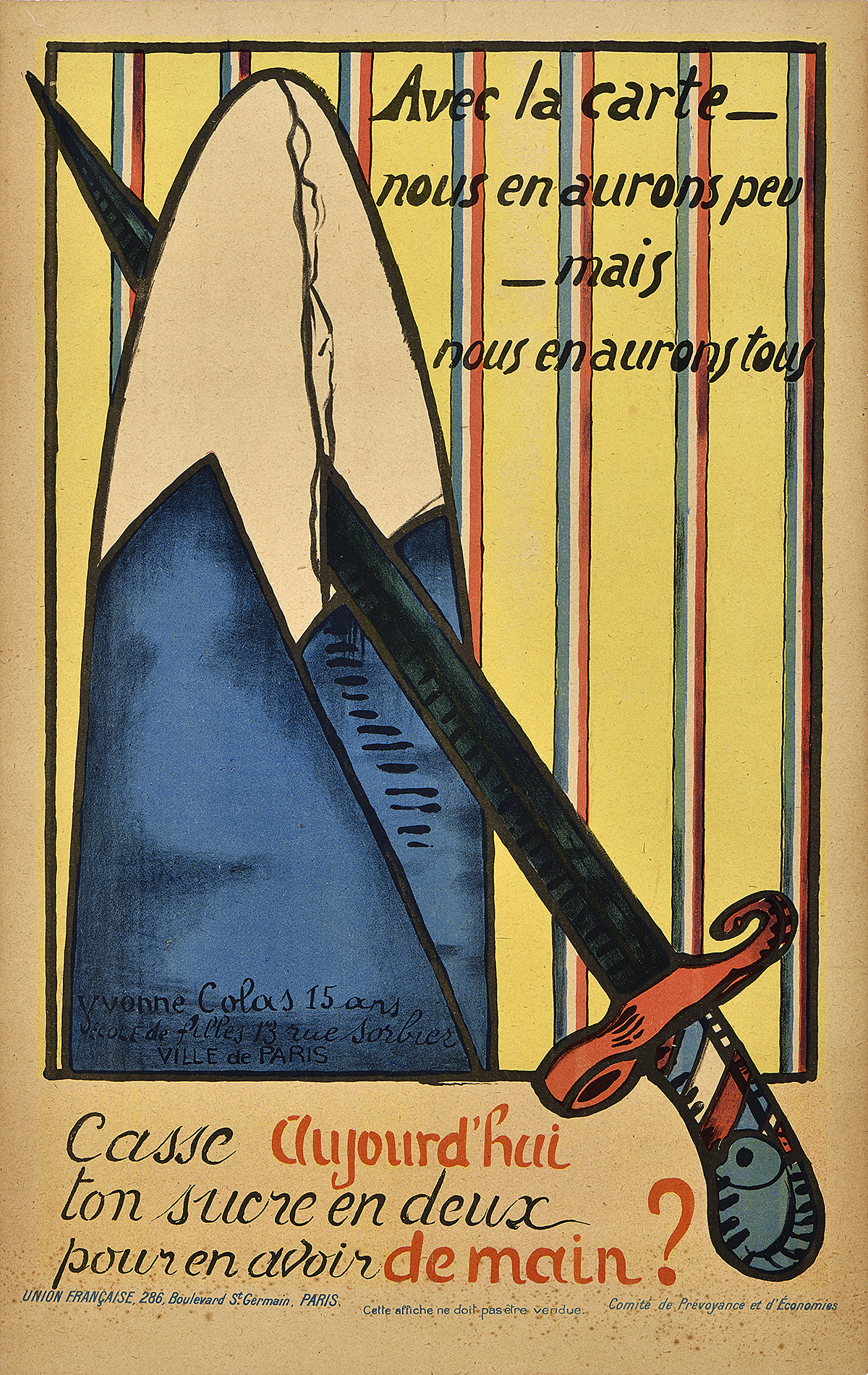
A lithographic poster of a nub of sugar being cut by a sword.

Ton Sucre, 1918

Yvonne Colas, 15 years old

Poster House Permanent Collection

  • The majority of France’s sugar came from sugar-beet farms in Germany and occupied zones within France, making it incredibly difficult to obtain as the war progressed. Other farms also switched to growing wheat and potatoes as they were more valuable as sources of food. 
  • The artist depicts a Gras bayonet slicing through a hard cone of sugar, typically sold wrapped in blue paper. The accompanying text states that “With the [ration] card—we would have little—but we’d all have some. Today, break your sugar in two so you have some tomorrow.”  

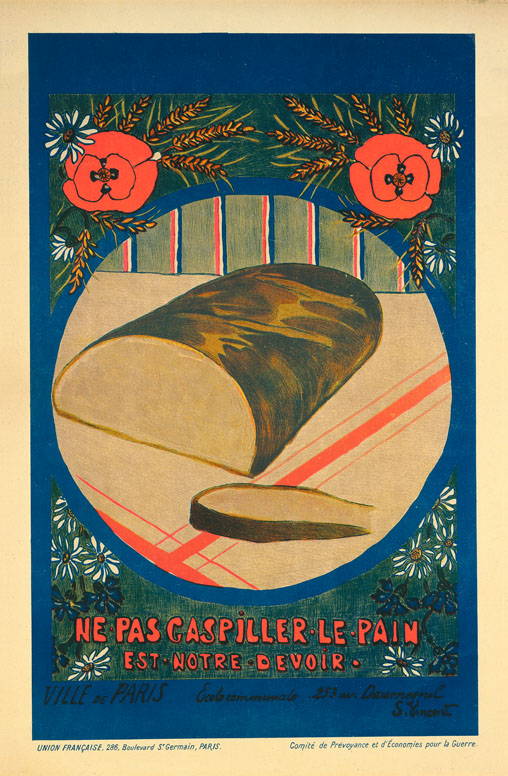
A lithographic poster of a loaf of bread cut on a table, surrounded by floral imagery.

Le Pain, 1918

S. Vincent (Age Unknown)

Gift of Peter A. Blatz, Poster House Permanent Collection

  • The management of an army’s food supply is essential to victory during a long war—a starving soldier cannot fight. As bread was one of the main foodstuffs given to soldiers, civilians were asked to reduce their consumption of it—a deeply felt sacrifice since bread constituted more than 50 percent of the diet of the average French citizen at the time. 
  • Throughout most of World War I, the cost of bread was fixed by the government, meaning that while other items rose dramatically in price, bread did not. This ended in 1918, when bread was rationed—emphasized here by the caption proclaiming that: “It’s our duty not to waste bread.”

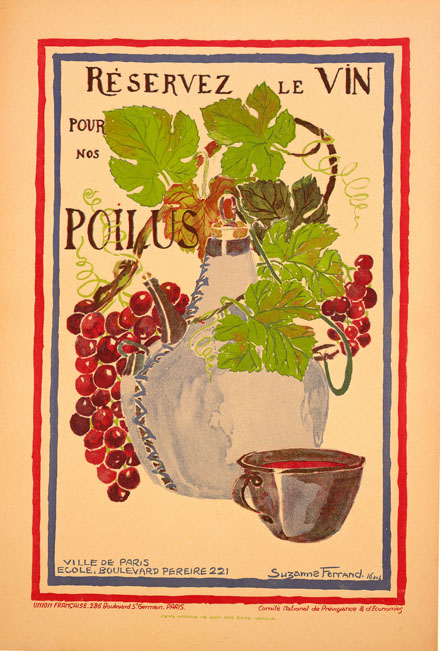
A lithographic poster of a jug of wine and a cup surrounded by purple grapes.

Le Vin, 1918

Suzanne Ferrand, 16 years old

Gift of Peter A. Blatz, Poster House Permanent Collection

  • Along with bread, wine was one of the most common rations given to French soldiers at the front, primarily to uphold morale. Here, the artist depicts a classic French wine flacon wrapped in leather.
  • While the caption can be basically translated as: “Save the wine for our soldiers,” the word “poilus” means “the hairy ones”—a term of endearment used to describe French infantrymen during World War I.

“Children were as such a vital component in efforts to mobilize adults, but they were also standalone actors on the home front.”—Manon Pignot, historian


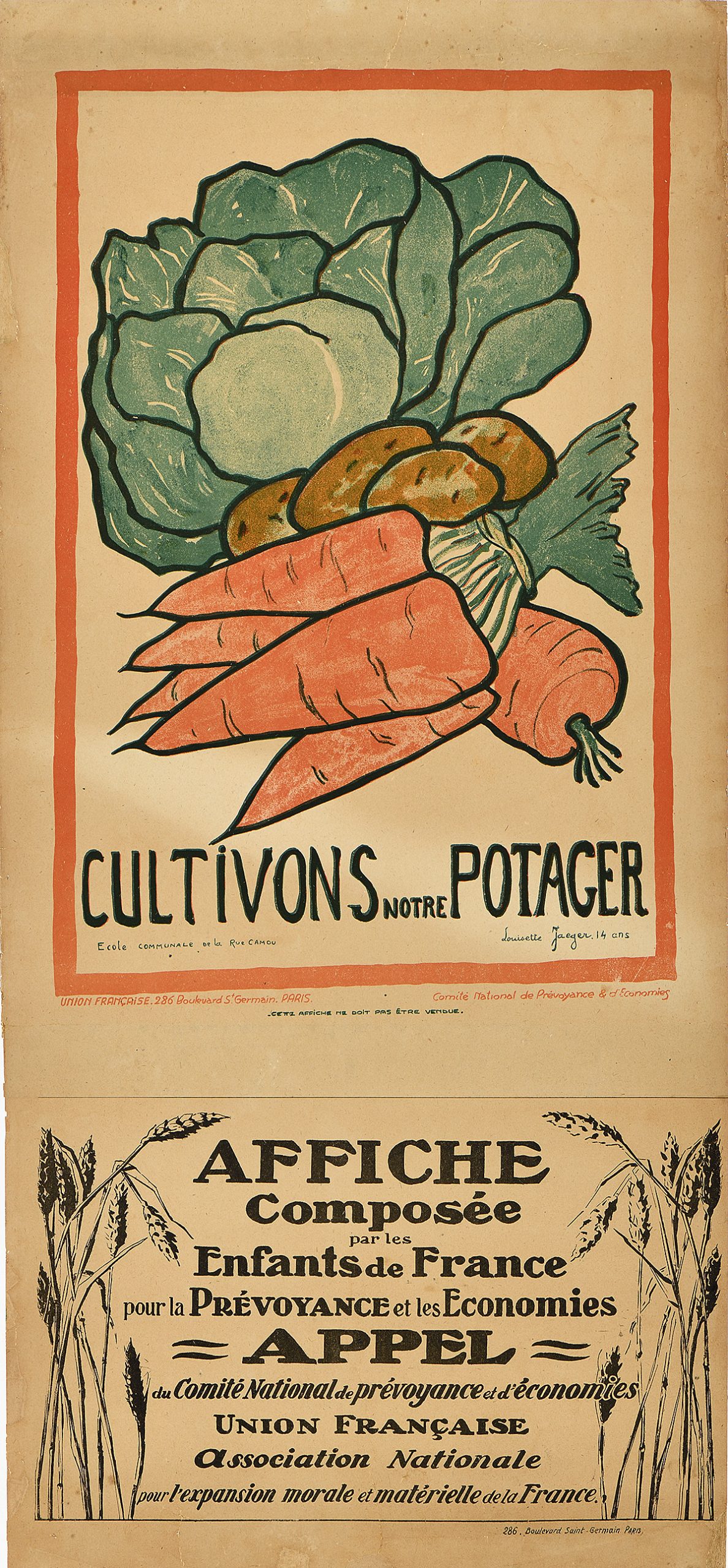
A lithographic poster of cabbage, carrots, and potatoes above text with wheat.

Notre Potager, 1918

Louisette Jaeger, 14 years old

Poster House Permanent Collection

  • As food became more scarce and many citizens faced starvation, the government began encouraging its people to plant small vegetable gardens in their backyards, as suggested by the text: “Let’s cultivate our kitchen garden.”
  • This impression of the poster features the uncut lower panel that would have been attached to all of these posters when they were originally released, but which would usually have been removed for display purposes. It notes that the “children of France” created these images for “the moral and material expansion of France.”

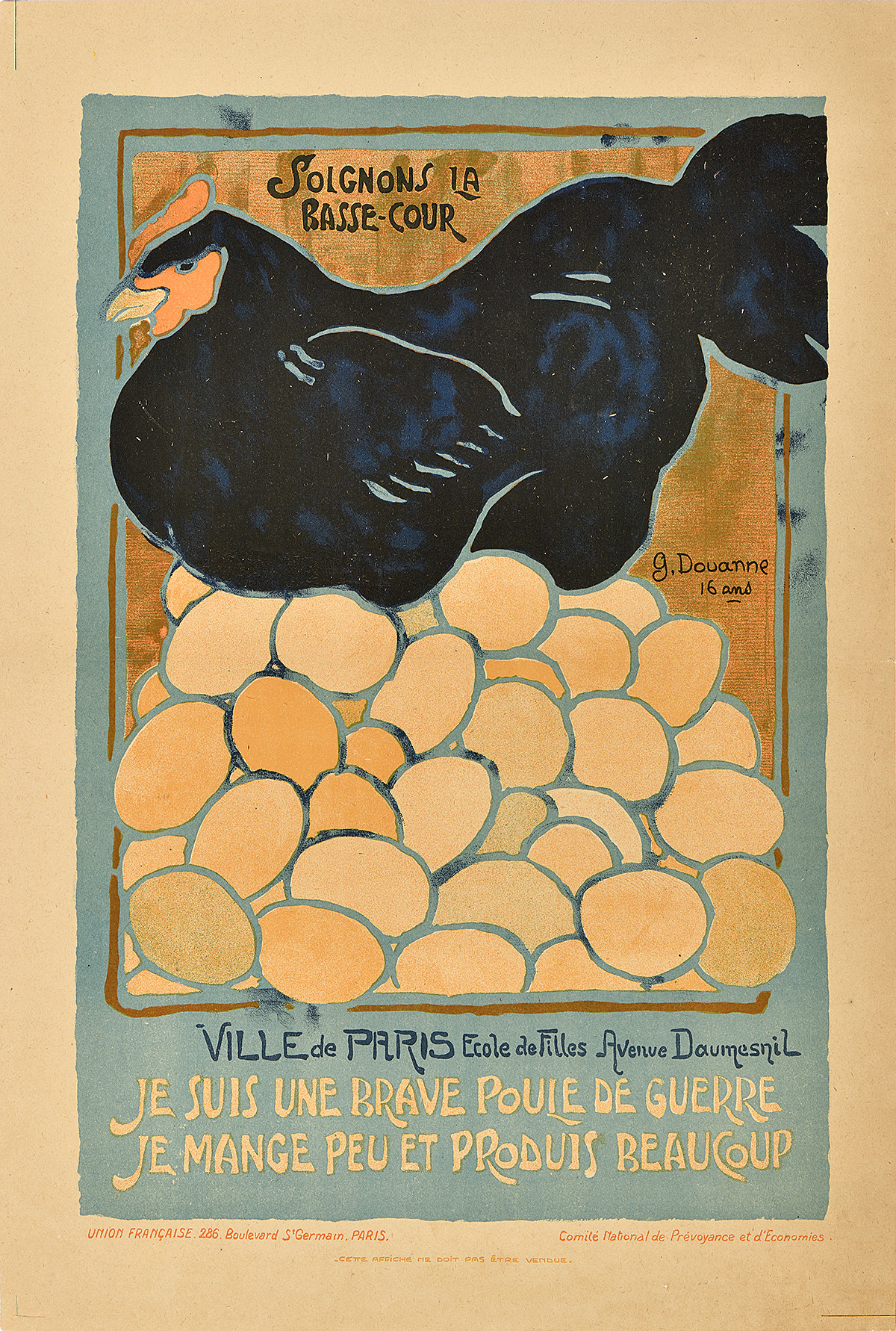
A lithographic poster of a black chicken sitting on a large pile of eggs.

Poule de Guerre, 1918

G. Douanne, 16 years old

From the collection of Nicholas D. Lowry

  • In addition to encouraging French citizens to grow their own food, the government also advocated the rearing of animals like rabbits and chickens which could be raised quickly and cheaply with limited space. 
  • Charitable groups like the Daughters of the American Revolution in the United States launched campaigns to help “rechickenize” France, sending money to buy hens and roosters for French families. 
  • This is the only poster in the series in which the subject (in this case, the chicken) speaks directly to the viewer. It recommends that people should “look after the barnyard. I am a brave war chicken. I eat little and produce much.” Given that the Gallic rooster is the symbol of France, this determined and productive bird may be seen as representative of the ideal citizen during wartime.

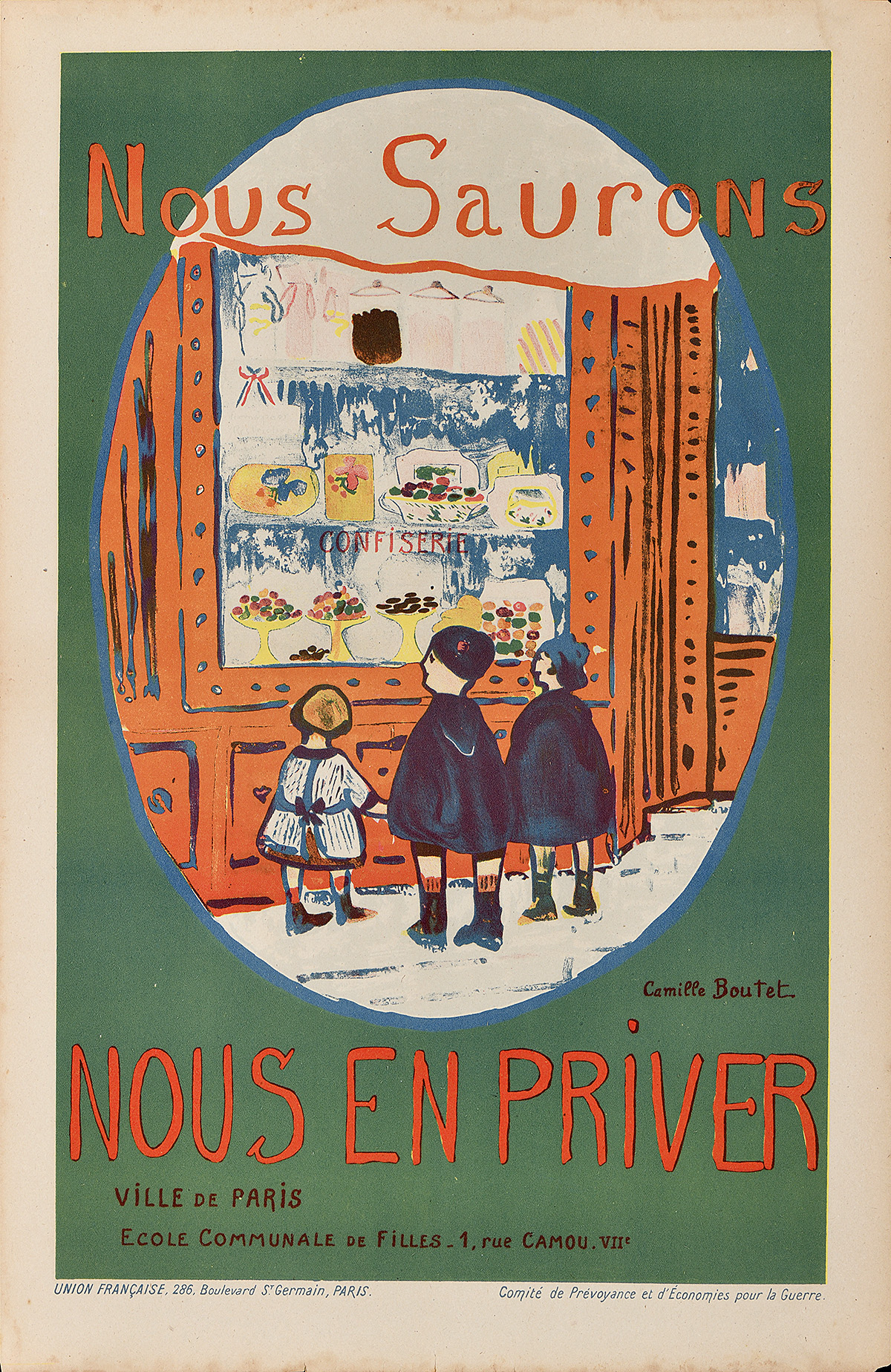
A lithographic poster of 3 children looking in a candy shop window.

Nous Saurons, 1918

Camille Boutet (Age Unknown)

Poster House Permanent Collection

  • In order to conserve sugar, the government ordered pastry and candy shops to close two days a week, and, in March of 1917, it introduced rationing, cutting individual consumption of sugar to one third of its prewar levels. 
  • This is one of the most touching posters in the series; it shows three children looking longingly into the window of a candy store decorated in the red, white, and blue of the Tricolore (the French national flag), accompanied by the caption “We will know how to deprive ourselves.” The implication is that if children can find the discipline to voluntarily restrict their simple desires, adults should be more than capable of doing so.  

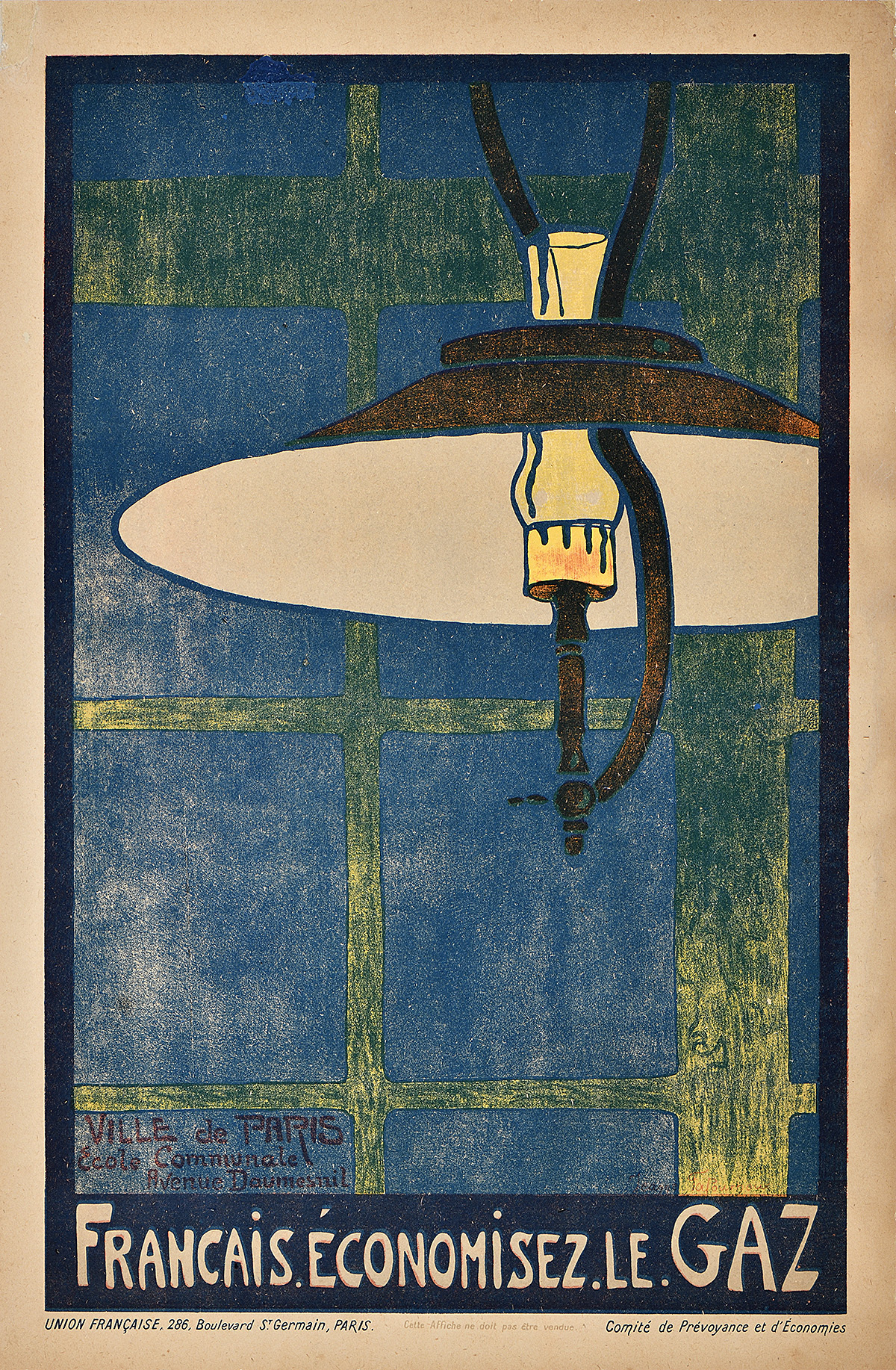
A lithographic poster of a lamp hanging in front of a blue and yellow criss crossed background.

Le Gaz, 1918

Jeanne Fapournaux (Age Unknown)

Poster House Permanent Collection

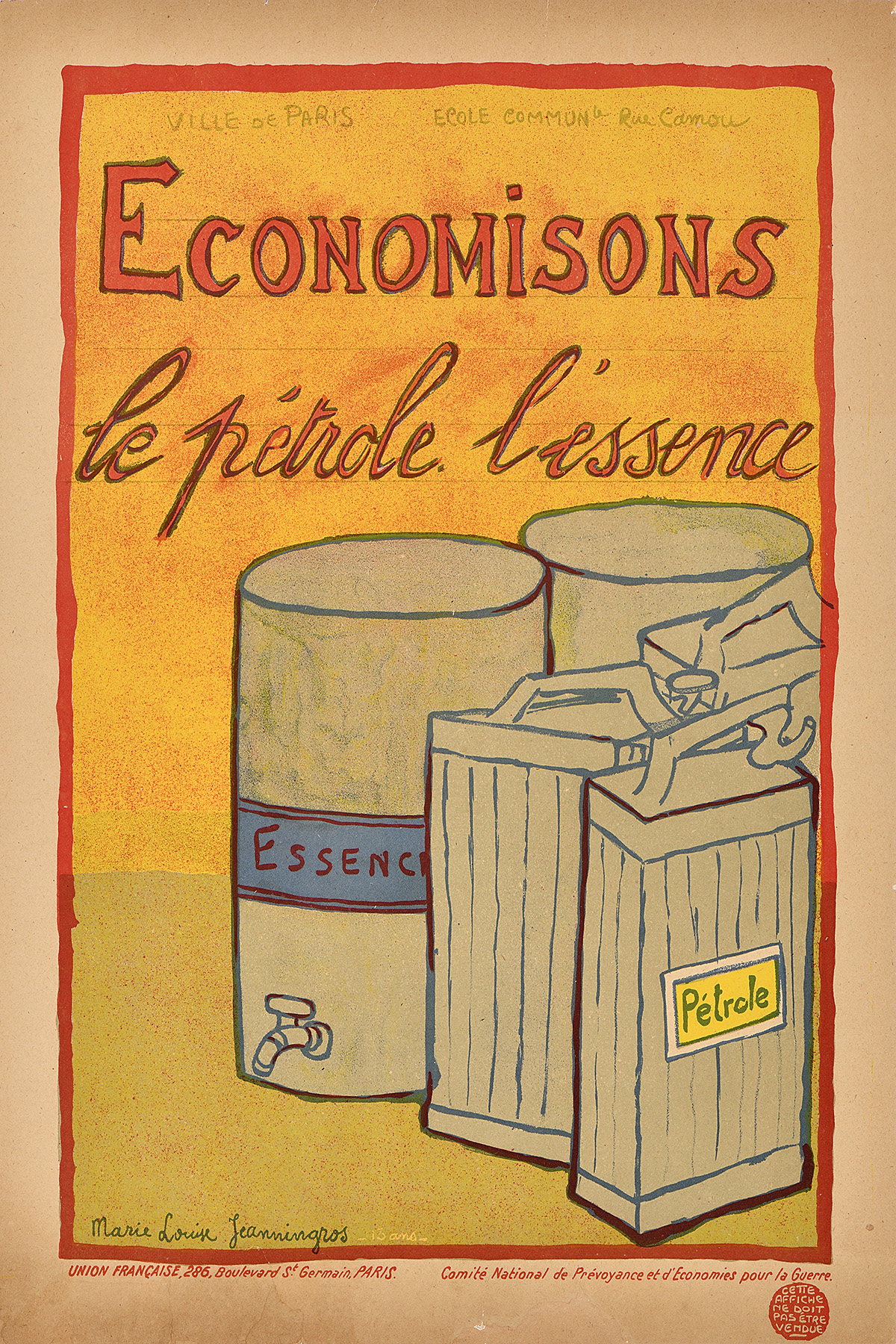
A yellow lithographic poster of 4 gas cannisters.

Le Pétrole, 1918

Marie Louise Jeanningros, 13 years old

Poster House Permanent Collection

  • All types of fuel were in short supply to civilians during World War I since they were being redirected to the front for machines and vehicles. These two posters ask the public to economize on natural gas, heating oil, and gasoline. 
  • The poster encouraging French citizens to reduce their use of gas for lamps demonstrates an advanced understanding of contemporary trends in the French print world, most notably the influence of Japanese woodblock prints.

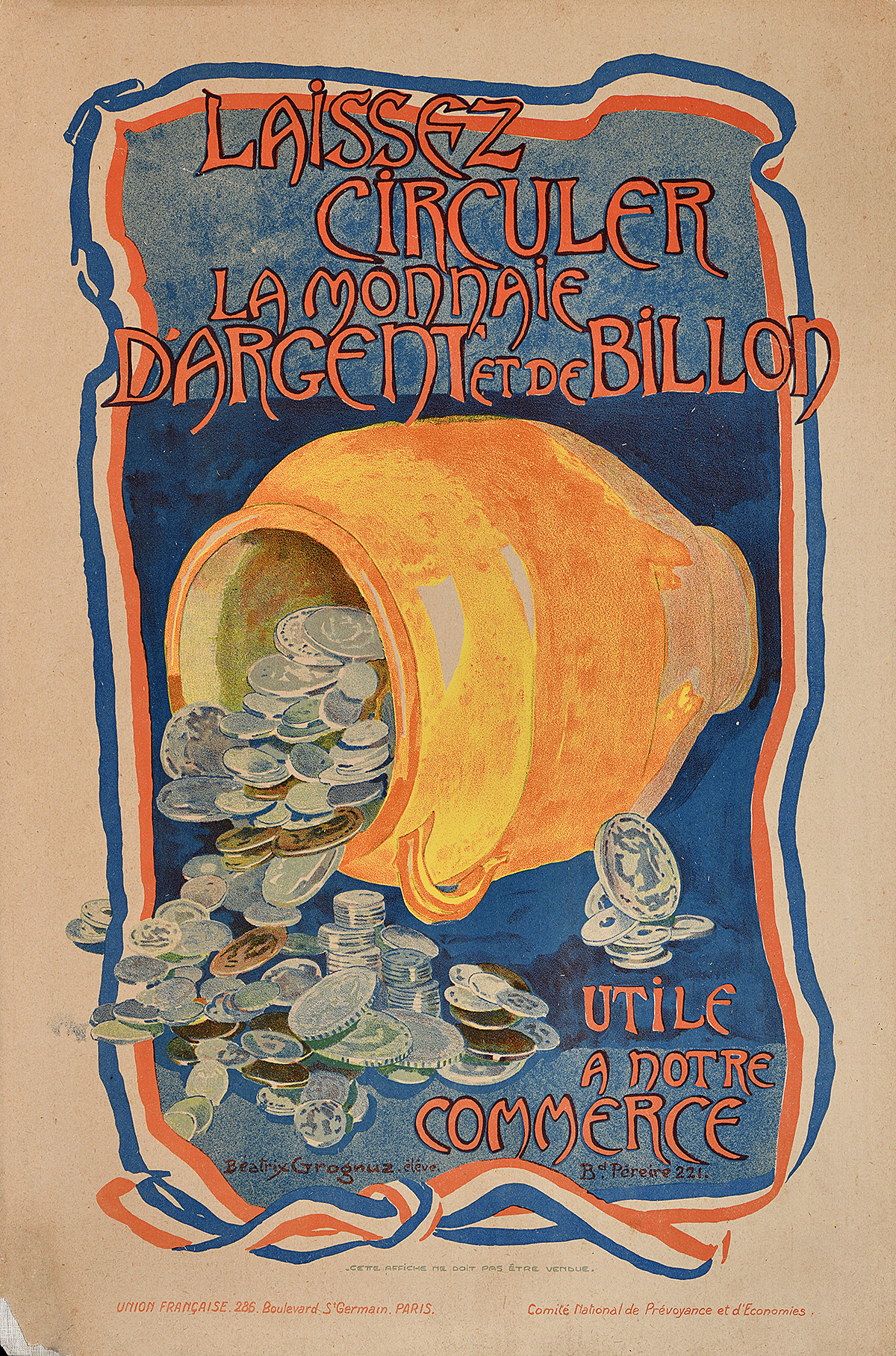
A lithographic poster of a large pot laying on its side with silver coins spilling out.

La Monnaie, 1918

Béatrix Grognuz, 16 years old

Poster House Permanent Collection

  • In order to avoid inflation and the devaluation of French currency, the government needed to convince people not to stash money in their homes. Here, the artist urges, “Let’s circulate coins made of silver and other metal useful to our commerce.” 
  • The large pot out of which the coins are spilling is a reference to Roman coin hoards that students would have learned about at school.

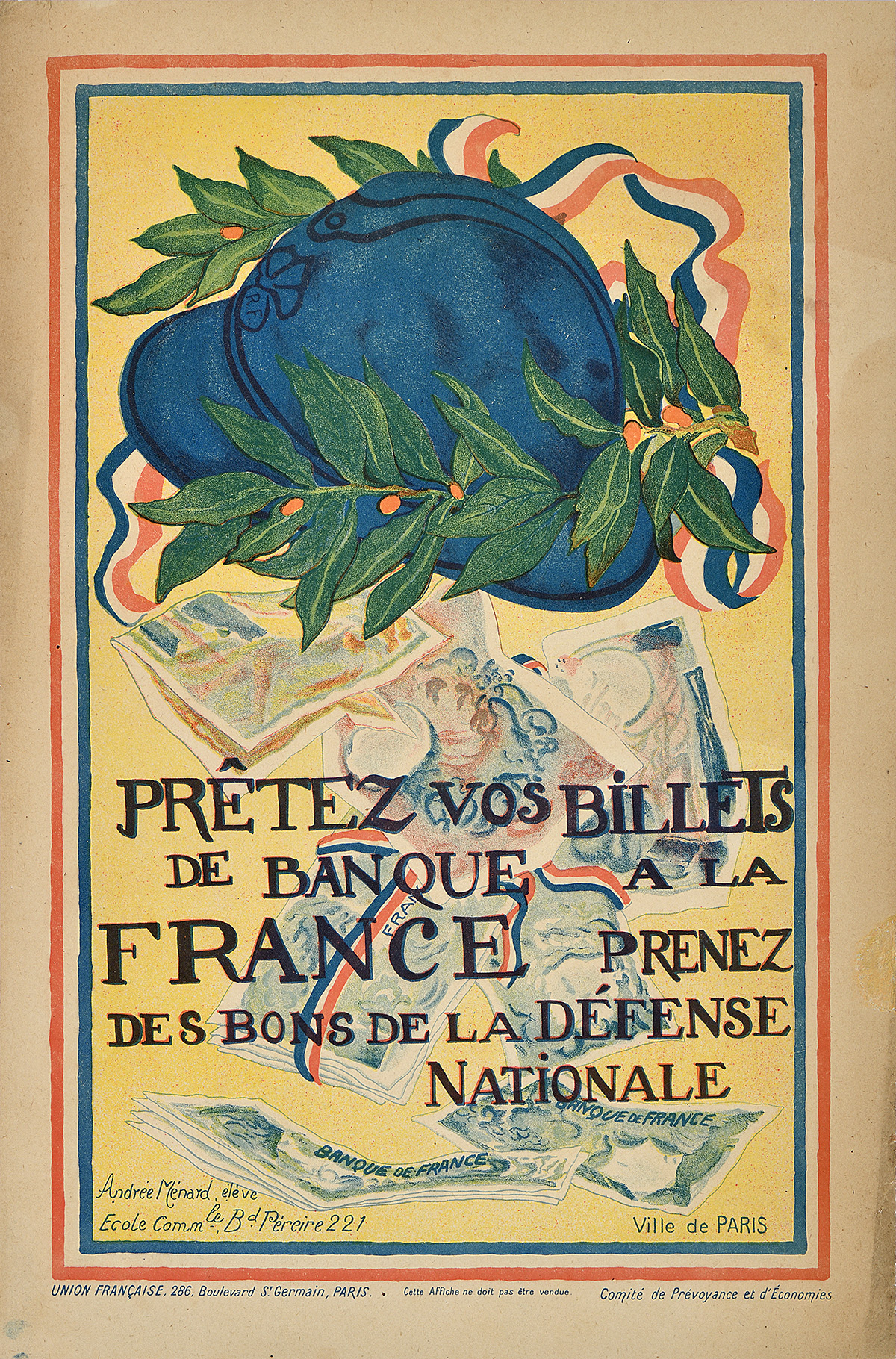
A lithographic poster of a helmet with laurels above falling money and a French flag ribbon.

Vos Billets, 1918

Andrée Ménard (Age Unknown)

Poster House Permanent Collection

  • In order to fund the war effort, many countries asked their citizens to buy government bonds with low interest rates. By 1918, it was possible for some of these bonds to mature in as little as a month. 
  • Here, an Adrian helmet crowned with victory laurels hovers above cascading Franc banknotes, some tied with a ribbon in the colors of the French national flag. The text implores the viewer to “Lend your banknotes to France. Buy National Defense Bonds.”

“The conservation theme of the posters was unexceptional, but their designs, by French wartime standards, were unprecedented.”—Mark Levitch, historian


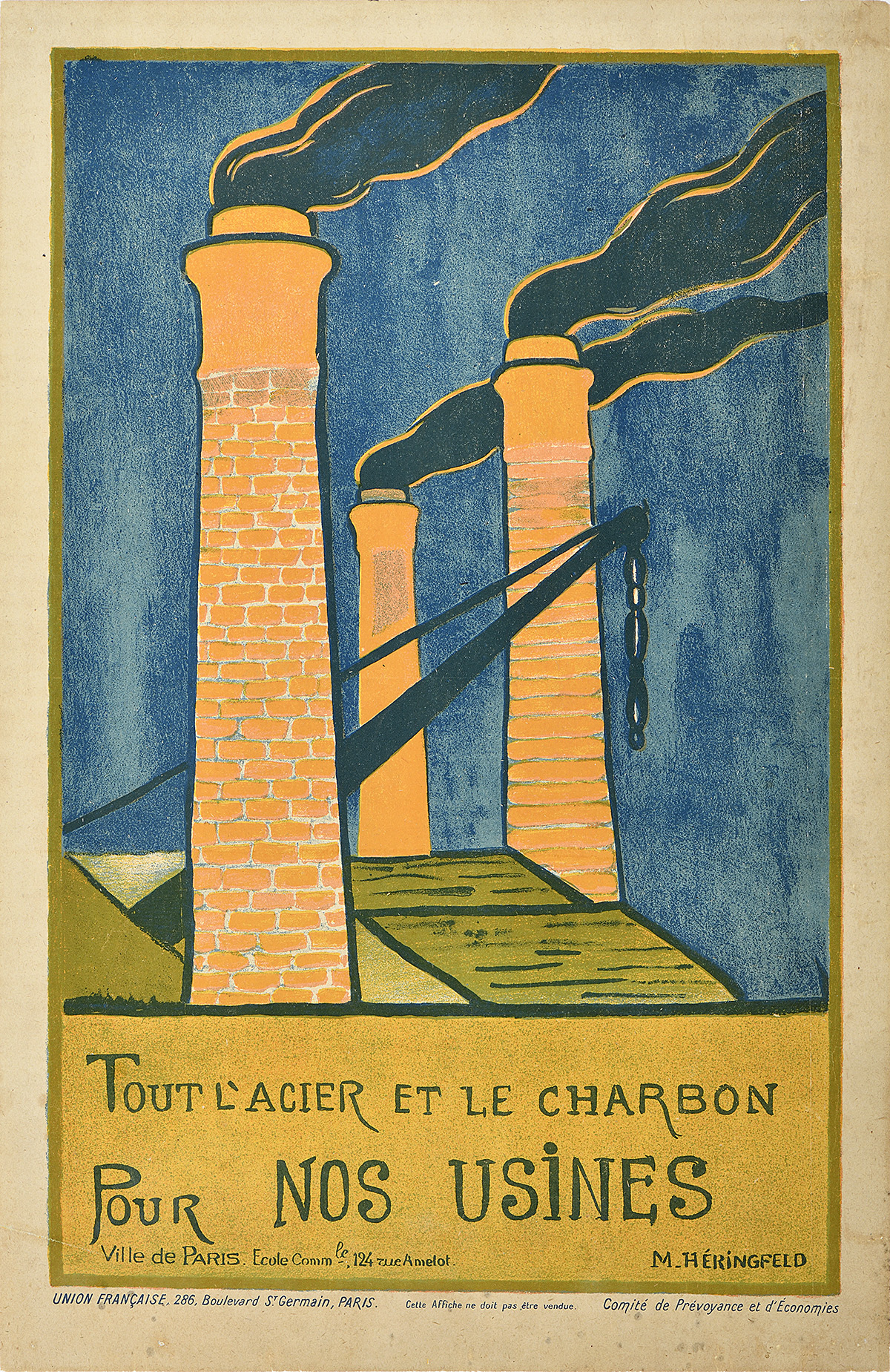
A lithographic poster of factory roofs and chimneys with smoke billowing out from them.

Nos Usines, 1918

M. Héringfeld (Age Unknown)

Poster House Permanent Collection

  • Since coal came from areas adjacent to the battlefields in the north, it became incredibly difficult to obtain in Paris and beyond. During the harsh winters of 1916 and 1917, children were often tasked with scrounging for firewood to heat their families’ homes, sometimes stealing wood from buildings so that they would not freeze. 
  • Coal was also used to fuel the furnaces that smelted steel, a key component in the manufacture of tanks, weapons, armor, and other military products. For every one hundred rifles that had been made in France at the beginning of the war in 1914, 29,000 were being made there by 1918—a staggering increase in production that required unprecedented quantities of raw material. 
  • Here, the artist directs “All steel and coal for our factories.” This could be read as both a demand for a reduction in the use of coal for heating and cooking and for the donation of metal objects like cutlery, bicycles, and fences that could be melted down and used for military purposes.

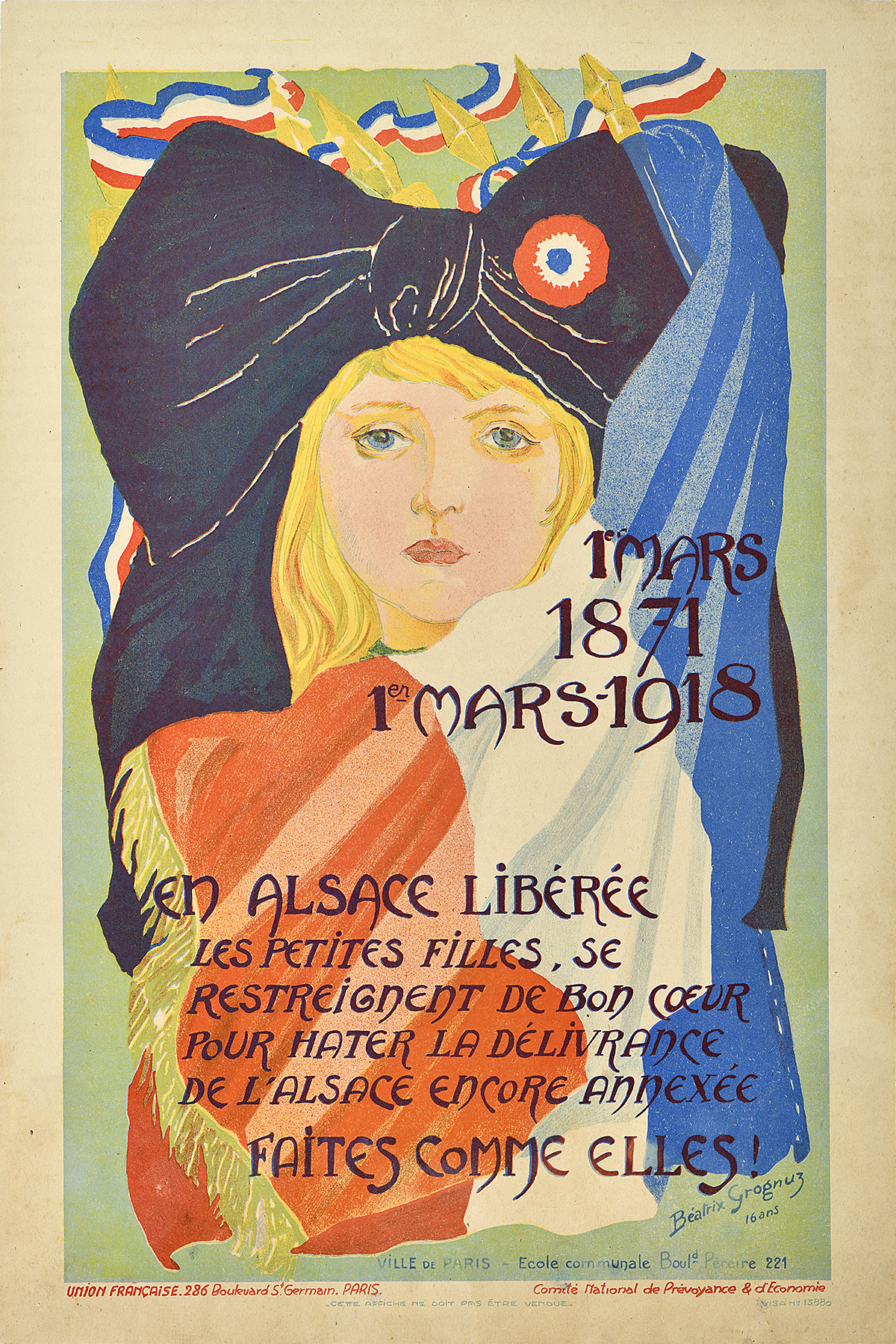
A lithographic poster of a young blonde girl wearing a big bow and surrounded by the French flag.

En Alsace Libérée, 1918

Béatrix Grognuz, 16 years old

Poster House Permanent Collection

  • On March 1, 1871, the Prussian army held a victory parade in Paris to celebrate its triumph in the Franco-Prussian War. From then on, the region of Alsace would be under German control. That same day, Alsace declared that it wanted to remain part of France. 
  • Forty-seven years later to the day, the French president commemorated the anniversary of that declaration, stating that the country would win back Alsace—a bold statement at a time when France was facing dismal odds in the war. 
  • This poster capitalizes on the national sentiment toward this lost territory, stating that “In liberated Alsace the young girls restrict themselves with a good heart to hasten the deliverance of Alsace, annexed again. Do like them.” In other words, the children of one of the most suffering parts of the country are willingly rationing their consumption for the greater good.

Acknowledgements

Curation
Angelina Lippert

Design
Mihoshi Fukushima Clark 

Special Thanks
Dr. Nicholas A. Harlow, military historian