Black Power to Black People: Branding the Black Panther Party

Introduction

During the 1960s, the civil rights of Black Americans were among the key issues addressed by demonstrators and protesters as they confronted many of the long-standing injustices that plagued the country. A number of Black-led organizations set out to redress systemic oppression, rallying the support of their communities through a variety of creative means. In particular, the Black Panther Party for Self-Defense—eventually shortened to the Black Panther Party (BPP)—emerged as one of the most influential militant groups of the time. The posters in this exhibition chronicle how the BPP devised a specific graphic language to reaffirm Black humanity and decommodify Black life. Its heroic images of party members, widespread distribution of printed materials like The Black Panther newspaper, and political campaign posters allowed it to control its own narrative and brand Black nationalism to advance a communal revolution.

As one of the largest groups to confront the plight of Black Americans, the Black Panther Party adopted Black nationalism as an ideology, practice, and identity to mobilize the community. Proponents of Black nationalism advocated for the economic and political self-sufficiency of Black people in order to achieve liberation from oppressive systems. A Black Power platform (a form of Black nationalism) guided the BPP as it branded a new movement that relied heavily on bold language, striking graphics, and powerful photographs of its members wearing black-leather jackets and carrying exposed firearms. More specifically, the graphics and posters of the BPP became important to the dissemination of information; they effectively exposed the public to radical images and slogans that captured a shift in tone in the fight for civil rights. With an emphasis on militancy, the Black Panther Party successfully mobilized visual and written content in its posters and newspapers to further establish an authentic Black identity, responding to historic systems of exploitation and anti-Black violence. 

Unless otherwise noted, all items come to Poster House through a generous loan from the Merrill C. Berman Collection.

Please be advised that this exhibition contains racist and violent imagery and language. There is also an audio component to the exhibition. 
Part 1: The Image of Black America

During the mid-19th century, lowbrow musical theater was one of the main sources of popular entertainment. Such performances eventually inspired and evolved into the minstrel show, consisting of dramatic sequences in which white and Black performers darkened their faces with burnt cork and, later, greasepaint or shoe polish—a practice referred to as “blackface.” The actors would perform using racist stereotypes that portrayed Black people with exaggerated features as dim-witted and lazy. 

Through the use of such stock characters as the Sambo, Zip Coon, Mammy, Sapphire, or Jezebel, actors in blackface performed their interpretations of Blackness to white audiences. Many minstrel shows romanticized white ideas of slavery and Black culture with simplistic and joyfully nostalgic themes that often alluded to formerly enslaved people yearning to return to their slaveholders on the plantations. 

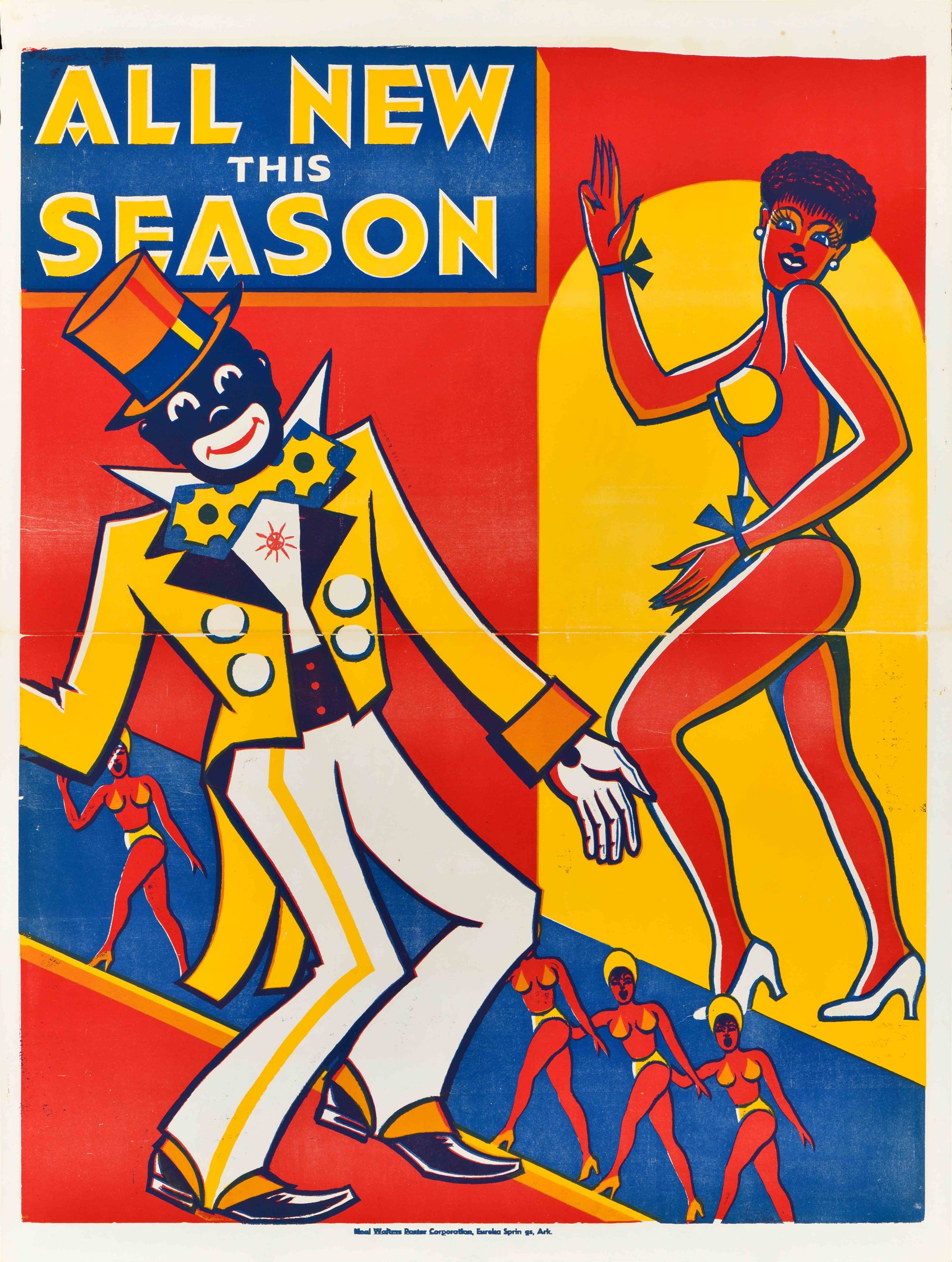
A photo offset poster of a sambo stereotype on stage next to a jezebel stereotype.

All New This Season, c. 1945

Designer Unknown

Poster House Permanent Collection

  • The Jezebel stereotype in minstrelsy depicts Black women as sexually promiscuous and uncontrollably lustful. This stock character extended into the 20th century and stemmed from the idea that Black women did not represent “true womanhood” and were therefore seen as exploiters of men’s—mainly white men’s—moral weaknesses. 
  • The Sambo stereotype in minstrelsy portrays Black men as happy, unintelligent, and lazy, perpetuating the notion that Black people—especially Black men—contributed little to society. The Sambo stock character smiled and laughed on stage as if all was well in his life.
  • This poster shows both the Jezebel and the Sambo characters as they would generally have been seen through the eyes of audiences in the mid-20th century. Although the poster design does not feature antebellum themes outside those of the characters, the use of racist stereotypes and the blackface makeup on white and Black actors kept the spirit of these subjects alive into the 1940s and beyond.
  • The Neal Walters Poster Corporation printed letterpress circus and carnival posters. The designs were generally distributed by hand, left in public places, posted on walls, or put up in store windows before the arrival of a troupe in a particular town. It is possible that these images were used to advertise a minstrel burlesque performance to both Black and white audiences that would have been familiar with these dehumanizing representations of Blackness.

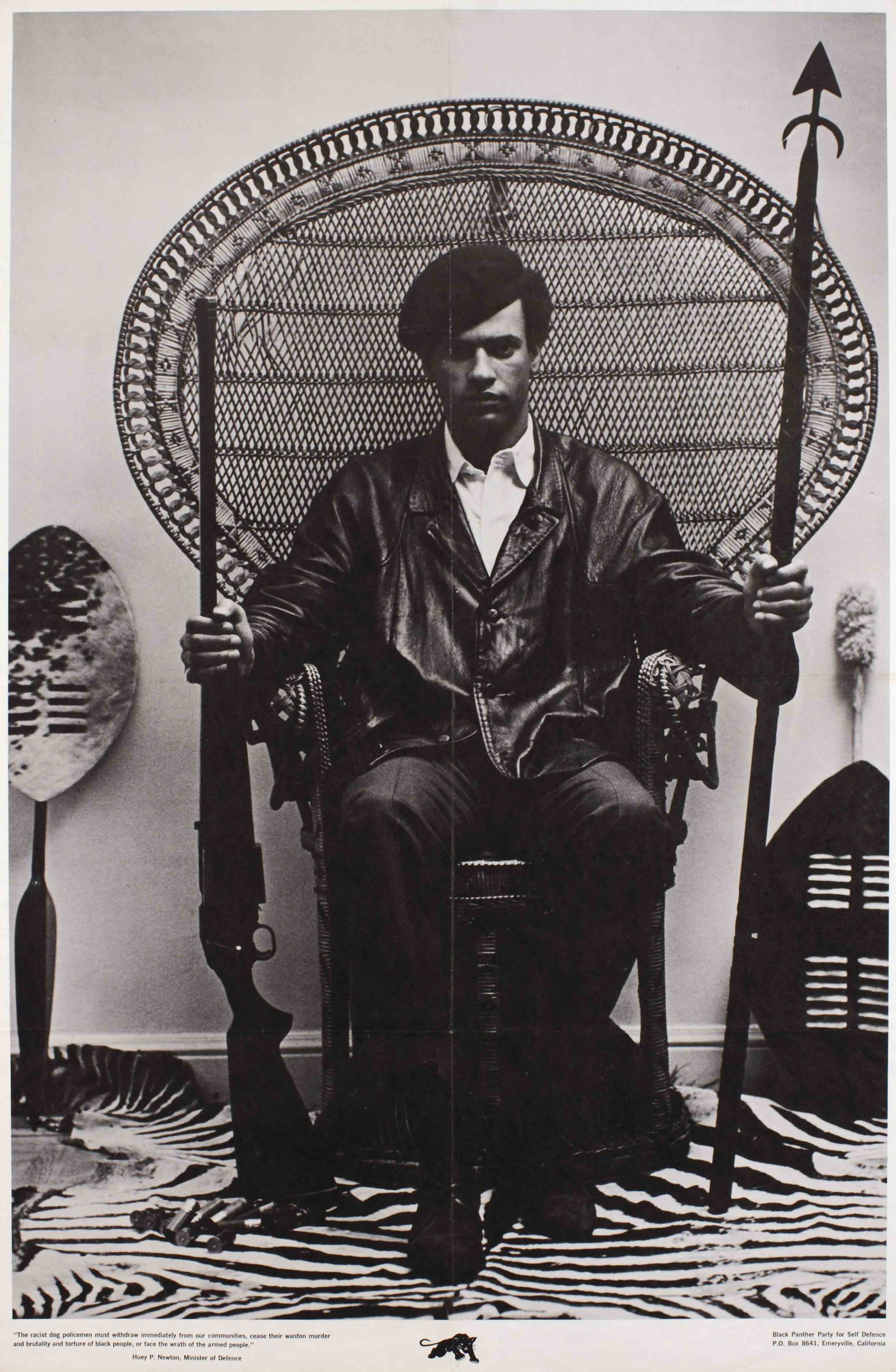
A photograph of a Black man sitting on a throne-like chair holding a rifle and a spear.

Untitled (Huey P. Newton), c. 1967

Photographer: Blair Stapp (Dates Unknown)

The Merrill C. Berman Collection

  • The Black Panther Party aimed to center its members and leaders in stoic and commanding poses that sent a clear message, leaving little room for non-Black communities to insert their own harmful characterizations of Blackness and the Black experience.
  • In contrast to the Jim Crow minstrel imagery of the Sambo stock character, Huey P. Newton—one of the founders of the BPP—is positioned here as an authoritative figure in a throne-like peacock chair. He holds a rifle and a spear, and a traditional Zulu shield rests beside him. The entire image, along with the official BPP uniform of a black-leather jacket and a black beret, resists the stereotypes used to present Black people as useless, happy-go-lucky, and ultimately defenseless.

Part 2: The Party and the Brand

Founded by Huey P. Newton and Bobby Seale in Oakland, California on October 15, 1966, the Black Panther Party swiftly established itself as a radical revolutionary group that prioritized communal survival through militant action. Newton and Seale furthered the Black nationalist program of economic and political self-sufficiency by working to reverse the exploitative policies that had stunted the Black community’s economic, political, and social growth. Furthermore, they understood that this ideology offered an alternative to integration as a means of obtaining equality, and they therefore focused on dismantling institutional structures that positioned Black people as second-class citizens. 
In 1967, artist Emory Douglas met Newton and Seale at the Black House in San Francisco, the cultural center of the Black Arts Movement that promoted the use of art as a weapon of oppressed people. At that point, he asked to join the Black Panther Party, and was subsequently given the title of “Revolutionary Artist and Minister of Culture” (later shortened simply to Minister of Culture). In that position, Douglas was responsible for arts policy and the preservation and protection of the party’s culture.  

In his work, Douglas consciously countered the notion that Black militancy was violent and savage by default. He depicted the police and those who abused power as pigs and rats in order to highlight their brutality toward Black Americans. By contrast, his Black figures appear proud and heroic, defending their right to exist while conveying outrage, passion, sorrow, and, in some cases, joy, thereby adding dimension to their characters that countered the flattening created by existing stereotypes. Douglas’s posters were meant for the people and prioritized community by offering accessible designs with bold colors, repetition, shocking iconography, and memorable phrases. Through these nuanced representations of Blackness and messages of resistance, he helped brand the Black Panther Party as a community-oriented organization.
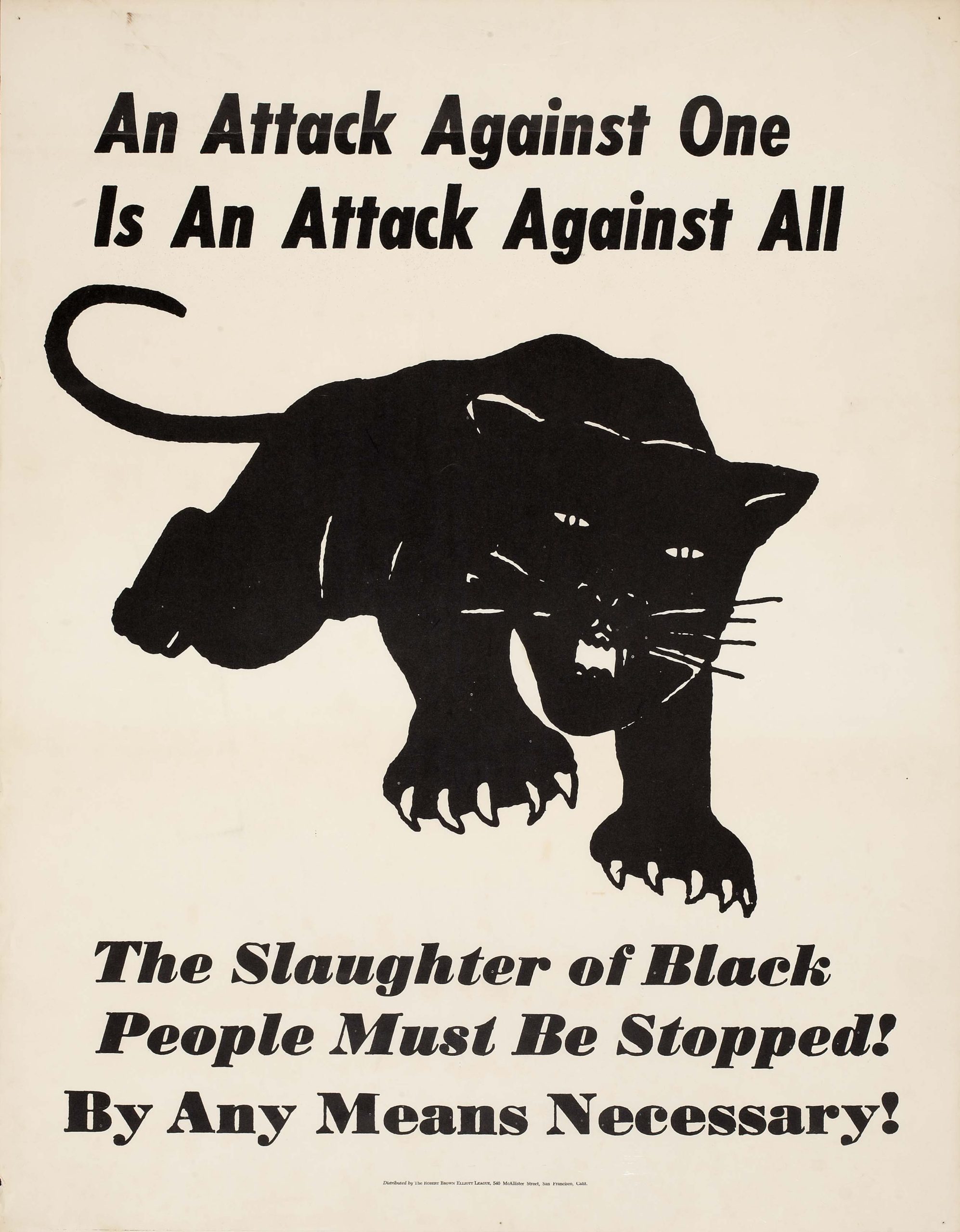
A photo offset poster of a black panther animal crawling towards the viewer surrounded by text.

An Attack Against One Is An Attack Against All, 1968

Designer Unknown

The Merrill C. Berman Collection

  • The history of the Black Panther logo can be traced back to designer Ruth Howard. Howard was a member of the Atlanta branch of the Student Nonviolent Coordinating Committee (SNCC) Communications Office where she learned how visual language could galvanize a community. In 1966, SNCC organizers in Lowndes County approached her to create the symbol. Howard had originally designed a dove to express power and autonomy but it was not well received. She eventually based her design on the school mascot of Clark College, a local HBCU (Historically Black College and Universities). Dorothy Zeller, a white Jewish woman, added the whiskers and the black color to Howard’s motif.
  • Lisa Lyons, a member of the Berkeley Independent Socialist Club (ISC), made several alterations to the basic design of the black panther between 1966 and 1969. Her version of the design for Black Power Day on October 29, 1966, at Berkeley is the most recognized and the most refined; Lyons also altered the number of the cat’s claws depending on the size of the image. 
  • This poster, distributed by the Robert Brown Elliott League of San Francisco, shows Lyons’s version of the black-panther symbol for the Black Panther Party. While little is known about the group, it was named after a Black man who had been elected into the South Carolina House of Representatives in 1868. After his appointment as commanding general of the South Carolina National Guard, he organized a state militia to fight the Ku Klux Klan. One hundred years after his appointment, Elliot’s initiatives still resonated with the BPP.

“[This poster is] a centralized symbol of the leadership of the black people in the community.”—Bobby Seale, Black Panther Party cofounder

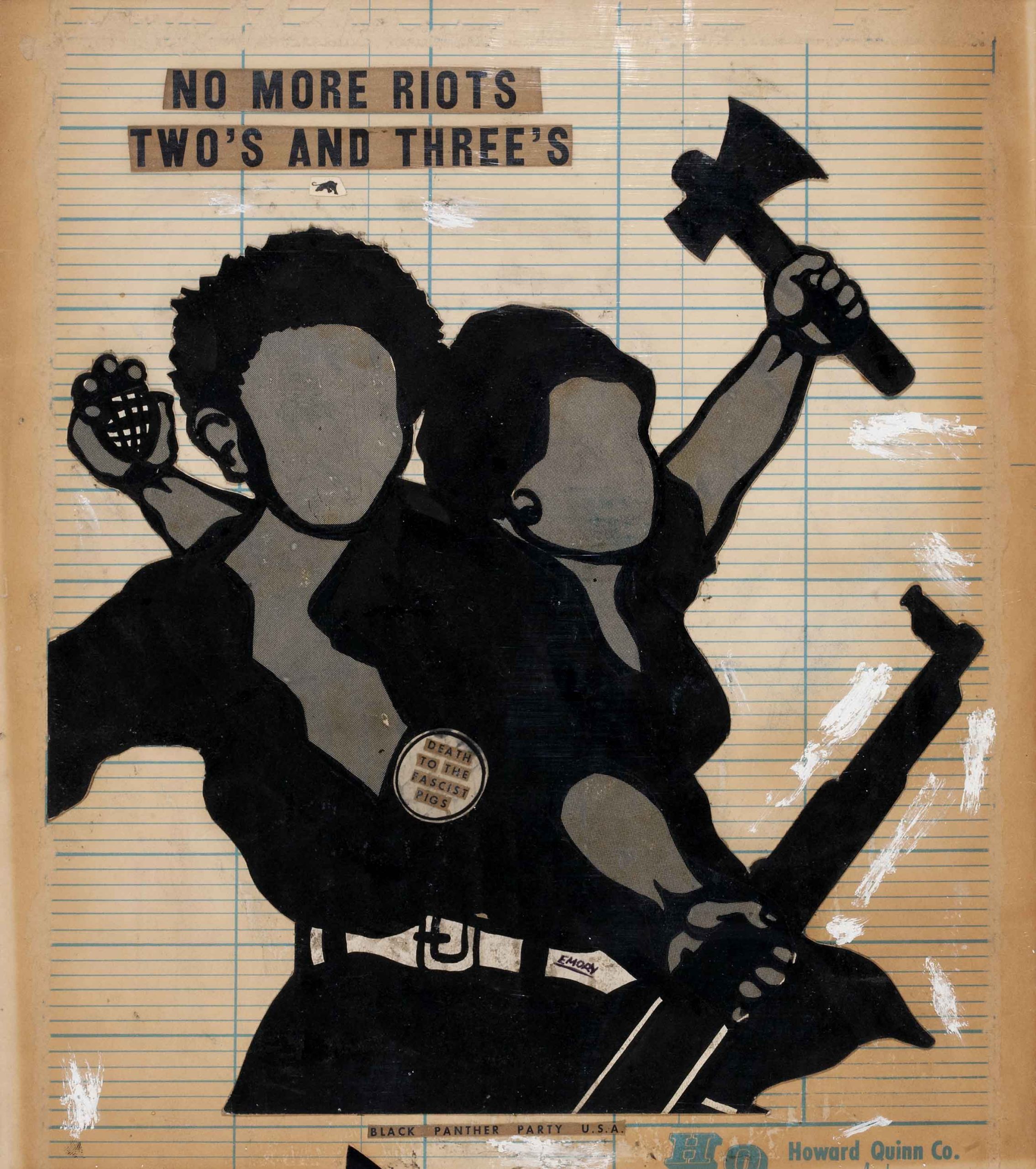
A maquette of 2 Black women with no facial features holding weapons.

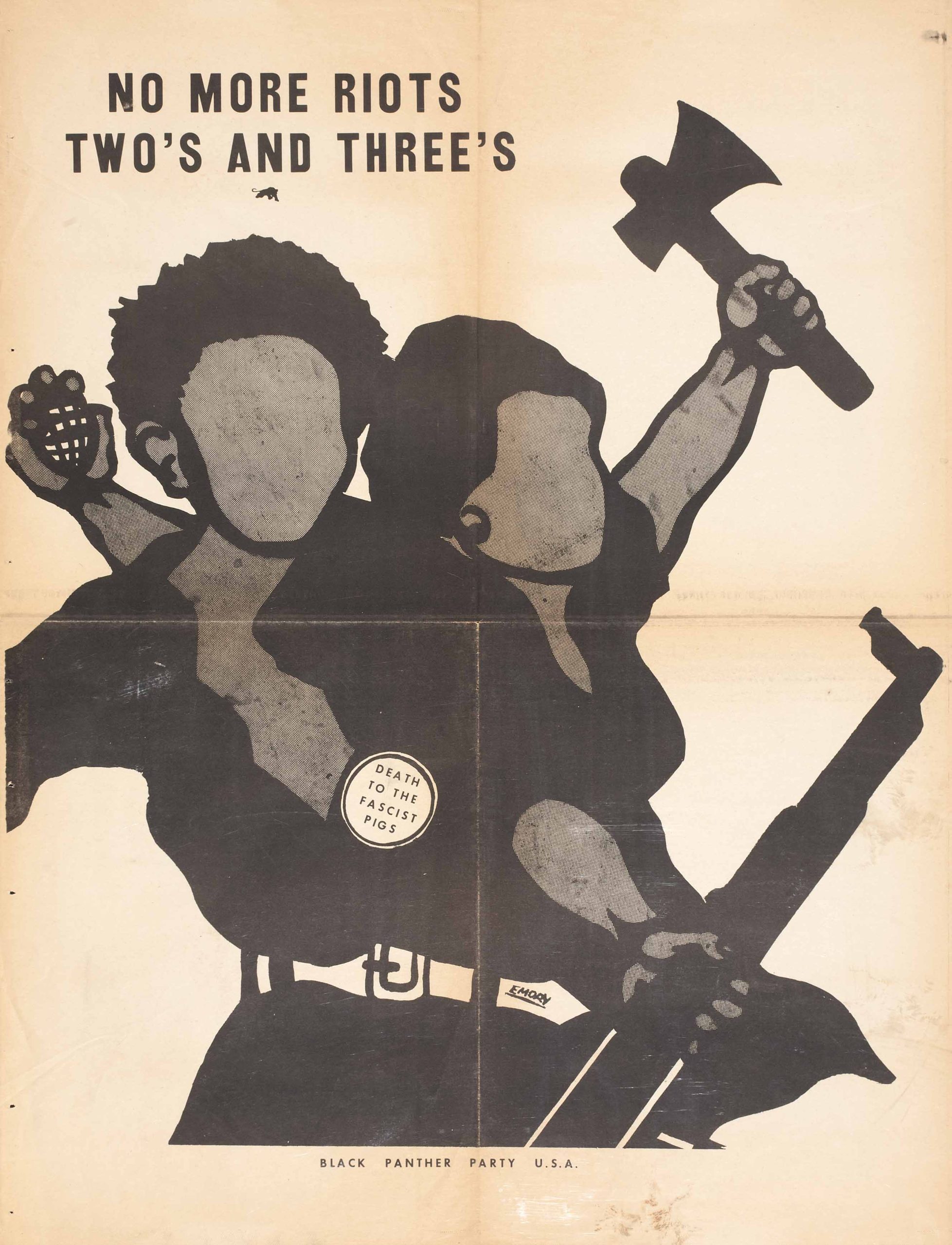
An illustrated poster of 2 Black women with no facial features holding weapons.

No More Riots Two’s and Three’s, c. 1970

Emory Douglas (b. 1943)

The Merrill C. Berman Collection

  • This image of two female figures armed with an ax, a gun, and a grenade points to the integral role of women within the Black Panther Party. Douglas frequently illustrated women undertaking the daily tasks of child-rearing, cooking, cleaning, and all the other labor that held both their households and the BPP together, alongside images of empowered women carrying weapons to defend themselves.  
  • The title of the poster refers to Newton’s belief in the tactical advantage of using small groups of two and three people to revolt against the oppressor rather than a large riot.
  • Douglas’s large posters were wheatpasted on walls throughout Black communities, reflecting the party’s belief in the power of images of valiant Black figures, accompanied by weapons and bold phrases, to attract membership.
  • The maquette on the left demonstrates Douglas’s use of collage, gouache, ink, and pencil to make the poster. Text was added separately before being transferred to a photo-offset printer. The printer did not register the blue lines on the maquette so the end result would be a smooth image. As funds and resources were limited, the design was printed only in black ink.

A photograph of two Black men standing in front of a building wearing black berets and rifles.

Bobby Seale and Huey Newton in Front of Black Panther Headquarters, c. 1968

Designer Unknown

The Merrill C. Berman Collection

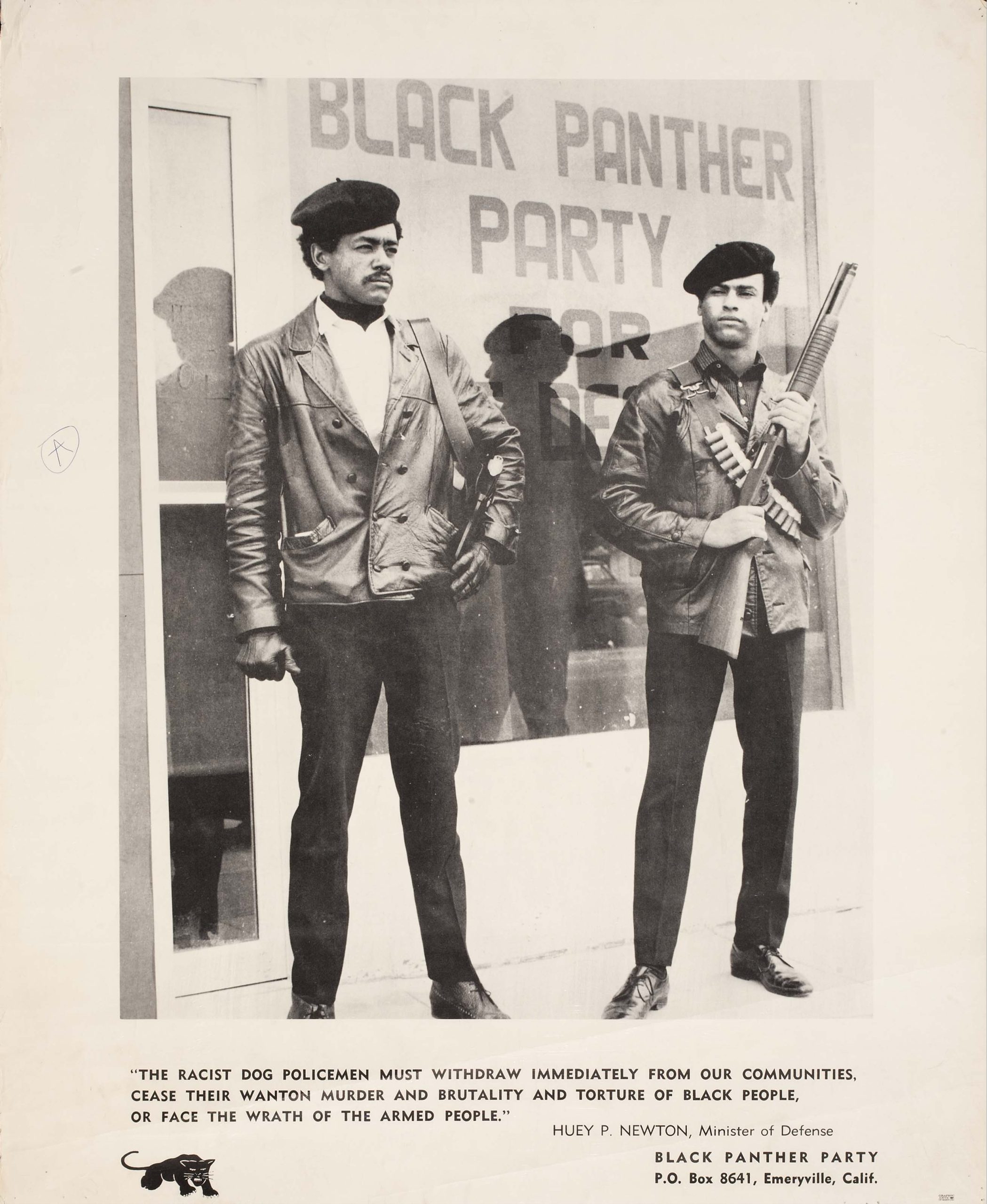
  • One of the most identifying features of the Black Panther Party was its members’ use of specific attire to convey a united front. The black berets were a play on the green berets of the military. Newton also stated that “they were used by just about every struggler in the Third World. They’re sort of an international hat for the revolutionary.” Black pants, black shoes, a blue shirt, and a black-leather jacket, with optional black gloves, evoke a military uniform.
  • This poster features the iconic photograph of Bobby Seale and Huey Newton standing at the storefront of the BPP headquarters in Oakland, California. Newton appears on the right with a rifle in hand and a bandolier of ammunition across his body, while Seale is on the left. 
  • The accompanying text suggests that police violence will be met with equally violent defensive action from the Panthers. The same phrase would appear on BPP posters displayed throughout Black neighborhoods both as a warning to the police officers who heavily patrolled the area and as encouragement to the residents who wanted to protect their communities.

Part 3: The Black Panther 

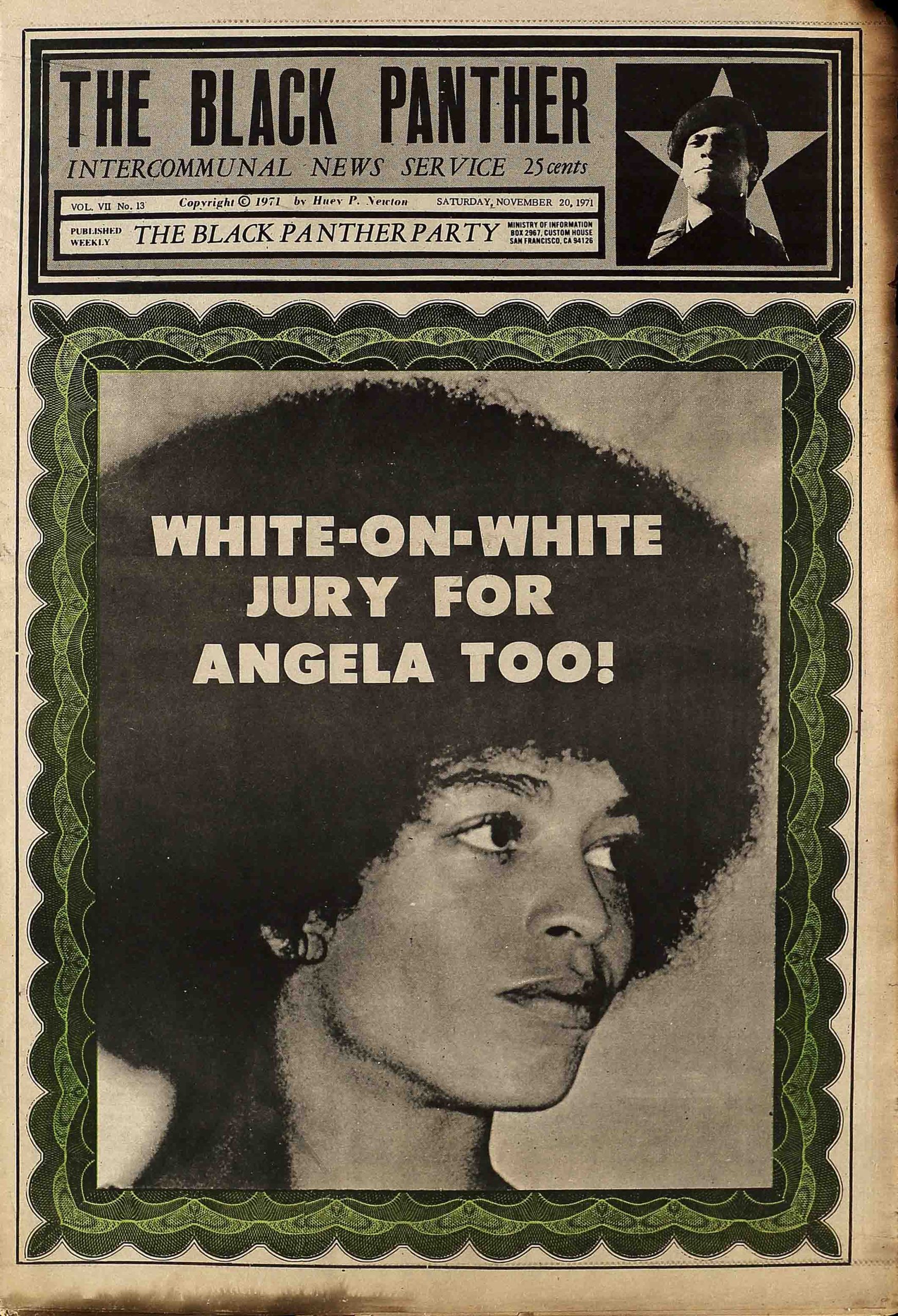
To combat the often biased language of white-controlled media outlets, Black-led organizations created their own vehicles of public information such as The Crisis by the National Association for the Advancement of Colored People (NAACP) and The Movement Newspaper produced by the Student Nonviolent Coordinating Committee (SNCC). The Black Panther Party printed The Black Panther, an official newspaper that updated the community on the state of the party’s political platform, exposed incessant police brutality, and highlighted Black artists. The first issue was published on April 25, 1967, with one of the earliest images of the Black Panther logo next to the masthead.

In order to raise money for the Black Panther Party, the back pages of the newspaper often advertised art and music created by fellow Panthers, including posters that could be purchased for a dollar. Posters of women and children with titles like “Hope” emphasized the importance and vulnerability of women and mothers, while images showing Huey Newton, Bobby Seale, and Stokely Carmichael with guns were intended to keep the spirit and urgency of self-defense alive. The posters sold in the newspaper further disseminated the distinctive brand that set the BPP apart from other civil-rights groups and allowed it to globally market its political ideology. The newspaper reaffirmed the importance of a Black-controlled press that could narrate and depict the everyday experiences—both joyous and demoralizing—of Black people.

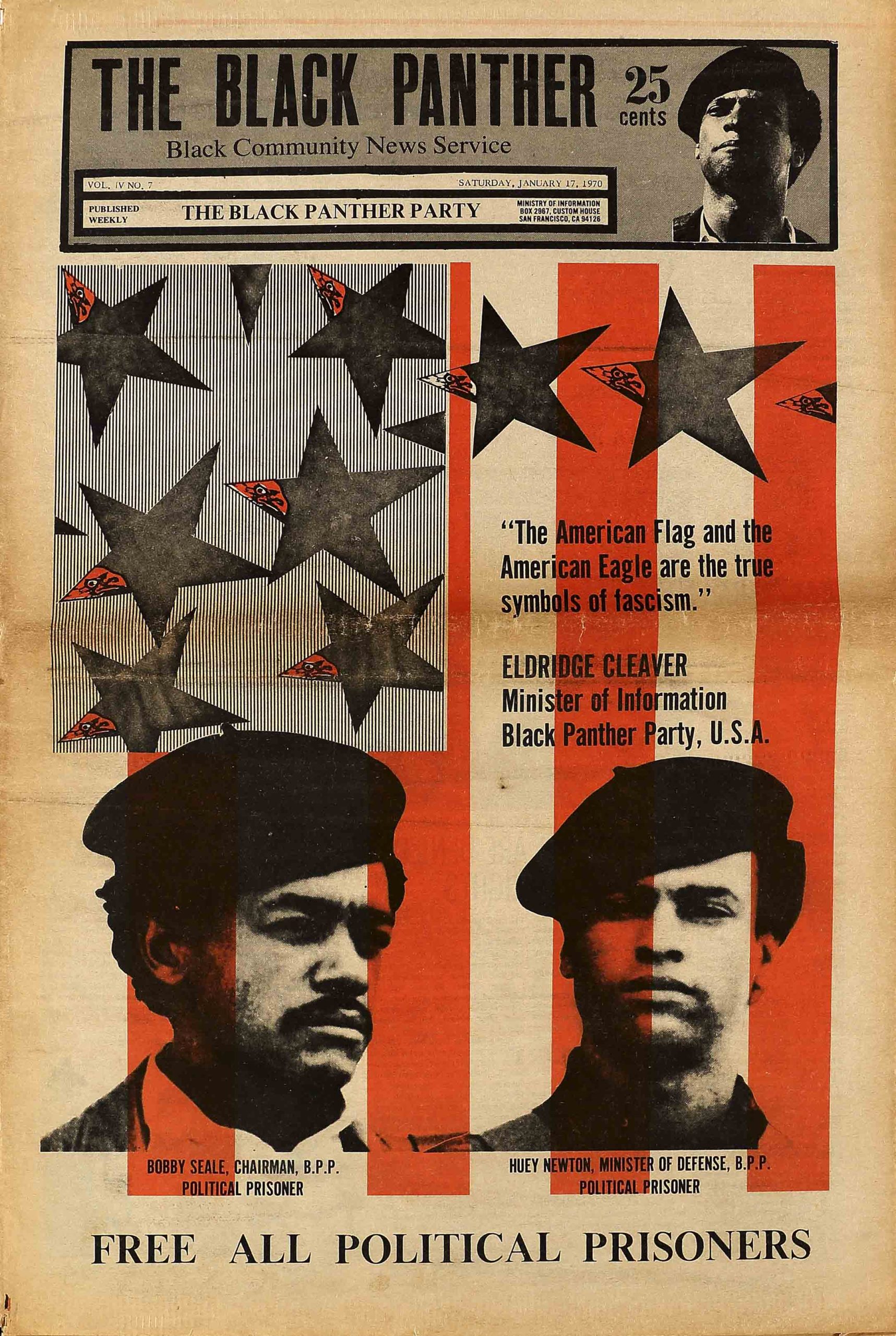
A newspaper cover of 2 Black men wearing berets in front of an American flag.

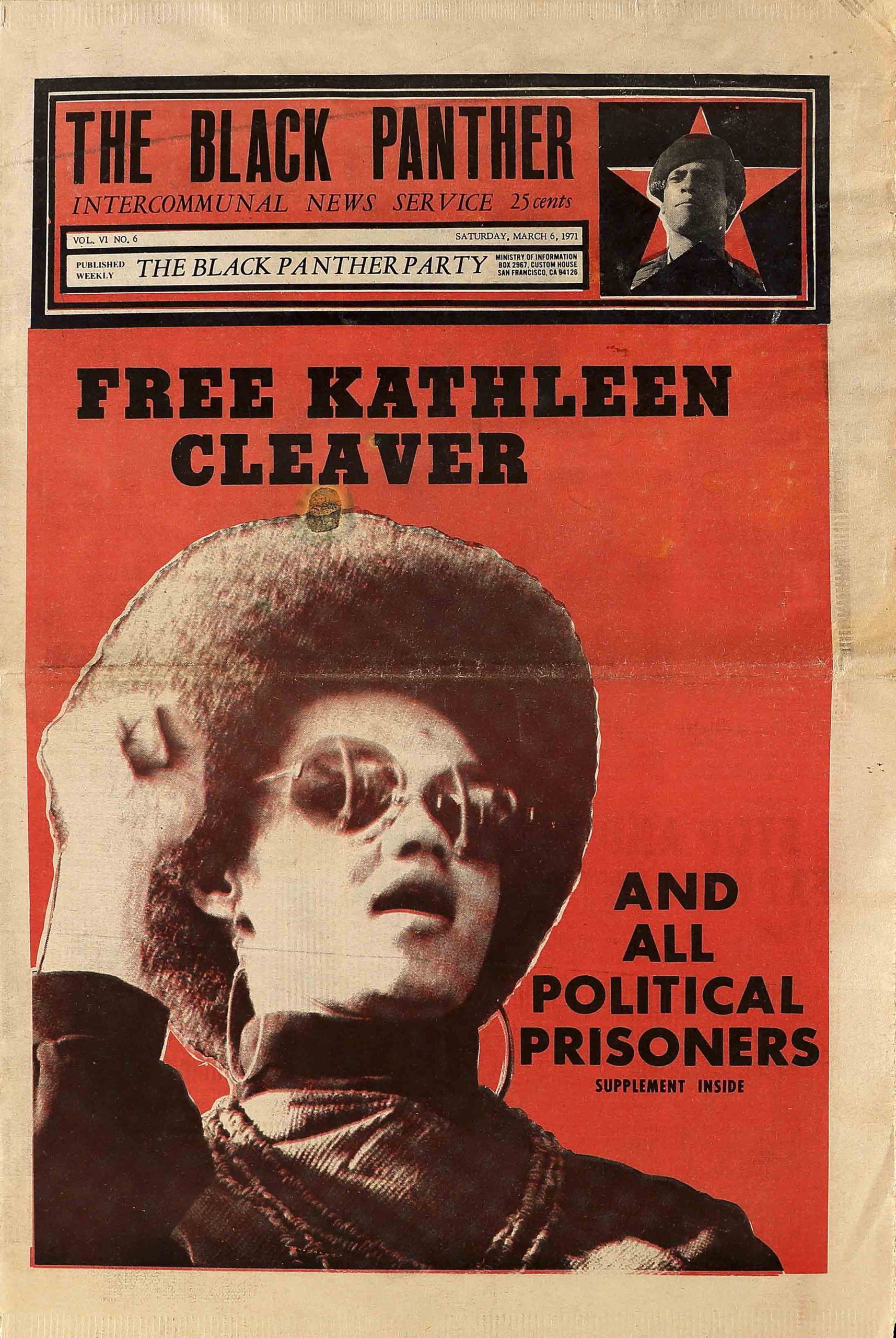
A newspaper cover of Kathleen Cleaver, a Black woman with an afro, holding a fist up in the air.

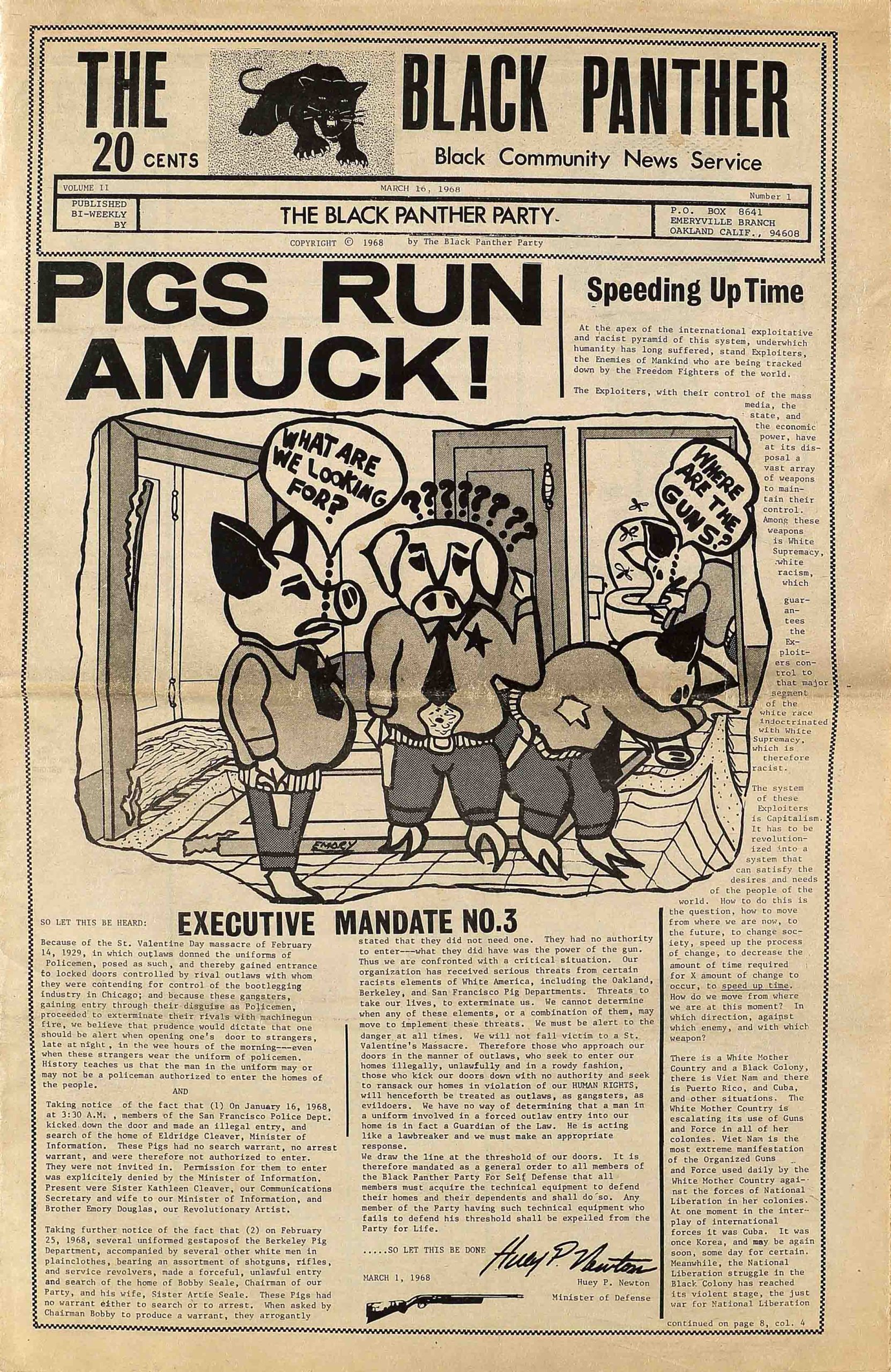
A newspaper article of with a picture of pigs in police uniforms with text

A newspaper cover of Angela Davis, a Black woman with an afro, looking serious in the distance.

The Black Panther, 1968–71

The Merrill C. Berman Collection

  • The Black Panther was distributed internationally from San Francisco. Every Panther was required to read the latest edition of the newspaper before selling it to the public. 
  • Although The Black Panther had a number of editors, Emory Douglas was the most notable. He decided to change the way the newspaper was printed, switching to a roll-fed press that allowed the use of two colors, including black, and shifted among nine Pantone colors each week. With limited resources, Douglas managed to add depth and texture to each design, propagating the party’s brand through eye-catching images showing Panthers in arms accompanied by radical slogans and statements. He also spared no feelings in his depiction of violent authority figures and what he saw as the hypocrisy behind the patriotic symbol of the American flag.
  • Douglas recalls that the New York branches of the Black Panther Party often turned the newspapers to the back (where his art was most prominently displayed) because it guaranteed the greatest number of sales. The art pages of the newspaper would often be torn out and used as decoration by purchasers.

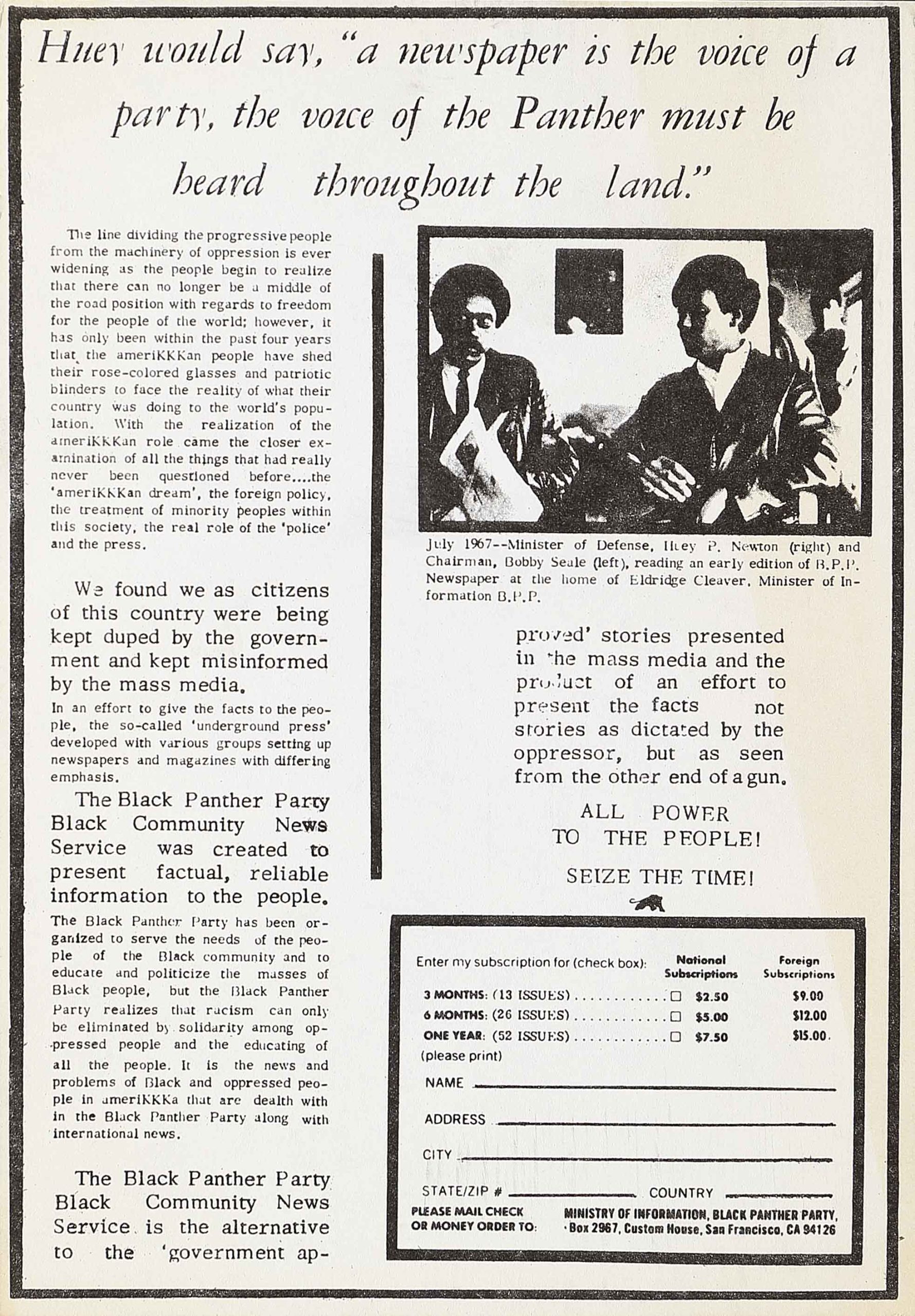
A newspaper article including a picture of 2 Black men reading a newspaper.

A Newspaper Is the Voice of a Party, 1970

The Merrill C. Berman Collection

  • For many readers, The Black Panther was the primary source for information and updates from the Black Panther Party.
  • Inserts like this were found in every edition of the newspaper in order to encourage subscription. The newspaper highlighted the importance of Black-created news sources, including phrases like “a newspaper is the voice of a party, the voice of the Panther must be heard throughout the land.” Newton would further state that “we found we as citizens of this country were being kept duped by the government and kept misinformed by the mass media” and “the Black Panther Party Black Community News was created to present factual, reliable information to the people.”
“A newspaper is the voice of a party, the voice of the Panther must be heard throughout the land.”—Huey Newton, Black Panther Party cofounder

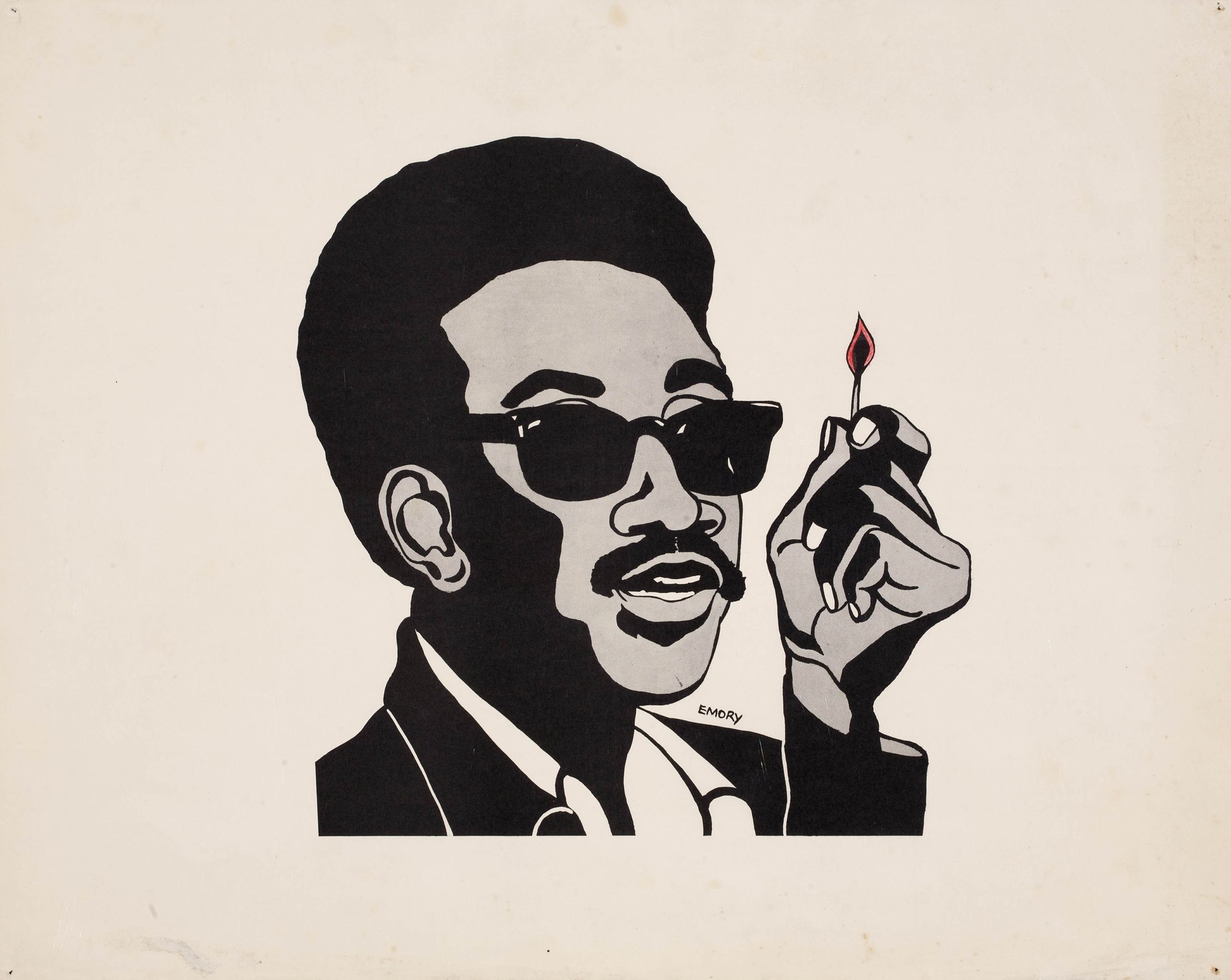
An illustrated print of a Black man wearing a suit and sunglasses holding a lit match.

H. Rap Brown (Man with Match), 1967

Emory Douglas (b. 1943)

The Merrill C. Berman Collection

  • H. Rap Brown served as the Minister of Justice during the brief alliance between the Student Nonviolent Coordinating Committee and the Black Panther Party. In 1965, the Voting Rights Act, which banned the use of literacy tests as a prerequisite for voting, was passed, and by 1966, Brown was appointed the director of voter registration in Alabama. The Voting Rights Act also provided federal oversight of voter registration and authorized the U.S. attorney general to investigate the use of poll taxes in state and local elections.
  • Brown was a well-known and effective speaker during his affiliation with both the SNCC and the BPP. Due in part to his popularity, he was continuously harassed by police and, in July 1967, was eventually arrested and charged with inciting a riot and committing arson. This print depicts Brown with a lit match between two fingers, reflecting the fact that he was often associated with the phrase “burn, baby, burn.” Brown would also say, “Black folks built America. If America don’t come around, we should burn it down.”
  • Like many designs created by Douglas, this one was advertised in the back of The Black Panther newspaper as part of the “Revolutionary Posters” series. Readers could purchase the print for a dollar ($1.25 outside of California).

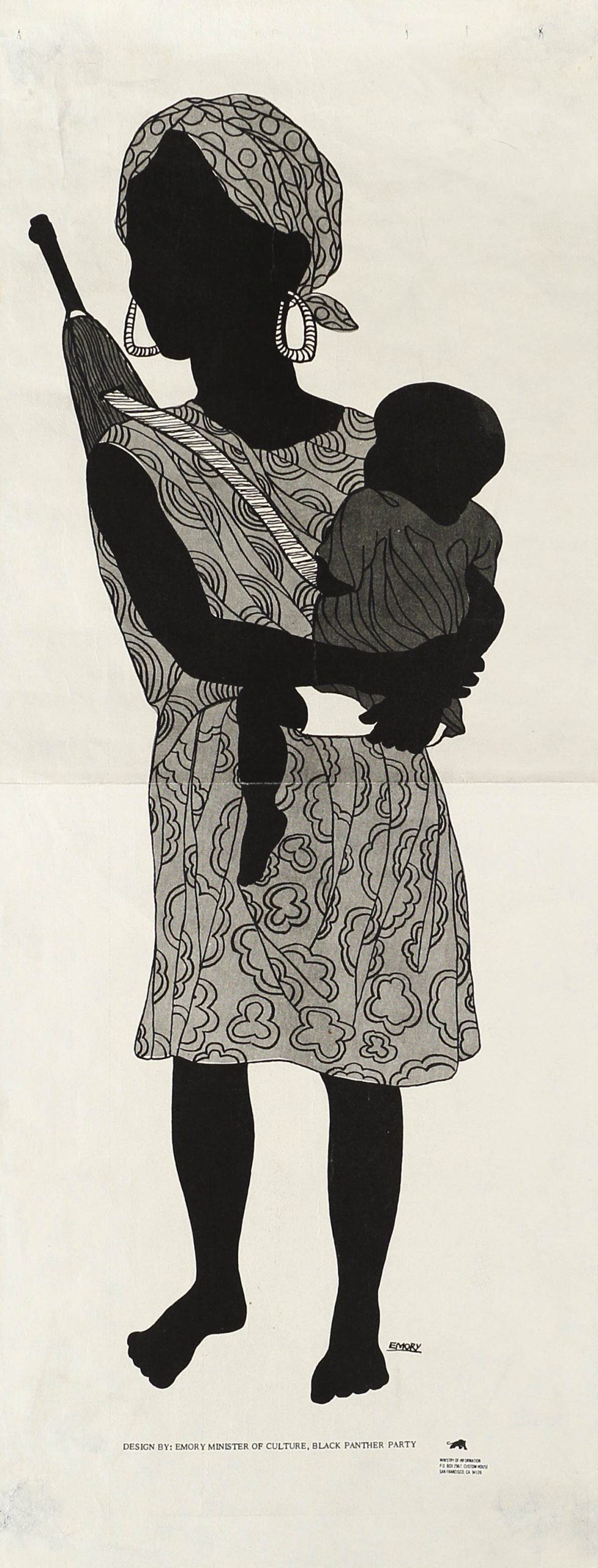
A photo offset print of a Black mother holding a baby with a rifle slung on her back.

Revolutionary Mother and Child, 1968

Emory Douglas (b. 1943)

The Merrill C. Berman Collection

  • Douglas often produced images that showed women on their “second shift,” emphasizing the importance of their domestic roles as well as their work defending the community, with or without men.
  • This image of a woman with a rifle strapped to her back while holding her child suggests a path for the future, one in which the next generation will follow in the footsteps of their parents and become militant Black Panthers.
  • The design is most likely a homage to the women of the African Liberation Movement. During the 1960s, images like these circulated in leftist newspapers, signifying that Black women played a significant role in the decolonization struggles of various African countries; they also showed female freedom fighters on the frontlines.
  • Unlike other posters and prints advertised in the back of The Black Panther newspaper, this image was sold for only ten cents due to its repeated circulation. The motif was also sometimes combined with the image of a student carrying a book and a rifle in a print called Revolutionary Student.

Part 4: The Enemy of Revolution

When the Federal Bureau of Investigation (FBI) launched the Counter Intelligence Program or COINTELPRO—a series of covert and illegal programs—Black nationalist groups became its primary target as it sought to infiltrate and weaken them. Though the Black Panther Party had always openly expressed its distrust of the police and certain prominent government figures, COINTELPRO exacerbated its concerns.

The FBI was keen on using local police to execute COINTELPRO projects. In the face of the constant terrorization of Black people and attempts to dismantle the organization’s community programs, the BPP used a unified language and iconography to identify the common enemy of a race and class revolution. It did not take long for Black and white supporters across the nation to rally behind the Panthers when they were unlawfully or unjustly arrested and held in jail. This degree of unity reflected the constant barrage of words and images from the party that encouraged the public to identify the true threat.

“Black folks built America. If America don’t come around, we should burn it down.”—H. Rap Brown, Minister of Justice

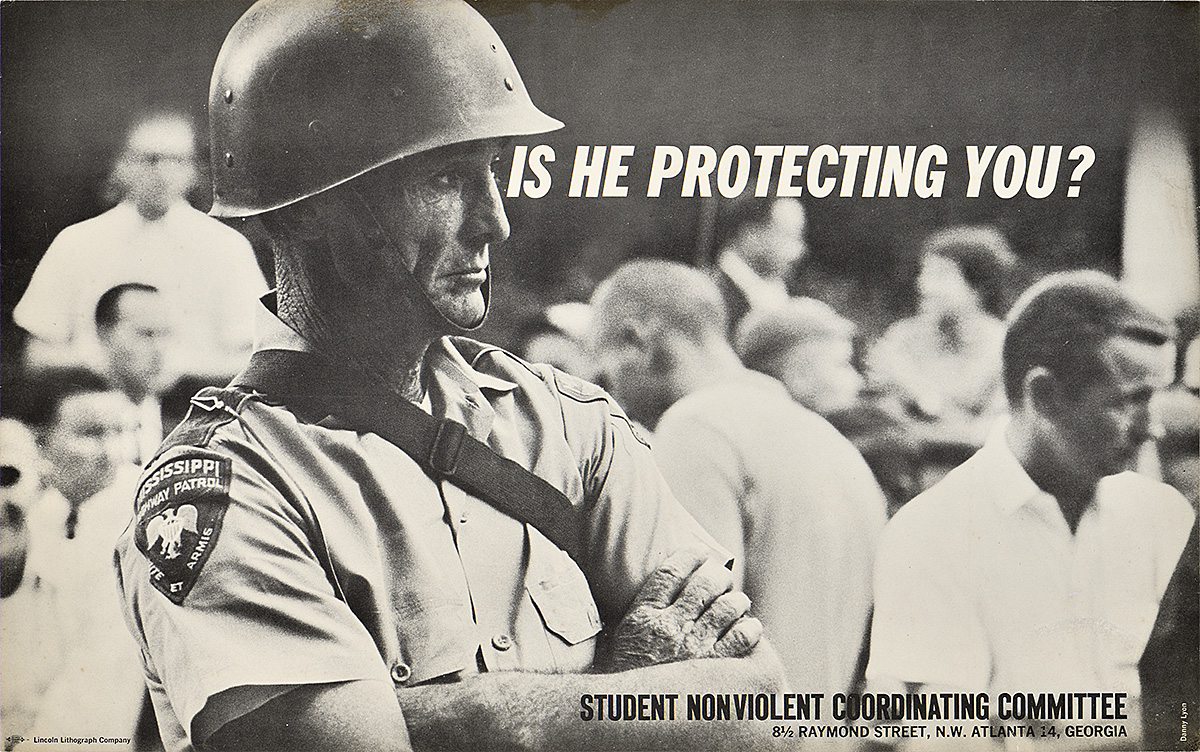
A photo offset poster of a white military officer with his arms crossed surrounded by a crowd.

Is He Protecting You?, c. 1963

Danny Lyon (b. 1942)

Collection of Mark Suckle

  • Law enforcement in all of its iterations often operated in Black communites chiefly to terrorize and criminalize Black people. There was no guaranteed protection for its residents, setting the tone for the ongoing distrust between the two groups. Many organizations and organizers broadcast this message through the media in order to illuminate police brutality that was heard of but not always seen by the broader population. From the 1960s, photography became one of the most essential tools in exposing the violence of law enforcement.
  • This poster features a 1962 photograph by Danny Lyon, the staff photographer for the Student Nonviolent Coordinating Committee. For two years, Lyon’s images established sympathy for the civil rights movement by humanizing SNCC members against the backdrop of racial violence. Much of Lyon’s work also emphasized the aggression and the irresponsible attitude of the police.
  • The poster poses one of the most prevalent questions for those who rallied behind Black nationalism, reinforcing the idea that Black people could only realistically expect protection from other Black people.

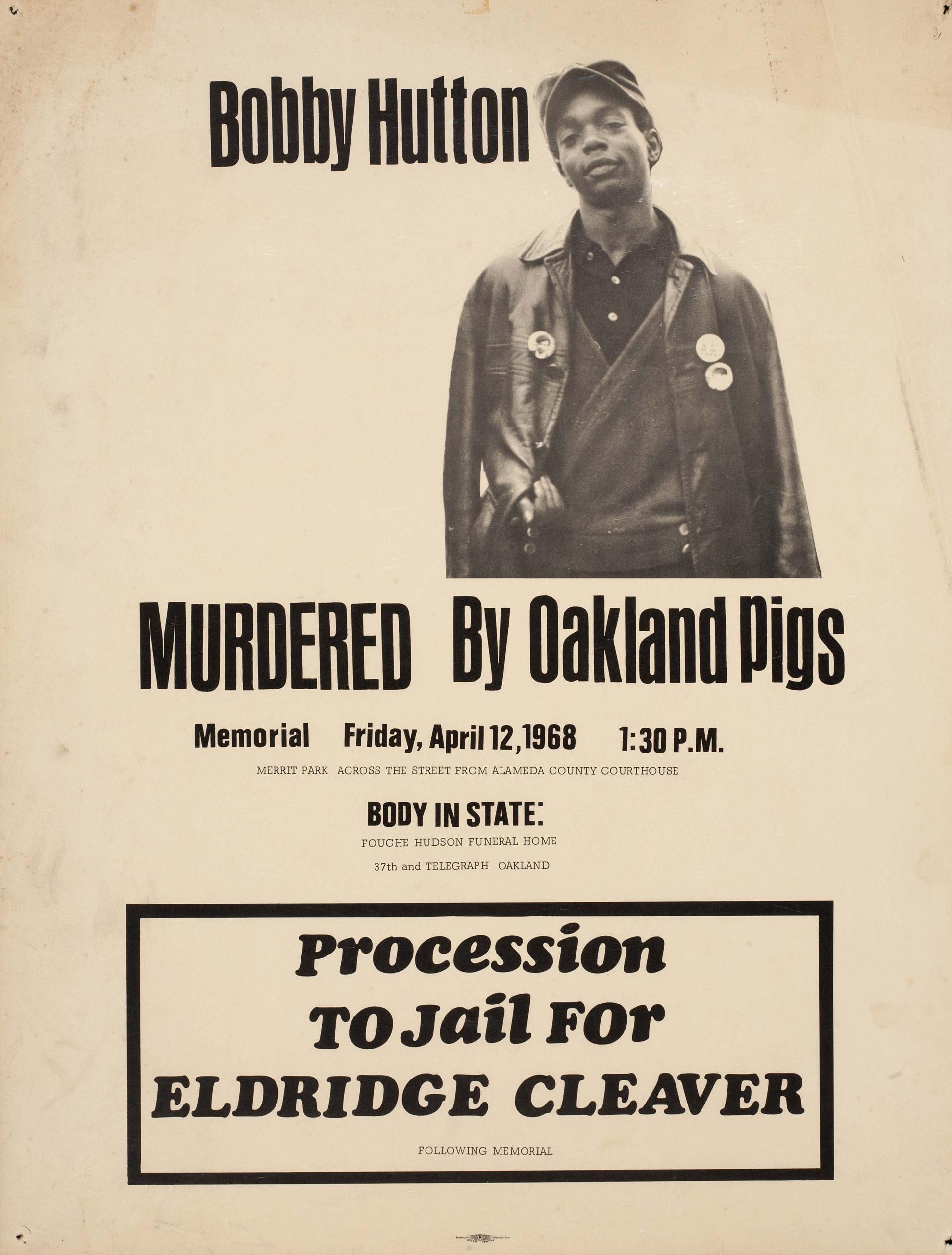
A photo offset poster of a murder notice and memorial of Bobby Hutton, a young Black man.

Bobby Hutton Murdered by Oakland Pigs, 1968

Designer Unknown

The Merrill C. Berman Collection

  • In 1966, sixteen-year-old Bobby Hutton became the first recruit and treasurer of the Black Panther Party. On April 6, 1968, two days after the assassination of Martin Luther King, Jr., Eldridge Cleaver led Hutton and twelve other Panthers in an ambush on the Oakland police, resulting in a 90-minute shoot-out. While Cleaver was wounded, Hutton surrendered, stripped down to show that he was unarmed, and held up his arms. He was immediately shot twelve times, becoming the first member of the BPP to be murdered by the police. 
  • His legacy established him as a martyr for the cause and reminded the nation of the extent of police brutality. In this poster, Hutton is pictured in his all-black BPP uniform alongside text that explicitly states the cause of his death and indicts the perpetrators in sensational terms. It also advertises a memorial for the young party member in front of the Alameda County Courthouse where Cleaver was brought after the shoot-out.

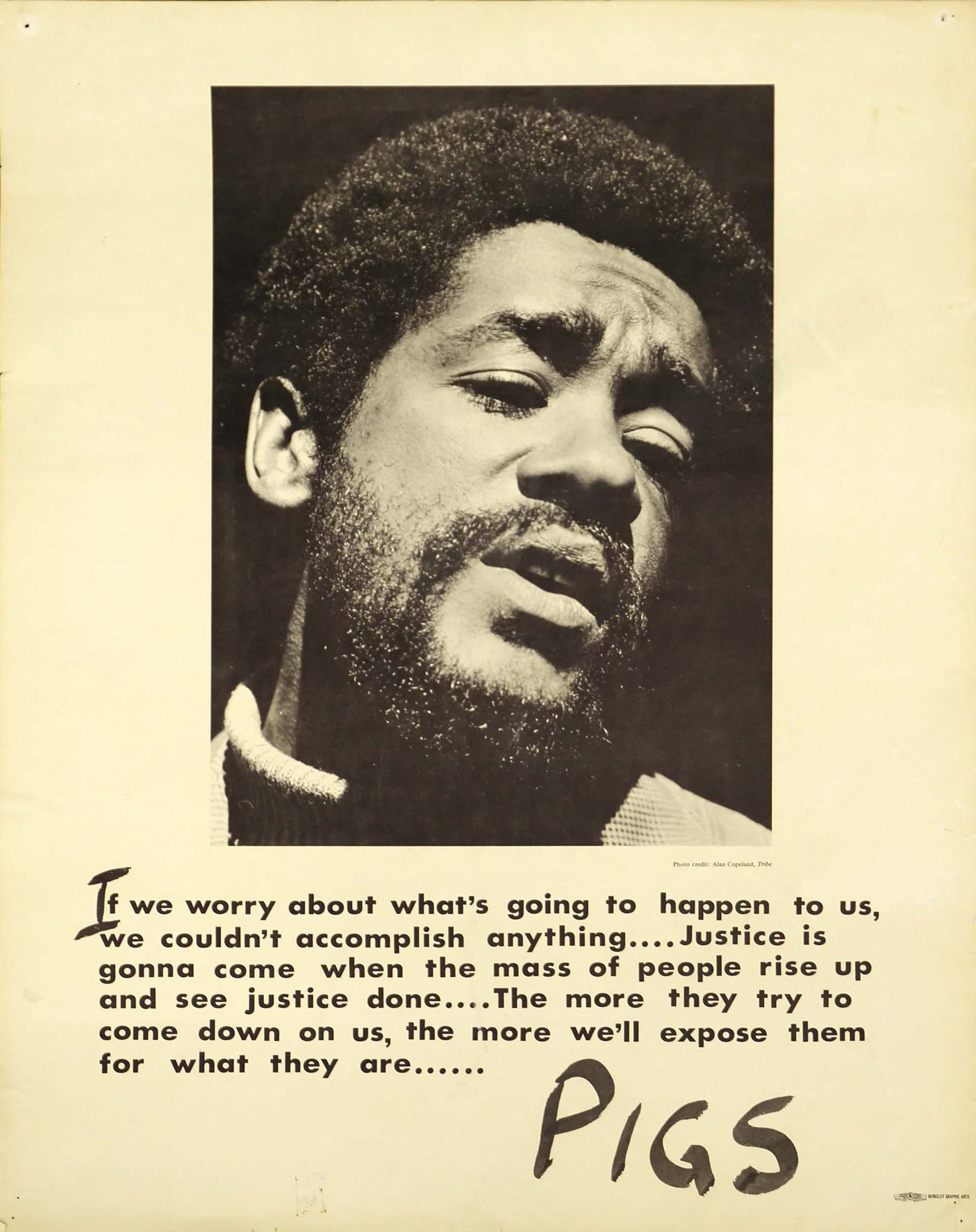
A photo offset poster of a photograph of a sad Black man's face above text.

Expose them for what they are…PIGS, c. 1969

Alan Copeland (1943–2012)

The Merrill C. Berman Collection

  • In an effort to monitor the increasingly militant police, the Black Panther Party assembled armed community patrols. The intention was to motivate individual departments to address unjust behavior within their ranks by confronting them with an equal level of intimidation. Community patrols also showed Black residents that they themselves could lawfully stand up against police brutality with the support of the BPP. 
  • Like the majority of the BPP, Bobby Seale was vocal about his opposition to the police and the need for reform. He explained that one of the main goals of the party was to push for a “community controlled” police force composed only of officers who lived within the community. 
  • Newton and Seale were repeatedly approached by the police in San Francisco, and they often referred to them as “swine” and “pigs.” Emory Douglas recalled a conversation that defined a pig as “a no-nation beast that has no regard for rights, the law or justice.” At one point, Seale showed Douglas clip art of a pig. Douglas then redrew the pig standing on only two legs with a badge and a uniform, thus making the police synonymous with an animal known for wallowing in filth.

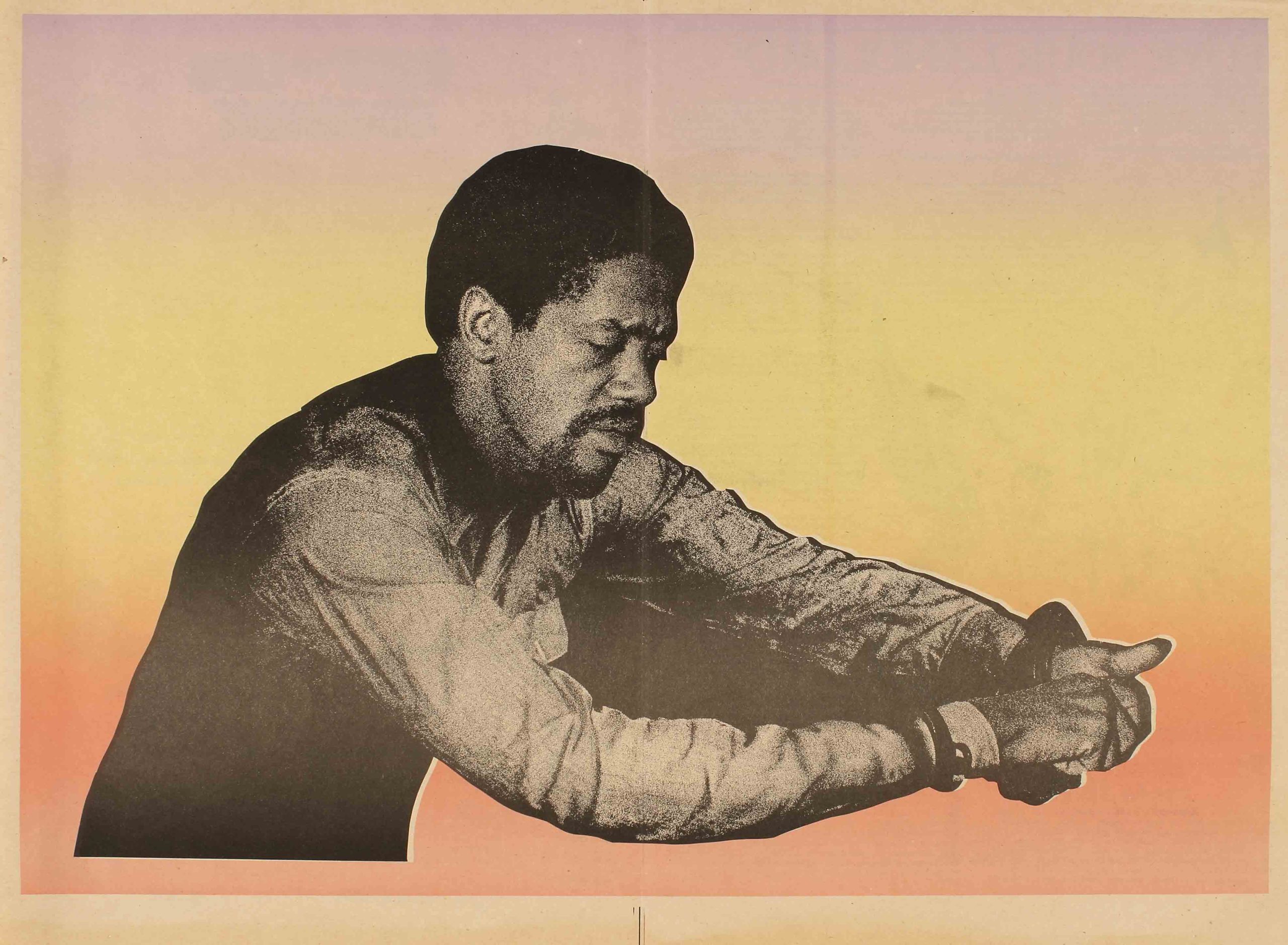
A photo offset poster of a Black man in handcuffs in front of a colorful ombre background.

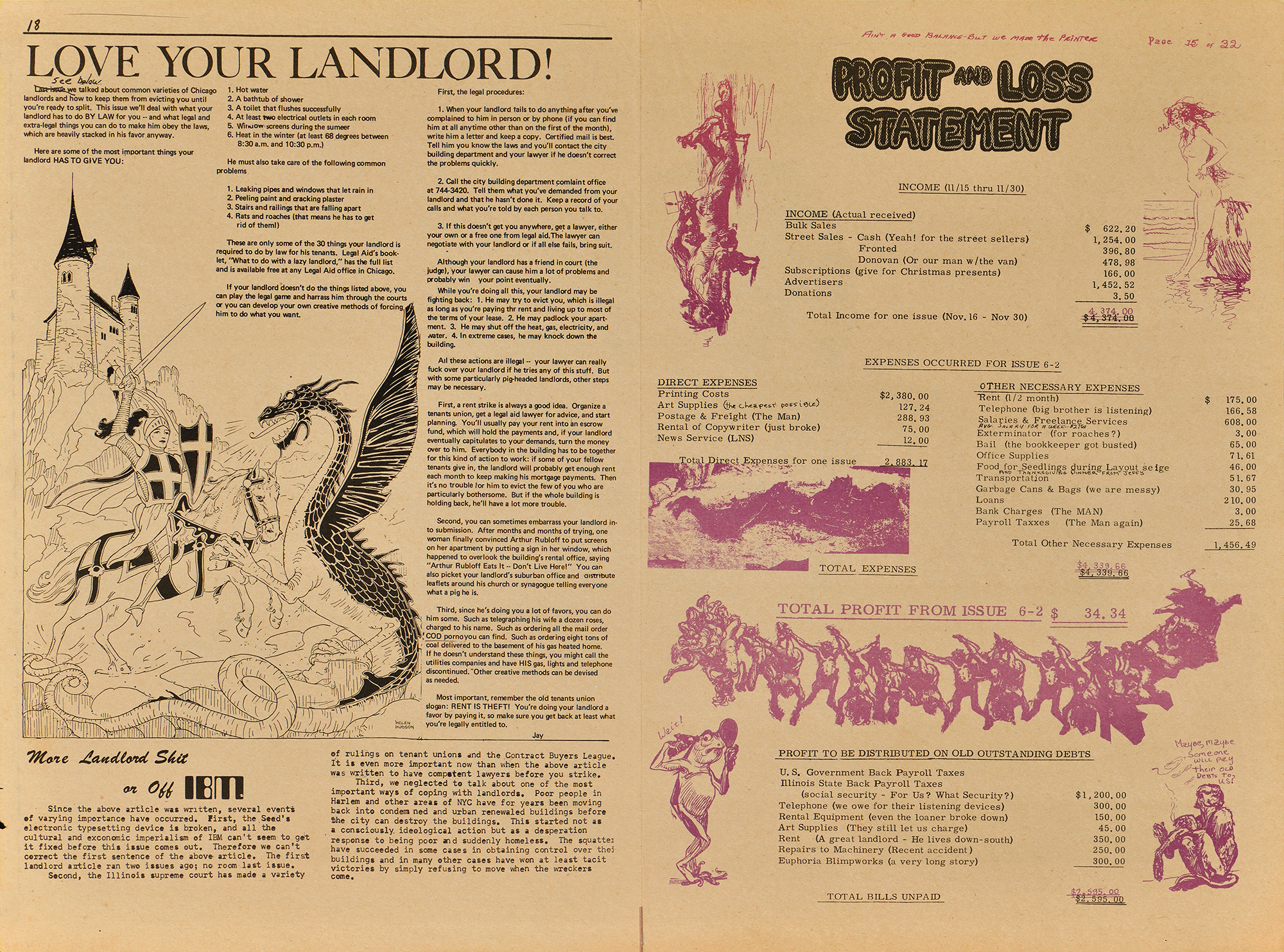
An open document of financial information about tenants’ rights with images of dragons and knights.

Profit and Loss/Bobby Seale, c. 1968

Designer Unknown

The Merrill C. Berman Collection

  • The Black Panther Party integrated the struggles of the working classes within its platform. Such class consciousness was important for its community initiatives and for all Black people since it built solidarity with other racial groups exploited by the brutal systems of capitalism and imperialism.
  • This design features a photograph of Bobby Seale in handcuffs taken during the trial of the Chicago Eight; Seale was one of eight men accused of conspiracy to incite a riot at the 1968 Democratic National Convention in Chicago.
  • The text on the verso presents financial information about Chicago landlords and guaranteed tenants’ rights. It also references the exploitative practices of landlords believed by the BPP to function within the same corrupt arena as law enforcement.

Part 5: The Politics of Black Power

From its inception, the Black Panther Party challenged government structure and policies, including policing and open-carry gun laws in California. In order to effect change on these issues and provide funding for community programs, many members of the party ran for office at local and state levels.

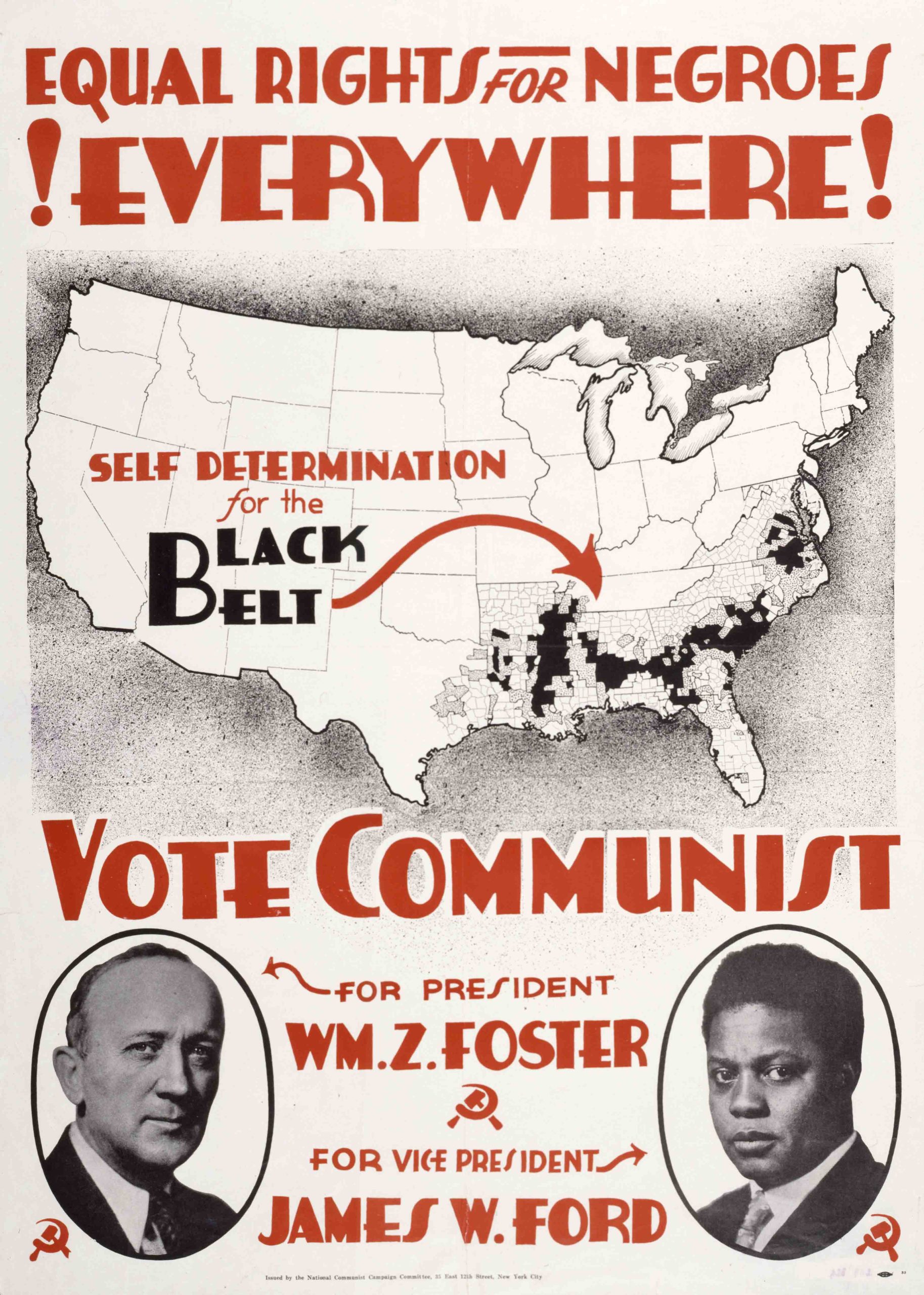
During the 20th century, Black nationalist organizations and individuals often aligned themselves with the Communist Party in America, assuming that its political and economic ideology would support Black liberation. From the 1920s to the 1940s, the Communist Party USA (CPUSA) vocalized its support of anti-colonialism and anti-imperialism, attracting the bulk of its membership from immigrant communities. The CPUSA also encouraged the secession of the “Black Belt,” from the United States through political self-determination. This geopolitical region, largely running from Alabama through Mississippi, had an overwhelming Black landowning population. It had been regarded as important to Black political movements since the early 20th century. By appealing to the Black working class through its anti-capitalist position and aligning itself with Black leaders, poets, and authors, the CPUSA increased its Black membership. Eventually, the party began to focus on more concrete issues, including unemployment, evictions, lynchings, and Jim Crow segregation. Posters for Communist candidates reflected its position in relation to these topics by showing images of revolutionary Black leaders.

Independent political parties appealed to the Black Panther Party for support because of its detachment from both imperialist structures and the Democratic Party. In early 1967, white radicals in California were trying to build an organization that could unite the Black liberation movement with the anti–Vietnam War movement. The project became the Peace and Freedom Party (PFP) of California. The PFP eventually managed to register more than 103,000 voters, guaranteeing a space on the ballot in January 1968. 

A photo offset campaign poster of a map of the United States urging voters to vote communist.

Equal Rights for Negros Everywhere! Vote Communist, 1932

Designer Unknown

The Merrill C. Berman Collection

  • In the 1920s, James W. Ford joined the Workers (Communist) Party of America and quickly gained recognition as one of the leading Black Communists in the nation. He also became the spokesperson for “The Negro Question,” positing that the Black struggle is an international struggle that must be lead by the Black working class rather than the Black intelligensia.
  • Ford was the vice-presidential candidate for the Communist Party during the 1932, 1936, and 1940 elections, becoming the second Black American to run on a vice-presidential ticket (the first was Frederick Douglass in 1872). Decades later, he was followed by Jarvis Tyner and Angela Davis, both of whom ran on the Communist Party ticket. The CPUSA asserted its position on racial equality by putting a Black man in a position of leadership.
  • This campaign poster issued by the National Communist Campaign Committee shows a map of the United States that highlights the Black Belt—an area in the American South with majority Black populations due to the predominance of plantations in the region before the Civil War. The image of the Black Belt on the poster suggests its significance, one that would have been familiar to viewers at the time.

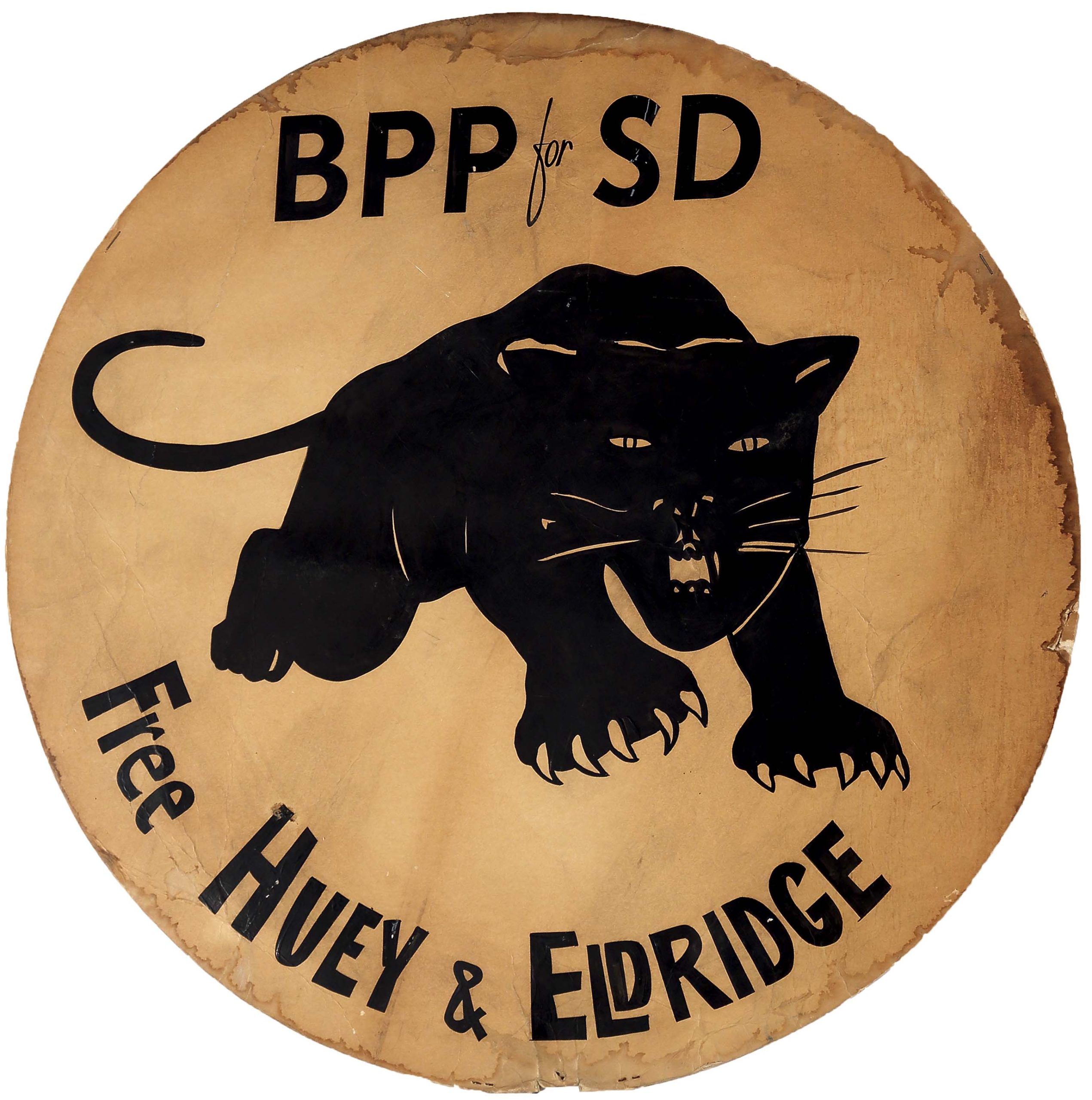
A double-sided sign of a black panther logo above the phrase “Free Huey & Eldridge.

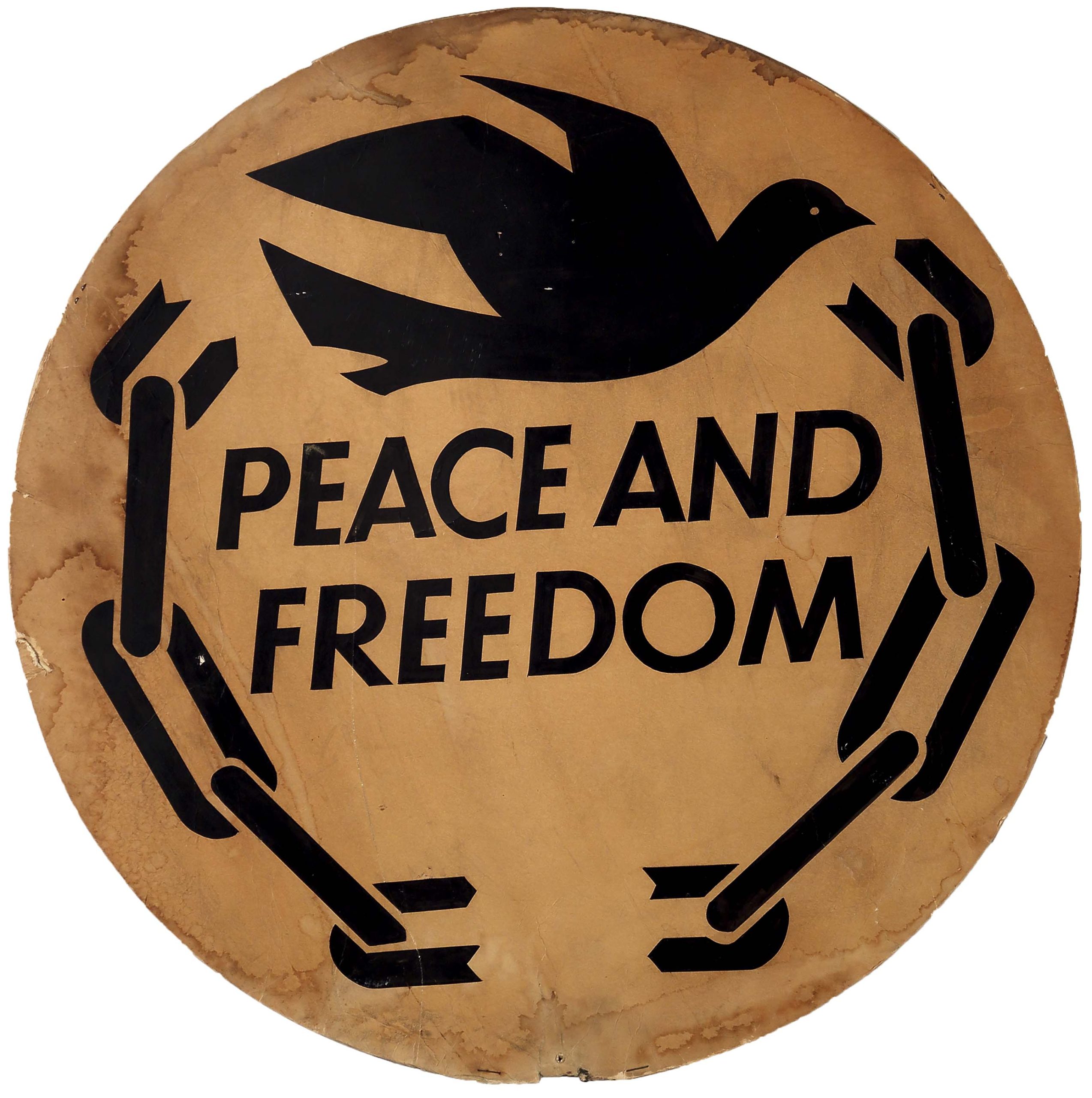
A double-sided sign of black dove logo flying between broken chains and text:

Free Huey & Eldridge, 1968

Designer Unknown

The Merrill C. Berman Collection

  • This double-sided sign was created by the Peace and Freedom Party (PFP), a socialist group born from the antiwar movement and founded on June 23, 1967. Built on the platforms of labor rights, Black liberation, women’s liberation, and gay liberation, the chief principles of the PFP aligned well with most of those held by the Black Panther Party.
  • Here, the iconic panther is positioned above the phrase “Free Huey & Eldridge.” At the time, Huey Newton was in jail for the alleged murder of police officer John Frey during a traffic stop that resulted in a shoot-out, while Eldridge Cleaver was being charged with the attempted murder after the incident in Oakland with Bobby Hutton. By late 1968, however, Cleaver had jumped bail and fled to Cuba.
  • This same year, the PFP received ballot status and nominated Eldridge Cleaver for president, although, since he was under the age of 35, he was not technically eligible to run.
  • The verso of this double-sided sign shows a black dove—one of the earliest logos associated with Black nationalism—flying between broken chains.

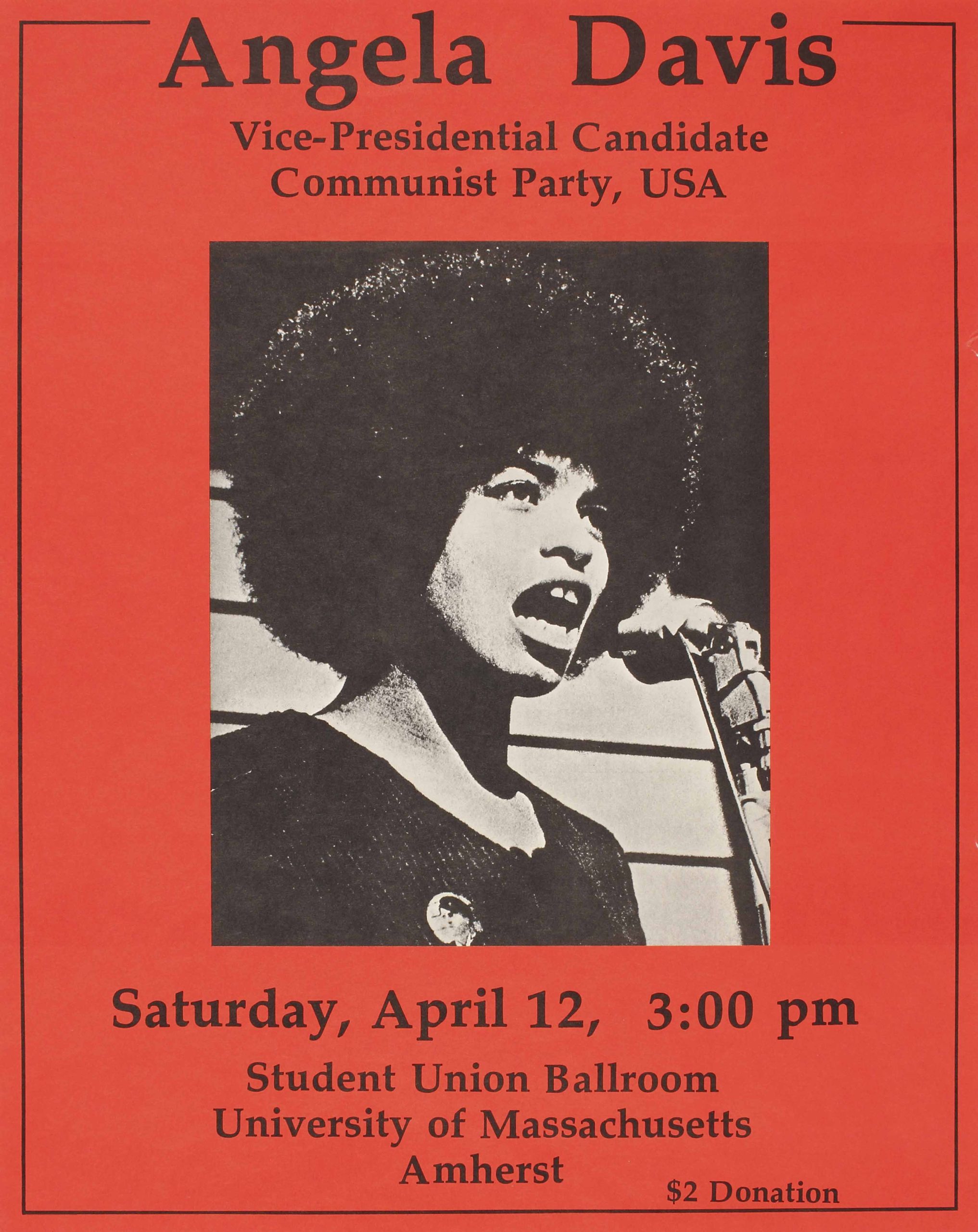
A red photo offset poster of Angela Davis, a Black woman with a large afro speaking at a podium.

Angela Davis Vice-Presidential Candidate, 1980

Designer Unknown

The Merrill C. Berman Collection

  • Throughout the 1970s, Angela Davis gradually became one of the most important figures in the Black Power movement. Her firm stance on Communism and anti-imperialism addressed the need for government systems that would protect the rights of the oppressed. Davis’s image was widely known and its use placed a Black woman at the forefront of political and social activism. 
  • In 1980 and 1984, Angela Davis accepted the Communist Party U.S.A.’s nomination for vice-president with Gus Hall as her running mate.
  • This poster advertises a speech by Davis at the University of Massachusetts, Amherst, and shows how the spirit of Black nationalism established in the ‘60s extended into the 1980s.

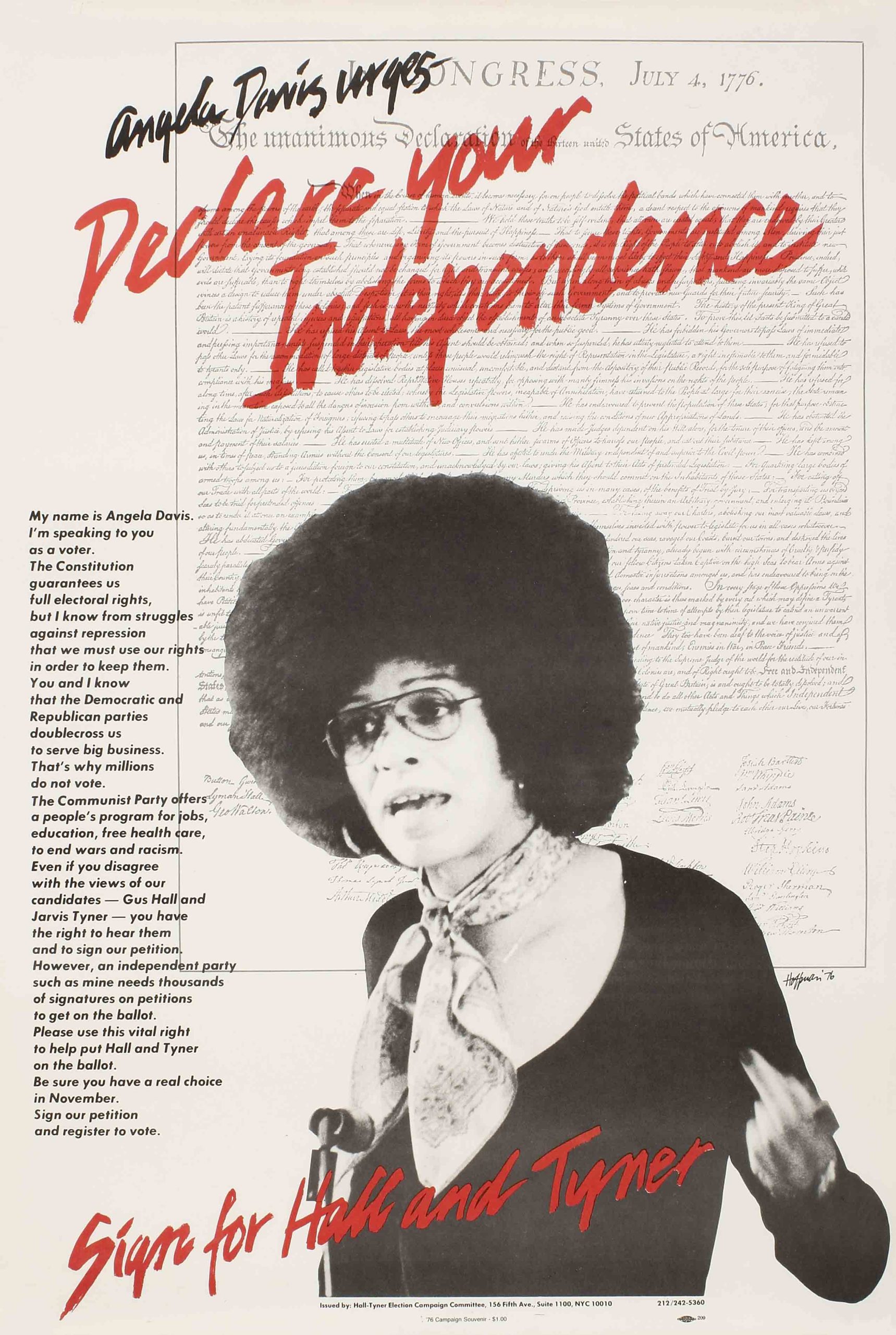
A photo offset poster of Angela Davis, a Black woman with an afro and glasses speaking at a podium.

Angela Davis Urges—Declare Your Independence, 1976

Designer Unknown

The Merrill C. Berman Collection

  • In 1969, Angela Davis achieved national notoriety for her support of the Communist Party U.S.A. while working as an assistant professor at the University of California, Los Angeles. While she was never an official member of the Black Panther Party, the pervasive media coverage of a powerful Black woman brought her to its attention. 
  • Davis had a lifelong relationship with the Communist Party due to her parents’ involvement with its membership in the South. She familiarized herself with the Communist Manifesto and appreciated the CPUSA’s support of women’s rights. She was ultimately fired from UCLA which rejected what it saw as the inflammatory rhetoric of her speeches.
  • This poster was produced for the 1976 presidential campaign of Gus Hall, the Communist Party U.S.A. candidate, and his running mate, Jarvis Tyner. It features a large portrait of Davis making a plea for voters to sign a petition to include Hall and Tyner on the ballot. A modified image of the Declaration of Independence is plastered in the background, a reference to the bicentennial of the United States and two centuries of injustice in the continuing fight for equality. Davis’s image is featured on the poster despite the fact that she was not running in the election, emphasizing that she was an influential radical figure even eight years after her initial termination from UCLA for her affiliation with Communism.
  • The poster was issued as a campaign souvenir during the 1976 election and sold for a dollar.

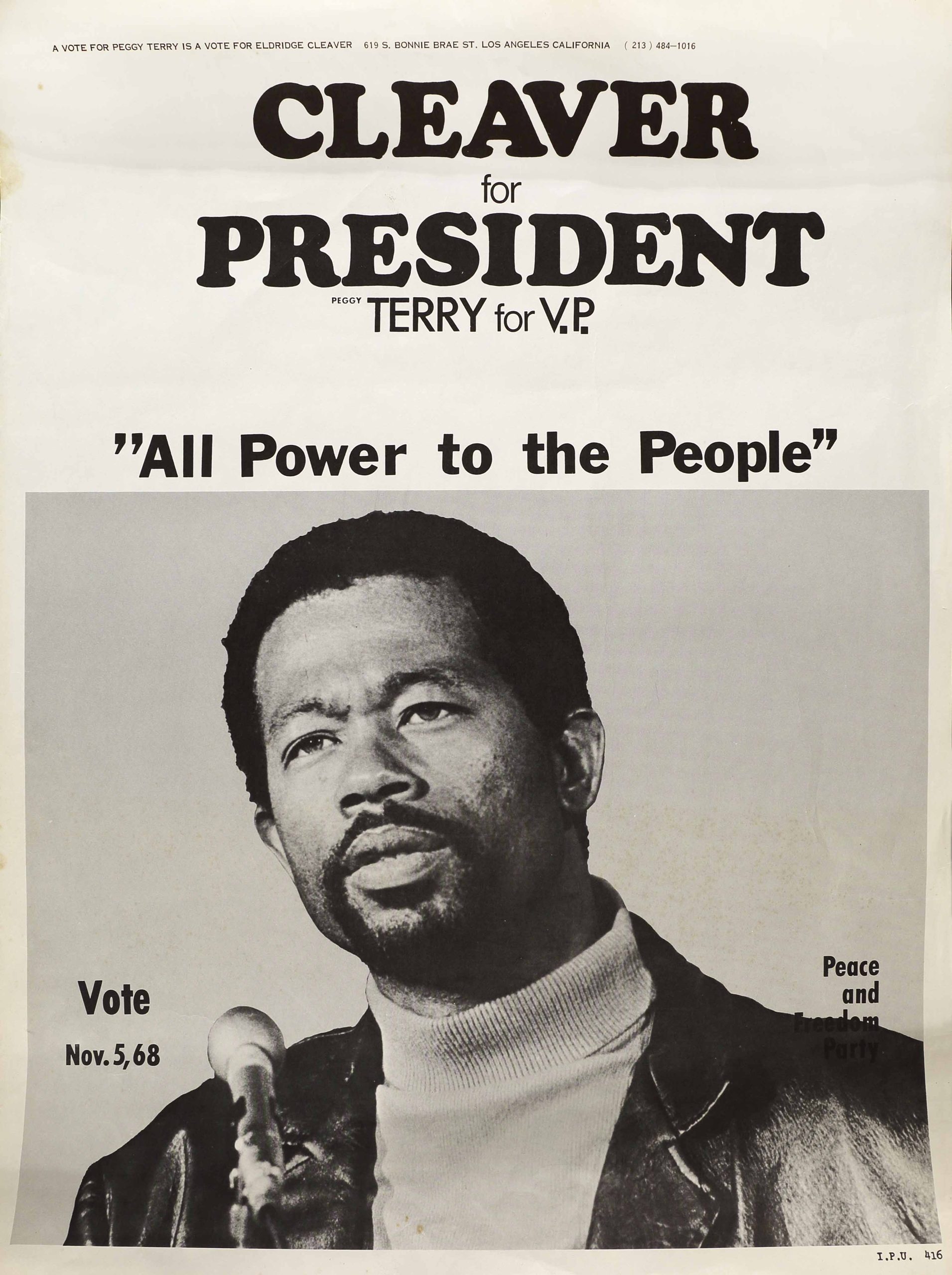
A presidential-campaign poster for Cleaver, a Black man wearing a jacket talking at a podium.

Cleaver for President, 1968

Designer Unknown

The Merrill C. Berman Collection

  • In early 1968, Eldrige Cleaver ran for president on the Peace and Freedom Party ticket. He was nominated over Richard “Dick” C. Gregory, a popular Black comedian and far-left activist. At the time of the election, Cleaver was not yet 35 years old and therefore did not meet the criteria for running for president in the United States. However, because the Constitution does not specify if the elected official must be 35 years old before or after Inauguration Day, he was allowed to appear on the ballot in select states.
  • On the poster, Peggy Terry—an established organizer of working-class white Americans—is listed as Cleaver’s running mate. The PFP chose Terry to represent economic inequality while Cleaver represented racial inequality. Cleaver’s preferred running mate, however, was Jerry Rubin, a well-known activist and counterculture icon.
  • While the poster features a photograph of Cleaver, the upper margin emphasizes that “a vote for Terry is a vote for Eldridge Cleaver.” In many states, Cleaver was left off the ballot entirely and campaign posters suggested that a vote for Terry was a vote for Cleaver by proxy.

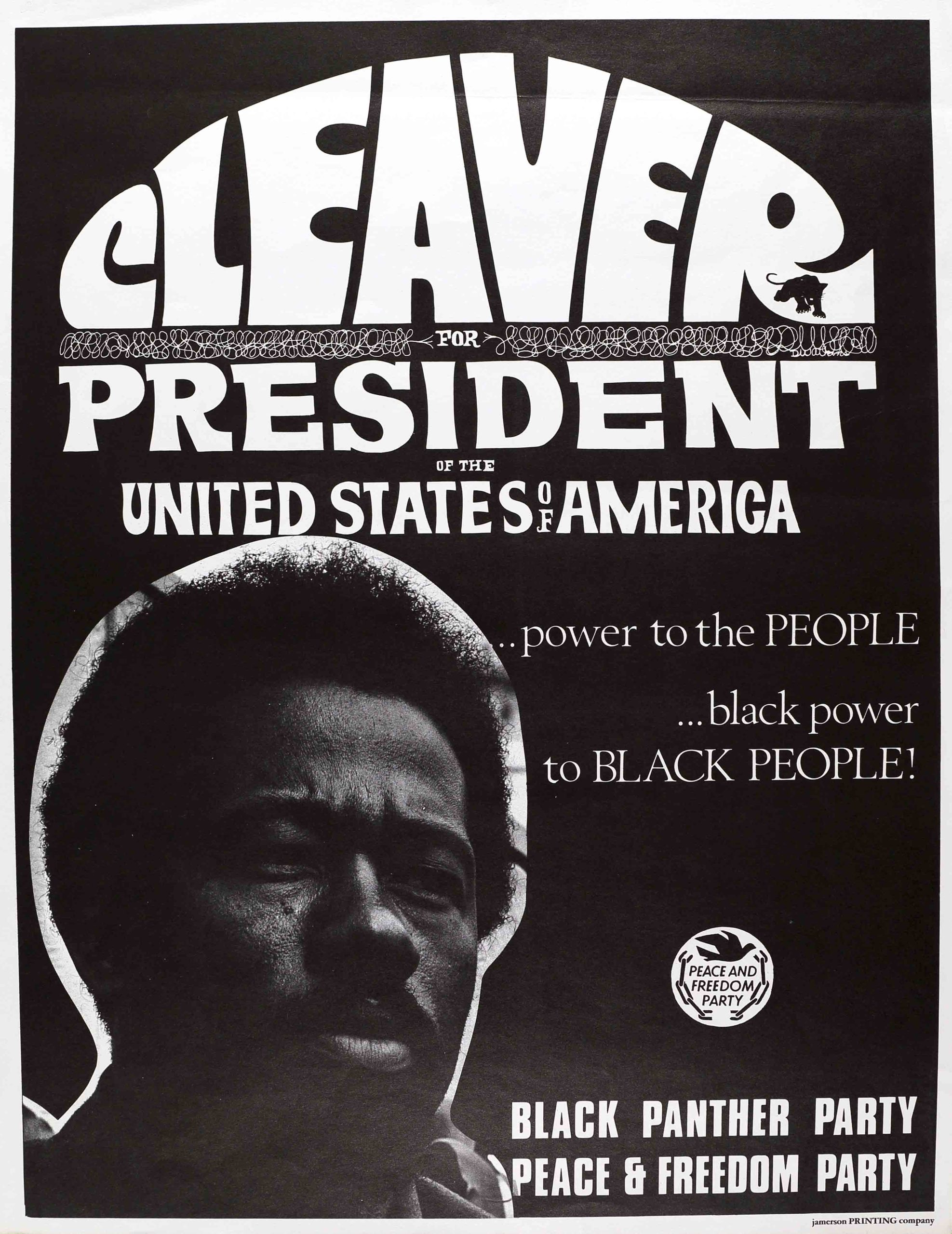
A black and white presidential-campaign poster for Cleaver, a Black man looking in to the distance.

Cleaver for President of the United States of America, 1968

Designer Unknown

The Merrill C. Berman Collection

  • Early in the campaign, Peggy Terry was the Peace and Freedom Party’s official vice-presidential nominee, though several other candidates, including activists Rodolfo Gonzales, Doug Dowd, Jerry Rubin, and Judith Mage, were considered. While Cleaver was in prison, Peggy Terry campaigned across the country on his behalf. On this poster, Eldridge Cleaver’s running mate is neither listed nor named. Eventually, Judith Mage was placed on the ballot as Cleaver’s vice-presidential running mate.

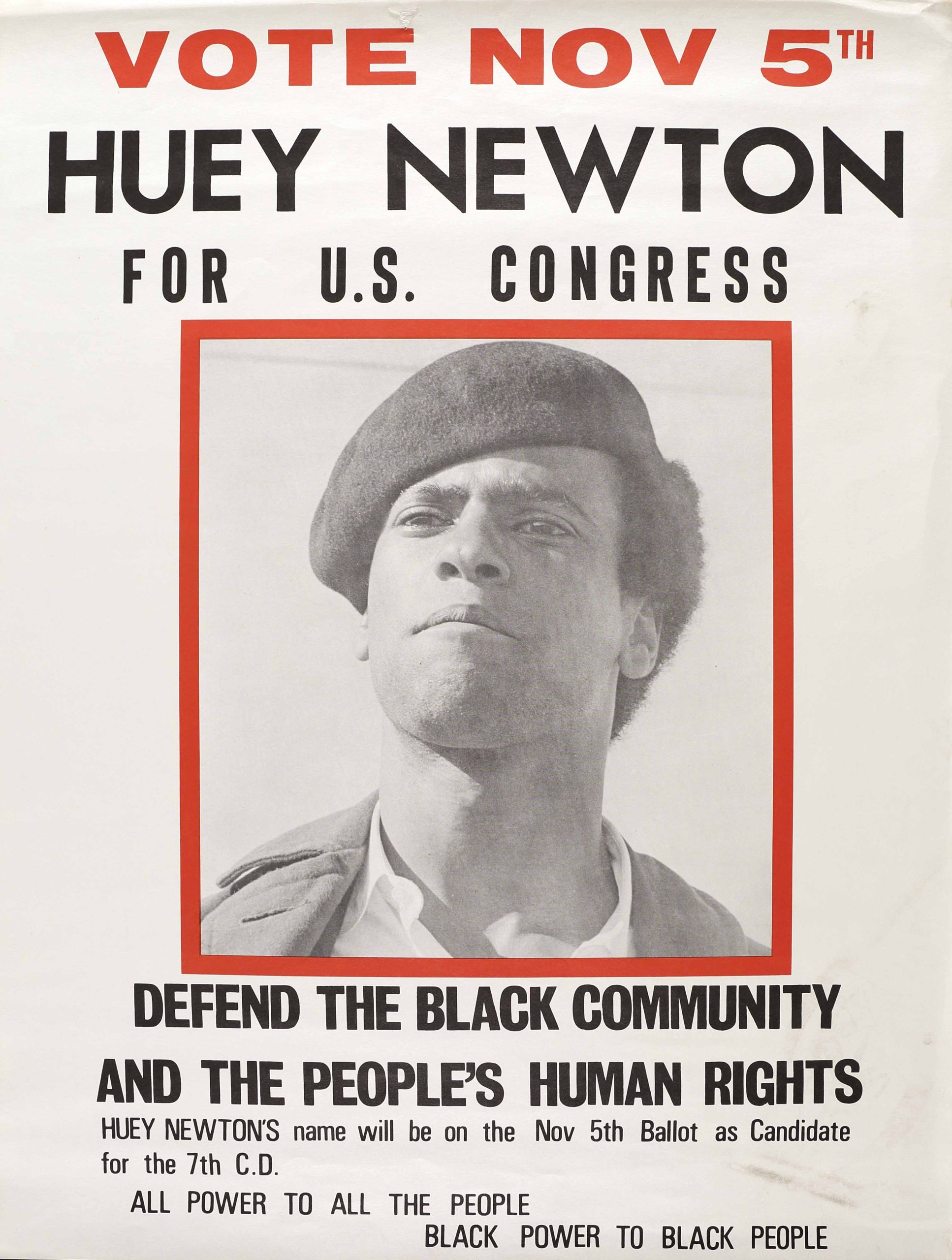
A congressional-campaign poster for Huey Newton, a Black man wearing a beret and looking ahead.

Huey Newton For U.S. Congress, 1968

Designer Unknown

The Merrill C. Berman Collection

  • In December 1967, led by Communications Secretary Kathleen Cleaver, the Black Panther Party organized a coalition to rally behind Newton and champion his release. The Peace and Freedom Party—a majority white, anti-war political organization—joined with the BPP in support of Newton. Cleaver prepared a “Free Huey” campaign and the BPP arranged for Newton to run for office from his jail cell. Although the party gained reasonable support in California, Newton was unsuccessful in his political bid.
  • Kathleen Cleaver officially endorsed Newton on the PFP ticket and, although Black Democrats rallied behind the “Free Huey” campaign, she stated that true liberation would only come when Black Americans detached themselves from the Democratic party. 
  • Newton’s congressional-campaign poster reaffirms the importance of defending the Black community and general human rights, a powerful message of hope from one of many jailed Black leaders.

Part 6: The Vision of Freedom

“How can we imagine freedom?” During the 1960s, this question was pivotal to the endeavors of Black revolutionaries and Black nationalist groups. In America, the history of enslavement had long-standing effects on Black Americans and Black immigrants who continued to feel vulnerable to white supremacy. Huey Newton, cofounder of the Black Panther Party, explained that its members were at the vanguard of leadership of the oppressed, and he encouraged Black Americans to arm themselves for self-defense. He drew inspiration from the American Revolution, stating that “with weapons in our hands, we were no longer their subjects, but their equals.” Further, he suggested that by openly displaying guns, the BPP was challenging the racial hierarchy and projecting the message of freedom by any means necessary. Weapons served as one of the most important symbols adopted by the BPP to brand its own form of nationalism and establish what the Black-liberation struggle should look like.

The notion of freedom expanded as the Black Panther Party experienced growing popularity and membership outside of the Bay Area. By 1969, the organization’s focus expanded from Black nationalism alone to include revolutionary nationalism, an ideology that focused on class critique and oppression within the imperial core. This ideology was further inflated during the split in 1971 during which one faction of the BPP, led by Eldridge Cleaver, began to focus more on global anti-imperial struggles while the other, led by Newton and Seale, began to concentrate on internal Black community programs. This shift is most evident in the emergence of the party’s support of socialism as an economic theory and in its production of posters that include statements by international Communist leaders.

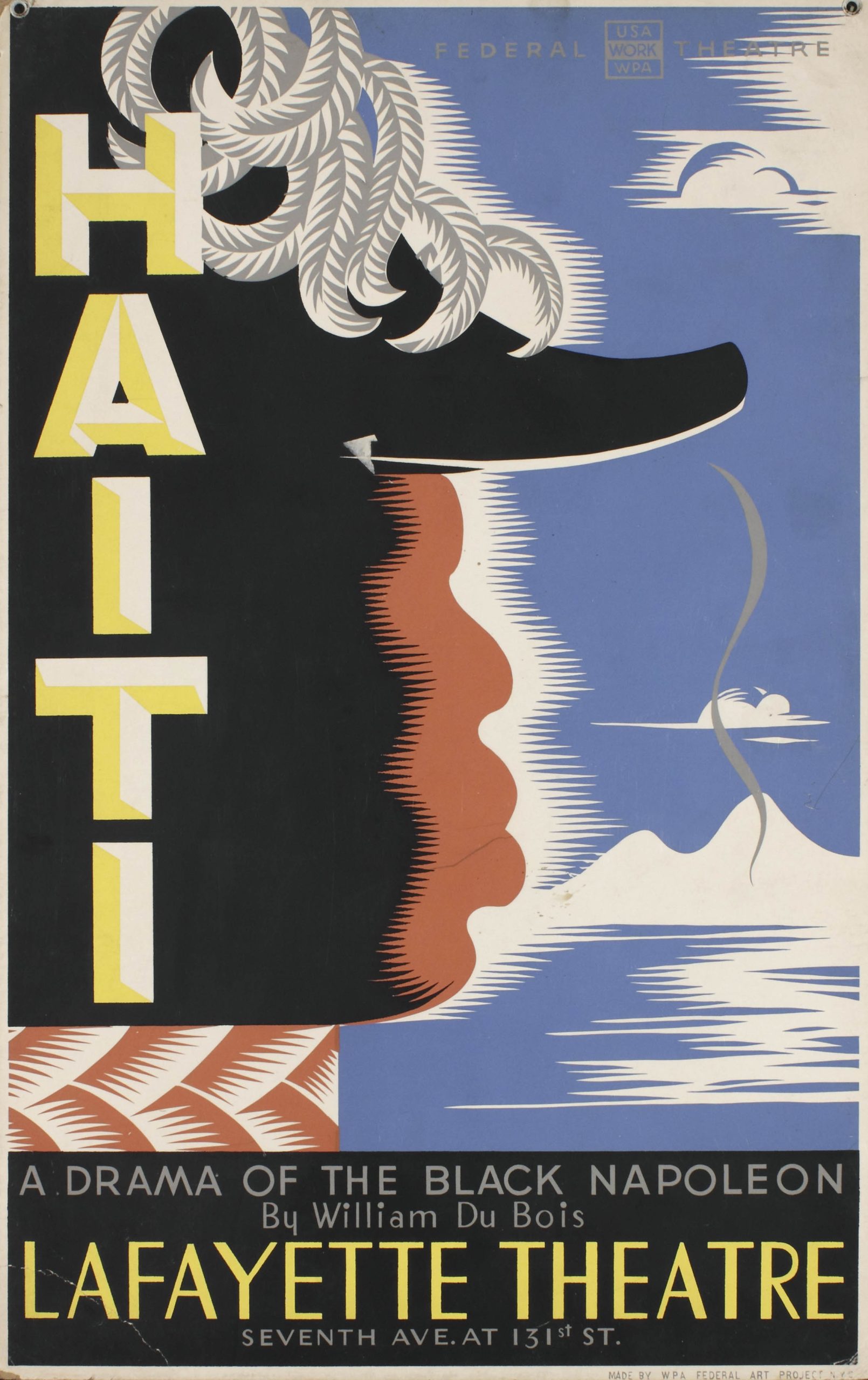
A silkscreen poster of a profile of a medium to dark skinned figure over a water background.

Haiti: A Drama of the Black Napoleon, 1938

Vera Bock (1905–2006)

The Merrill C. Berman Collection

  • After the end of the United States’ occupation of Haiti between 1915 and 1934, the American public developed a broad interest in the country’s literature, theater, and poetry. William DuBois, a white New York Times journalist and editor, originally wrote the play Haiti: A Drama of the Black Napoleon. The script was then reworked by Maurice Clark, a Black director of the Harlem unit of the Federal Theatre Project of the Works Progress Administration (WPA). In Clark’s hands, the play was transformed from a tale warning of the dangers of miscegenation to “a dramatization of the black struggle for freedom.” Haiti was criticized by members of the House Committee of Un-American Activities (HUAC), an organization tasked with investigating Communist threats to the United States.
  • This type of creative messaging provided the framework for both international revolutions by fighting back against the oppressor. Haiti would also show Black audiences the importance of a powerful Black figure leading the charge for the liberation of all oppressed people.
  • Vera Bock’s design for Haiti: A Drama of Black Napoleon exhibits the Art Deco style for which she was best known. The figure seen on the left side of the poster depicts Toussaint L’Ouverture or the “Black Napoleon” as he was known after leading a successful slave uprising in Haiti.

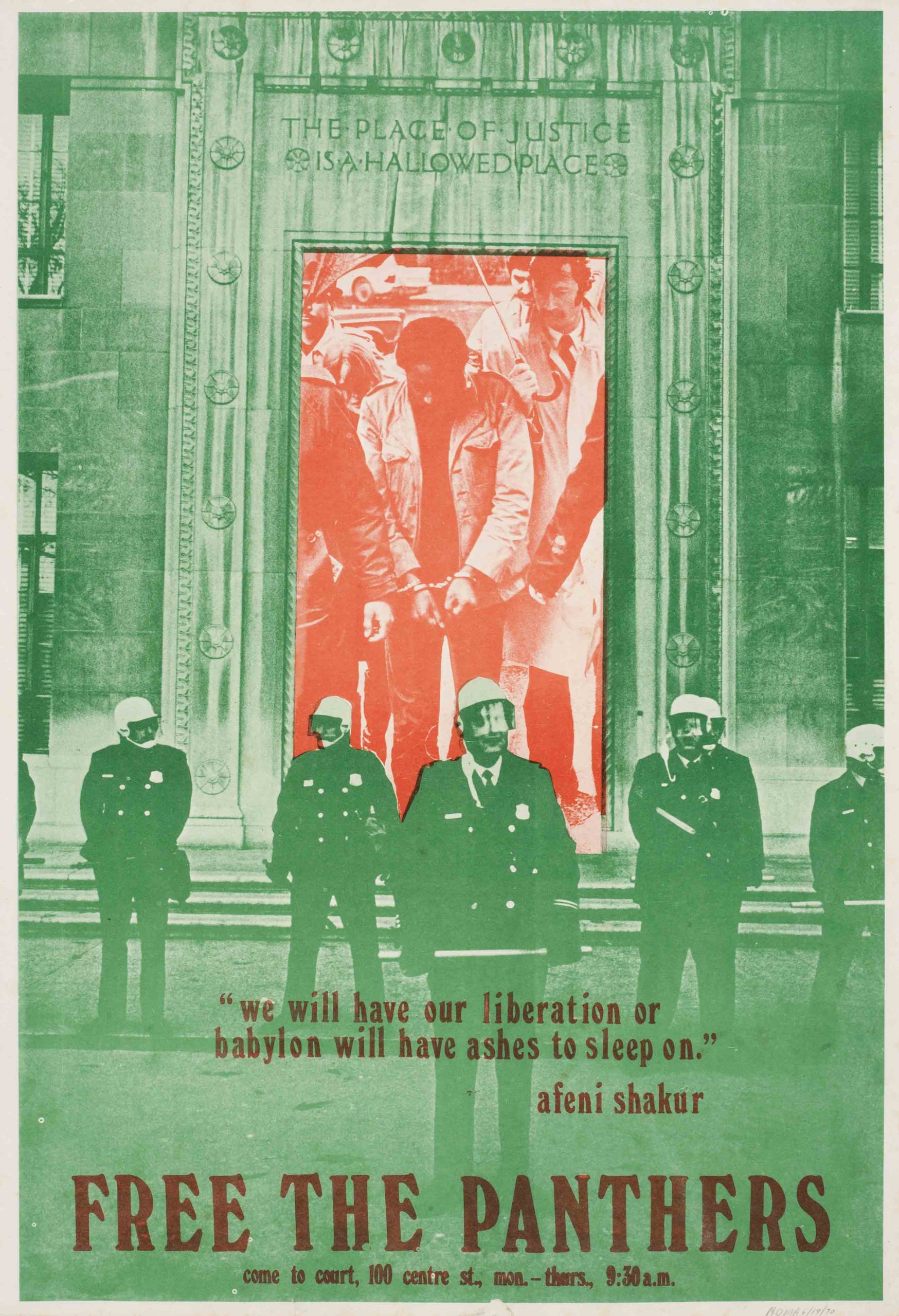
A photo offset poster of police in front of a doorway with a photo of Black Panther in handcuffs.

Free the Panthers, 1969

Designer Unknown

The Merrill C. Berman Collection

  • In 1969, 21 Black Panthers in New York were accused of planning the bombings of three separate locations: the Bronx 44th Precinct, the Manhattan 24th Precinct, and the Queens Board of Education office. 
  • The police arrested and indicted the 21 accused Panthers, but the number eventually dropped to 13. Bail for each Panther was set at $100,000. Since not all the defendants could make bail, however, many were held at Rikers Island under charges of conspiracy to kill police officers and to attack a number of buildings. Church congregations around New York City as well as prominent public figures raised bail money for each imprisoned member.
  • After an eight-month trial—one of the longest and most expensive in New York state history—all 21 Panthers were acquitted in May 1971.
  • This poster incorporates a photograph of a Black Panther being escorted in handcuffs by white plainclothes police officers. The image is framed by the stone doorway of the court building, inscribed above with the phrase “The Place of Justice is a Hallowed Place,” an ironic juxtaposition highlighting the hypocrisy of the American judicial system. It also includes a quote from Afeni Shakur, section leader of the Harlem division of the Black Panther Party: “we will have our liberation or babylon will have ashes to sleep on.”

“All Power to All the People, Black Power to Black People.”—Eldridge Cleaver, Minister of Information

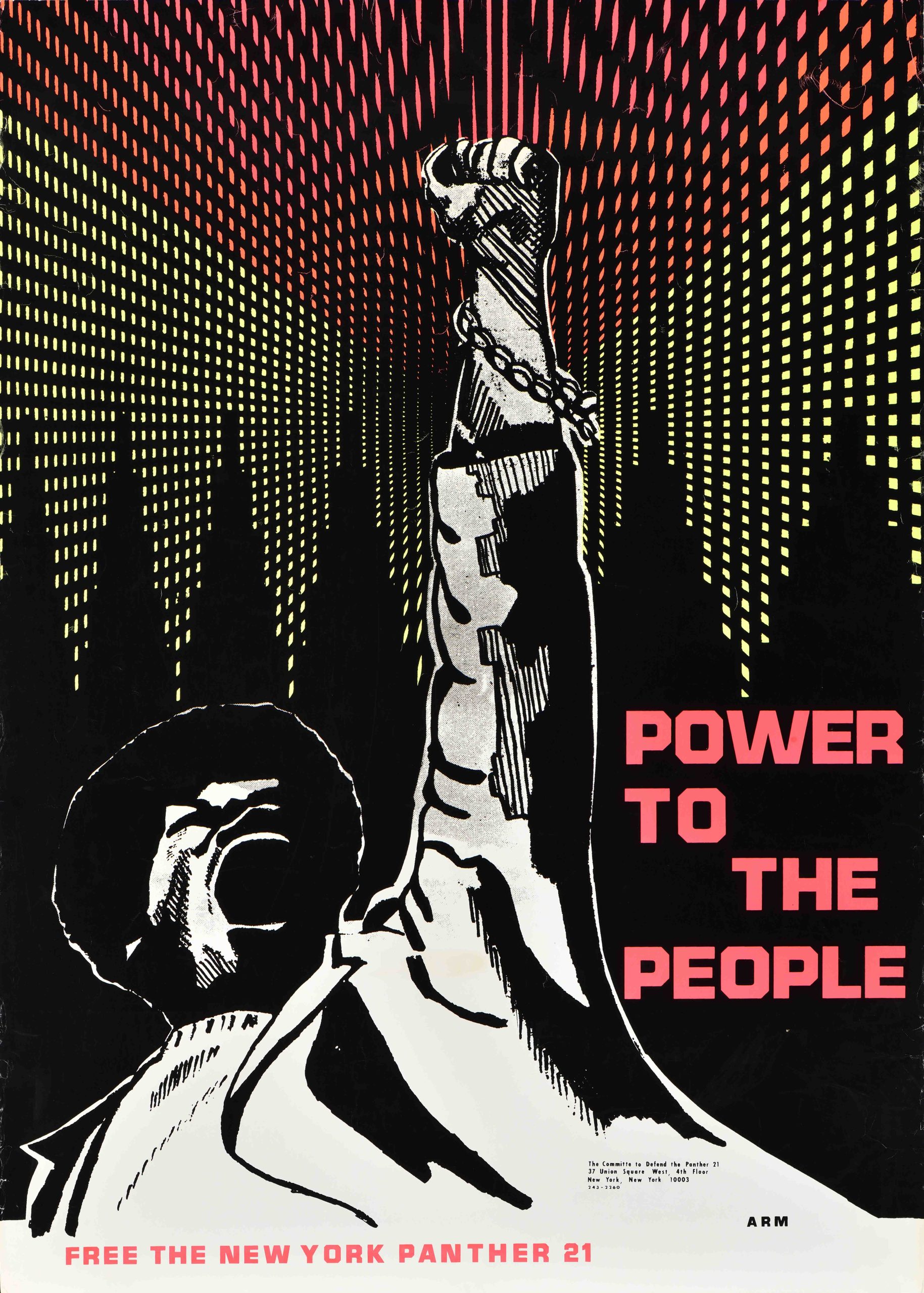
A psychedelic poster of a figure with a fist in the air between repeated Chrysler Buildings.

Power to the People, 1969

Designer Unknown

Poster House Permanent Collection

  • This poster is designed in the psychedelic style, visually referencing the drug-fueled counterculture movement of the time. 
  • The triumphant figure’s raised fist is thrust between repeated silhouettes of the Chrysler Building in New York, an identifiable icon of the city impacted by the case of the Panther 21.

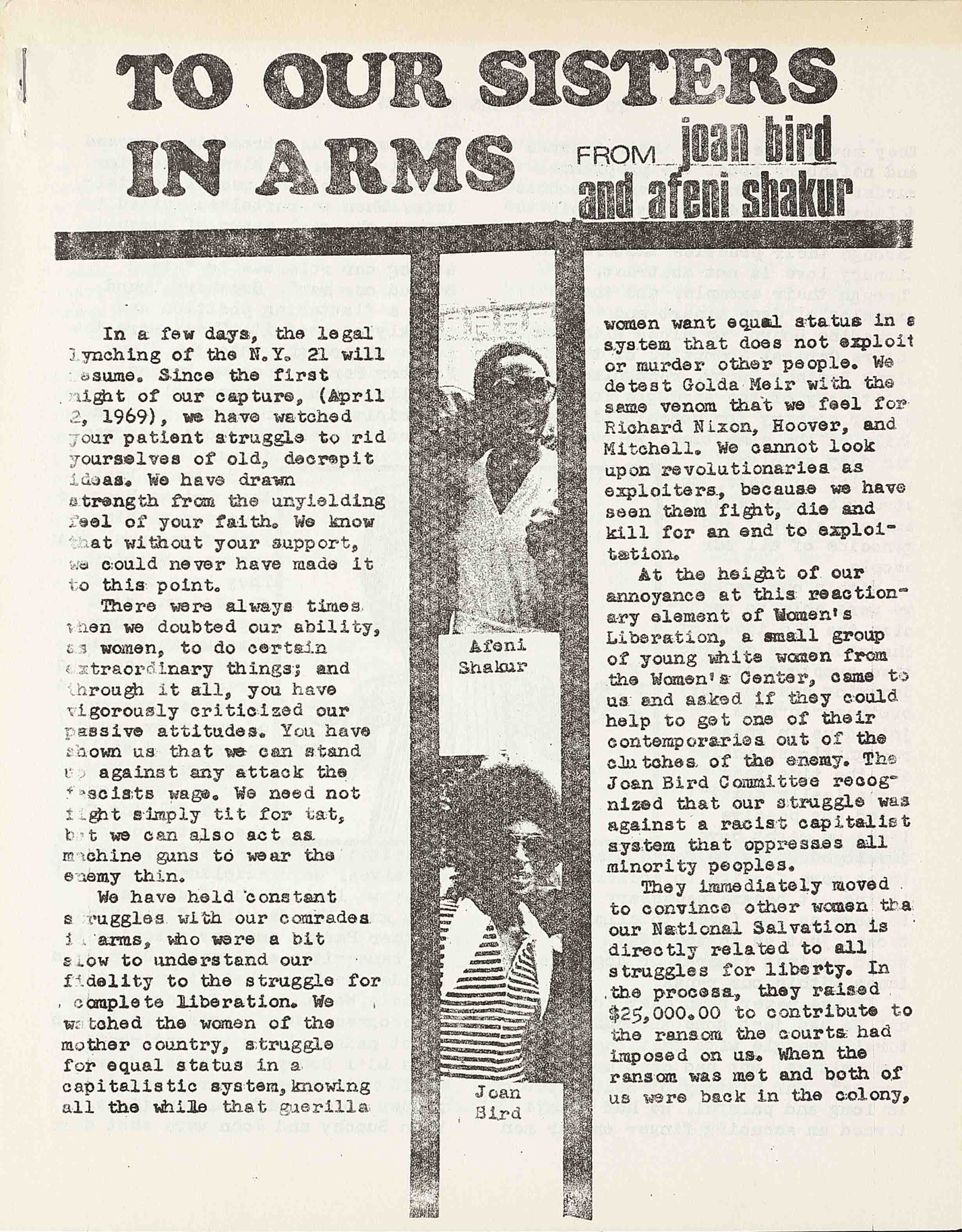
A pamphlet of 2 images of Black women in the center of the page inbetween text.

To Our Sisters In Arms, 1970

The Merrill C. Berman Collection

  • Joan Bird and Afeni Shakur were among the 21 Panthers arrested and tried for planning a series of bombings on New York City police stations in 1969.
  • At the time of her arrest, Bird was 19 years old and in nursing school at Bronx Community College. She first became interested in joining the Black Panther Party in high school after witnessing police treatment of a group of Panthers outside of a courthouse.
  • Shakur was the only Panther to represent herself in court during the trial, preparing her defense with meticulous research. She cross-examined Ralph White, a presumed suspect in the attacks, and got him to admit under oath that he was an undercover policeman who, with the help of others, had provoked the incidents.
  • This pamphlet specifically calls attention to both women, as their writing raised awareness of the condition of Black women in general within the BPP. Their words anticipate the intersectional struggle that they and other women experienced as they participated in the revolutionary movement.

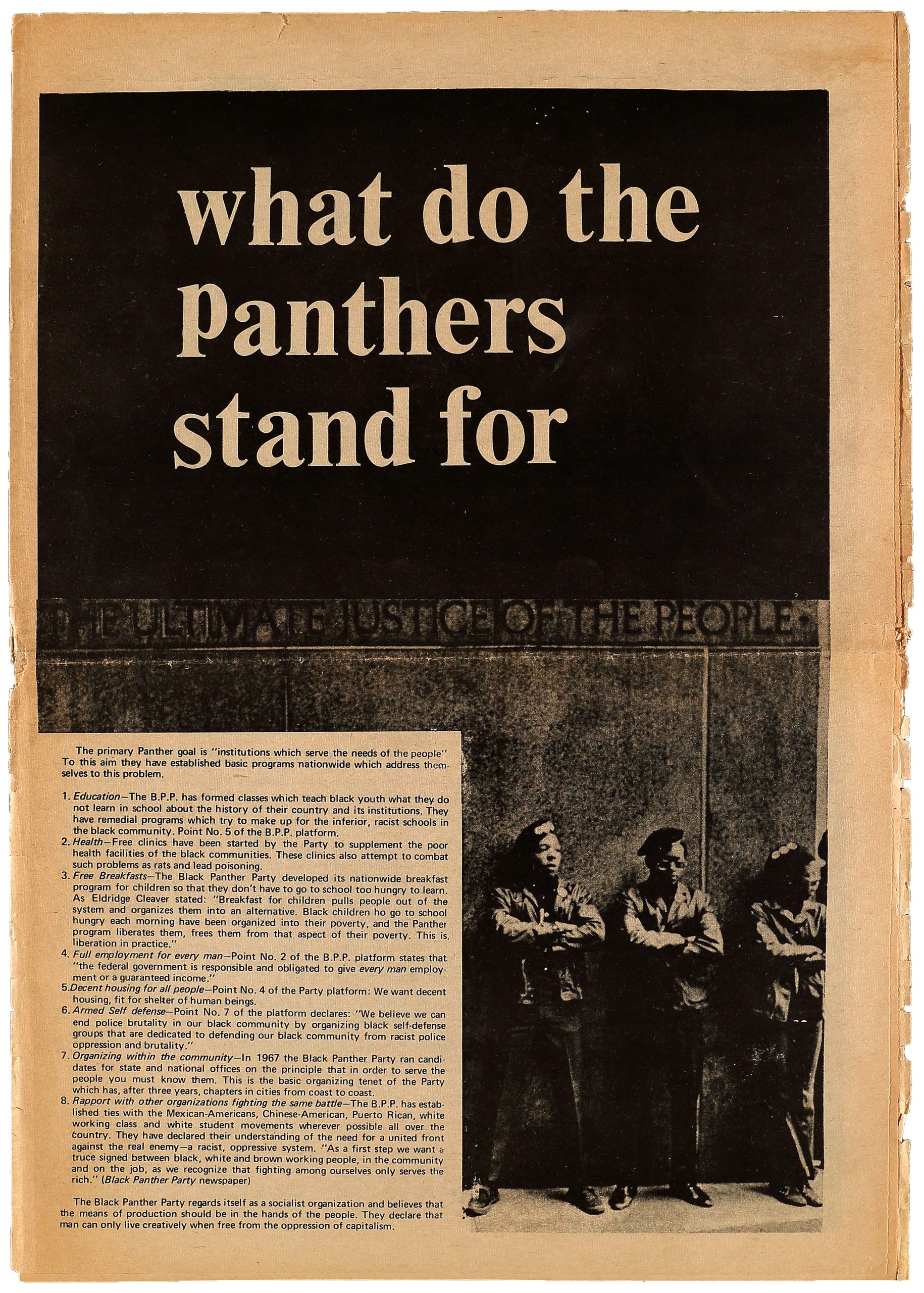
A newspaper page of Black Panther memebers standing with their arms crossed with text around them.

What Do the Panthers Stand For, 1970

The Merrill C. Berman Collection

  • The Committee to Defend the Panther 21 was composed of Communist and other left-wing activists 
  • This broadside, distributed by the committee, includes a list of the socialist principles that guided the Black Panther Party, emphasizing the communal goals of its activism as well as serving to humanize the Panthers in the light of their alleged violence. Socialism was part of the BPP’s move from Black separatism to a revolutionary nationalism that addressed systems that prevented racial and economic mobility. The broadside also states that the bombing of stores and property—acts that the members had been accused of—were acts of terrorism vehemently rejected by the BPP.

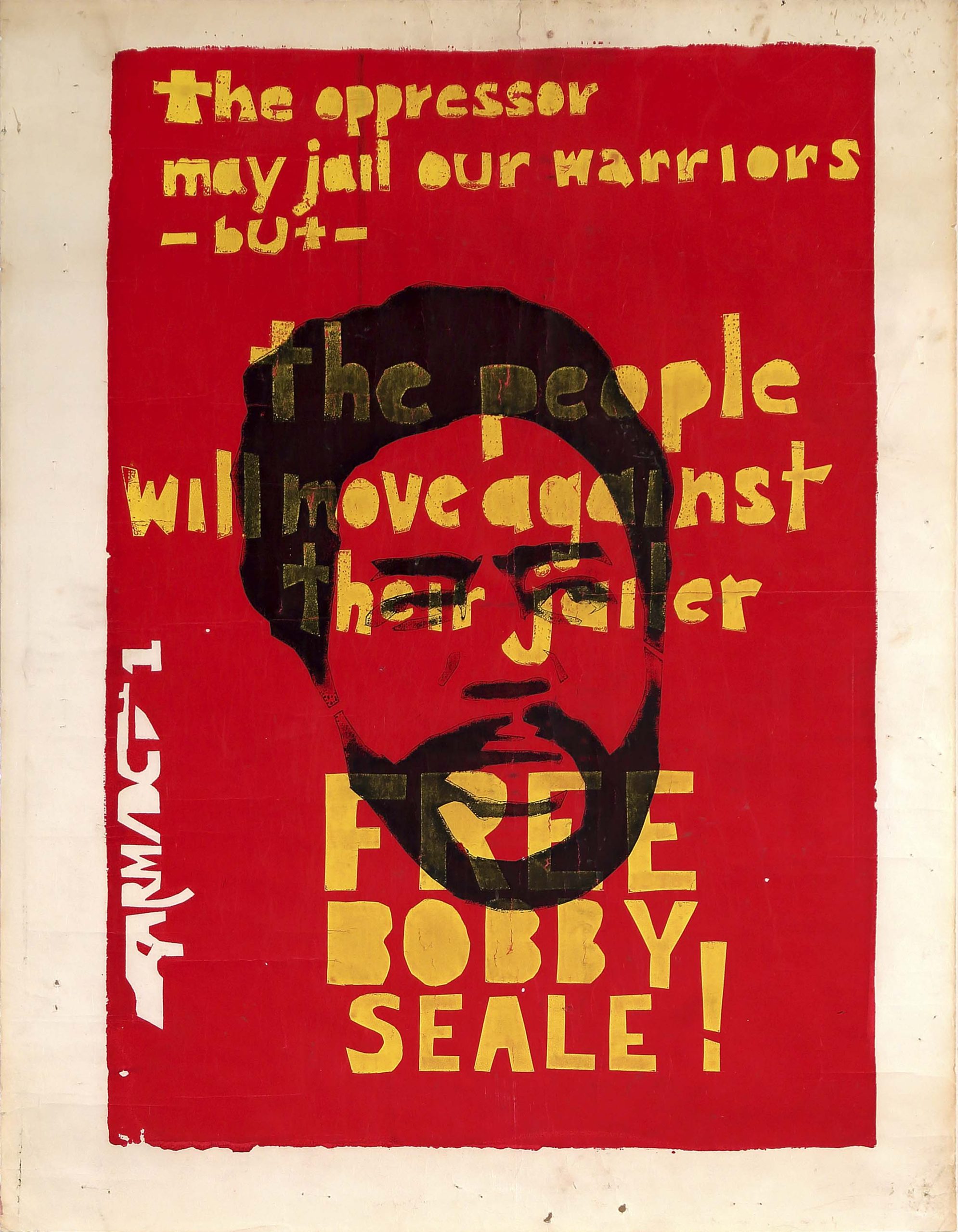
A red silkscreen poster of Bobby Seale's face printed over yellow text about

Free Bobby Seale!, c. 1969

Designer Unknown

The Merrill C. Berman Collection

  • Bobby Seale was one of the Chicago Seven (originally the Chicago Eight) charged with conspiracy to incite a riot during the 1968 Democratic National Convention. Seale, however, did not actually participate in any protests during the convention as he was only in Chicago to replace activist Eldrige Cleaver as a Black Panther Party representative.
  • Seale was denied proper legal representation in court by Judge Julian Hoffman, whom Seale then accused of being a racist. In a humiliating display, Seale was ordered by the judge to appear in court bound and gagged. He repeatedly argued in court that he was being denied his constitutional right to defend himself, and his legal counsel stated that the courtroom display was not one of order but rather that of a medieval torture chamber. In November of 1969, Judge Hoffman declared a mistrial for Seale, and the Chicago Eight became the Chicago Seven.
  • This poster references the court audience’s chant of “Free Bobby!” during his appearances. The language also alludes to the prison system and the unjust and racist decisions of the state and its representatives in this trial.

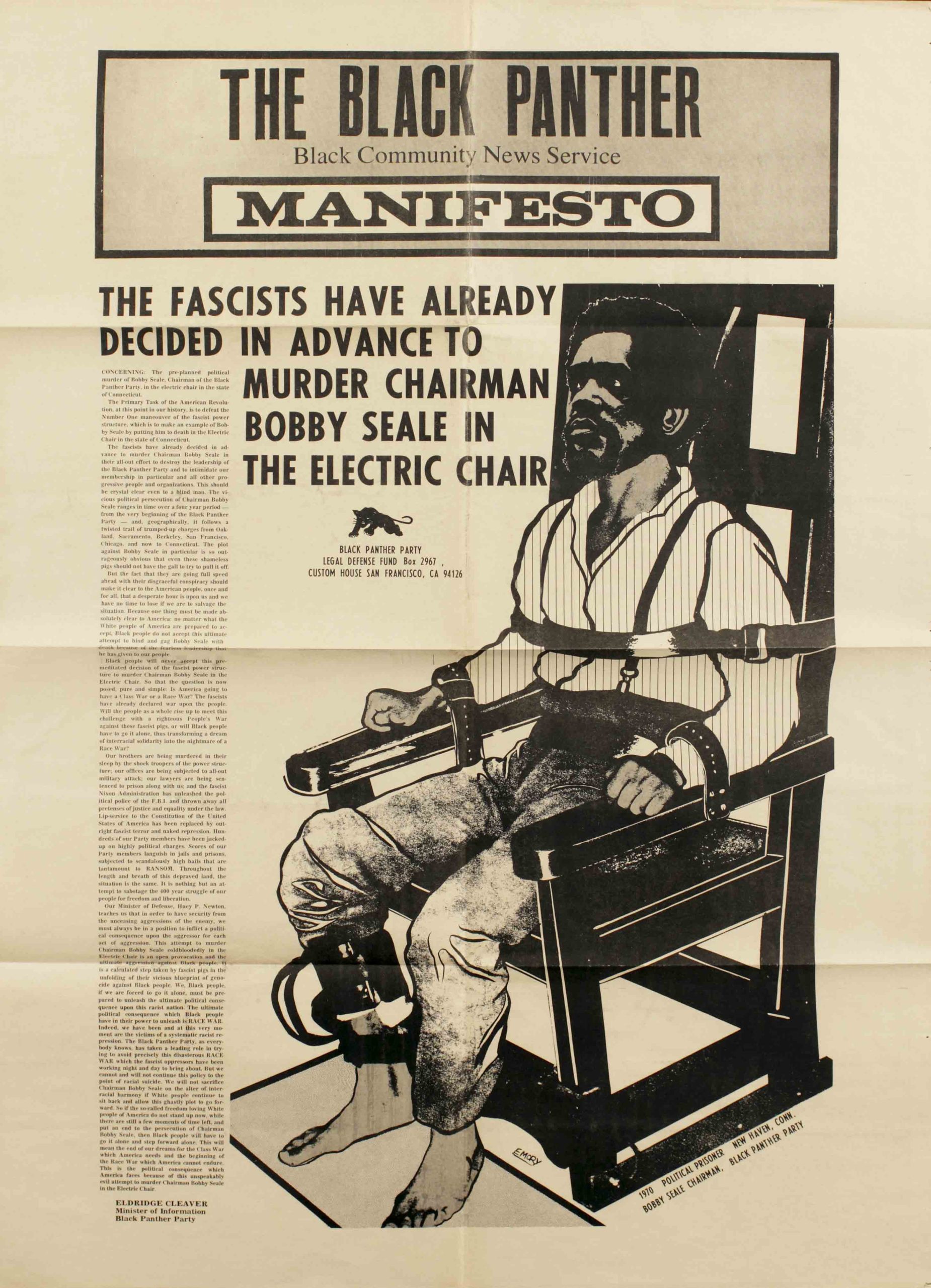
A newspaper cover of Bobby Seale, a Black man, sitting in an electric chair.

Black Panther Party Manifesto, 1970

Emory Douglas (b. 1943)

The Merrill C. Berman Collection

  • In 1970, while serving a four-year jail sentence, Bobby Seale was brought back to court in the New Haven Panther Trials. Various Black Panther Party members in Connecticut faced charges for the murder of 19-year-old Panther Alex Rackley. Rackley had been kidnapped, interrogated, and tortured by fellow party members who suspected that he was an FBI informant. The interrogation was recorded by the Panthers, and a few days later Rackley was shot and killed. Seale, who had been in New Haven speaking at Yale University, was alleged to have ordered the execution after his speech. 
  • Seale and Ericka Huggins, founder of the New Haven BPP, stood trial together. The prosecutor sought the death penalty despite a lack of evidence that either had any part in the torture and murder. 
  • Here, Emory Douglas depicts Seale in the electric chair during his trial, commenting on his unjust treatment. The image was reprinted in numerous forms, including pamphlets and newspapers, that were widely distributed. Later, Seale claimed that the power of this image contributed to his aquittal.

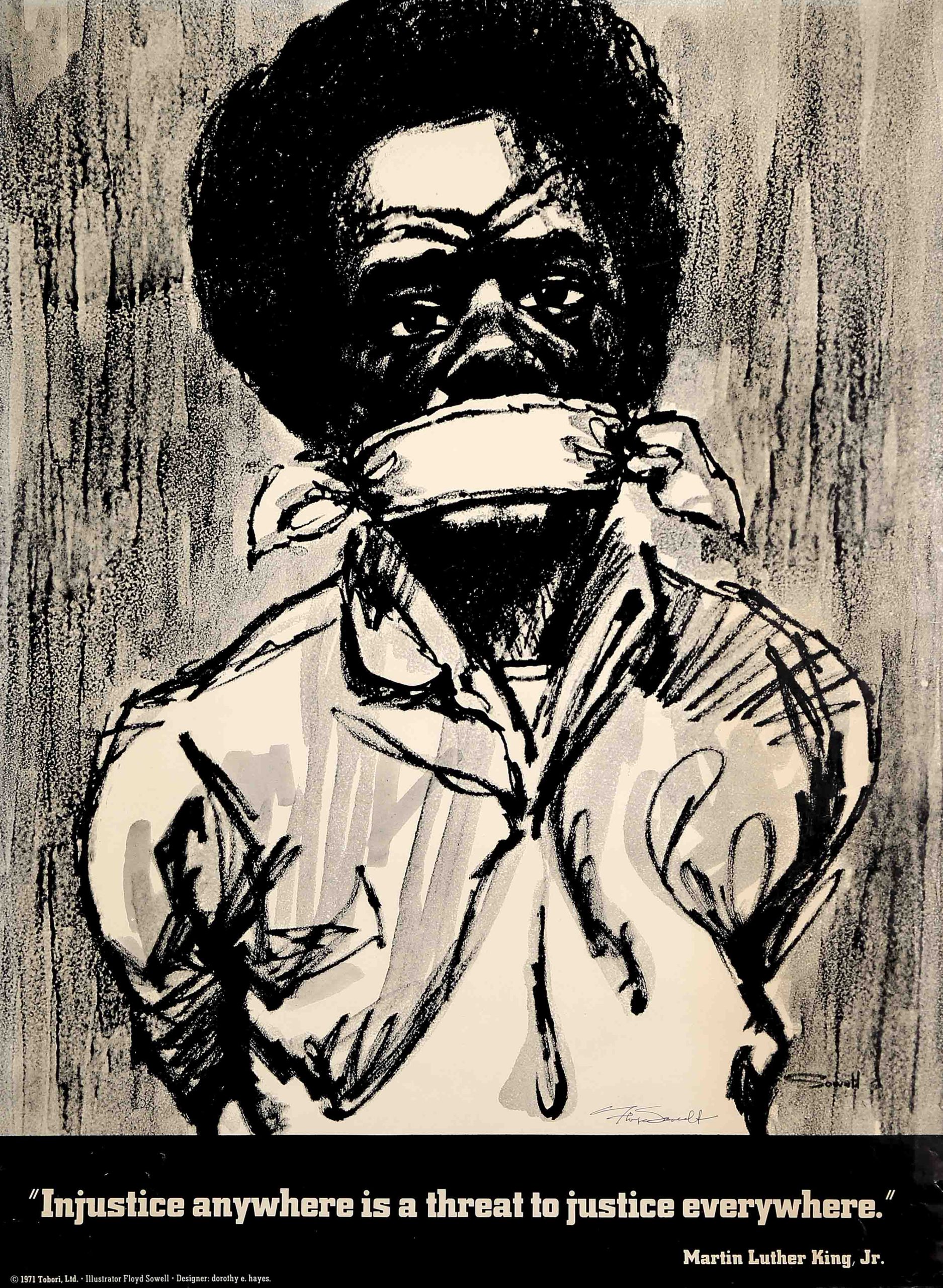
A photo offset poster of Bobby Seale with a cloth tied around his mouth and hands behind his back.

Injustice Anywhere Is a Threat to Justice Everywhere, 1970

Illustrator: Floyd Sowell (Dates Unknown)
Designer: Dorothy E. Hayes (1935–2015)

The Merrill C. Berman Collection

  • This brutal image highlights the gross mistreatment Bobby Seale suffered during the trial of the Chicago Eight in 1970. It is supported by the final line from Martin Luther King, Jr.’s “Letter from a Birmingham Jail.” 
  • Designs like this emphasized the actual faces and experiences of the accused who were often dehumanized in the popular imagination once they had been framed as criminals.

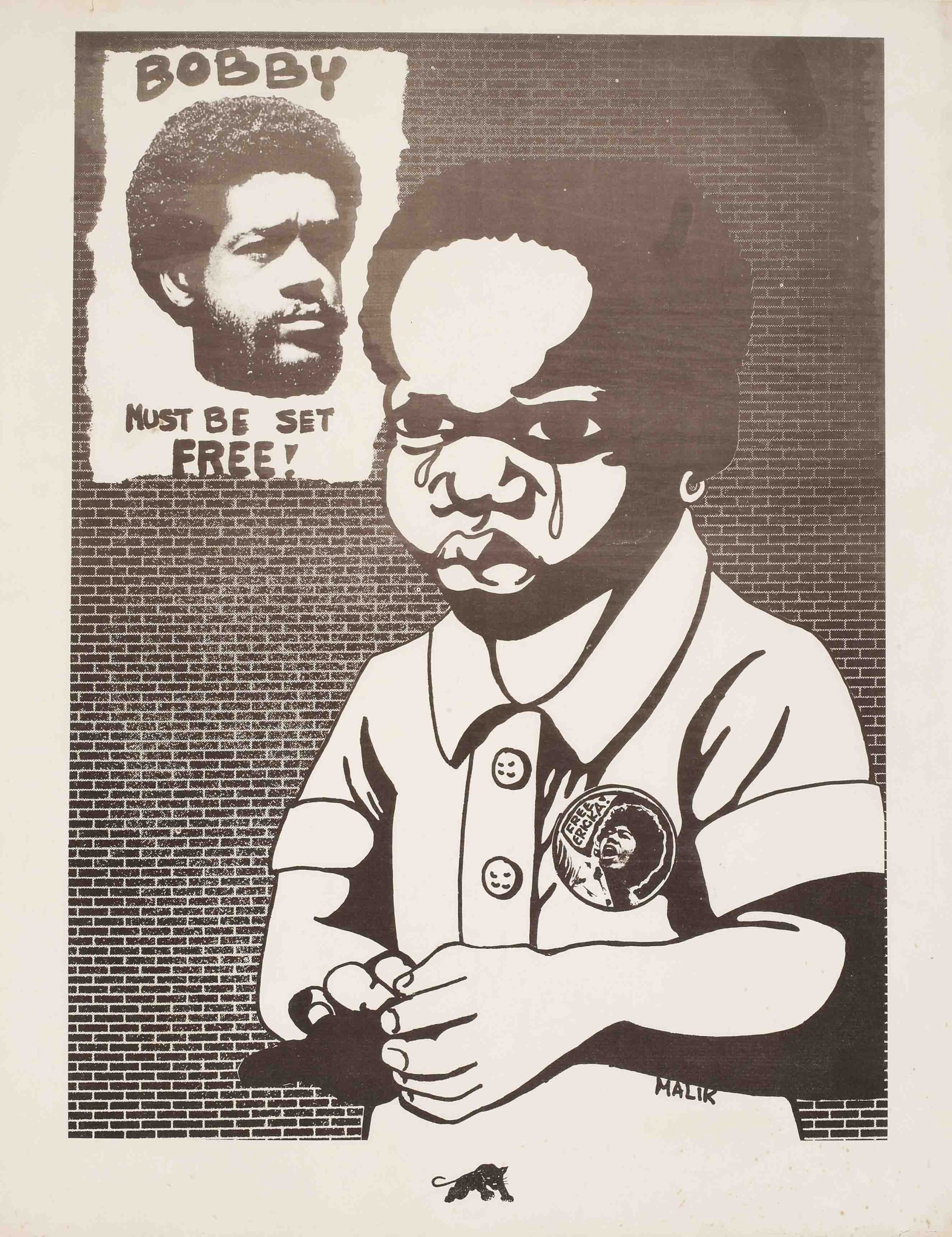
A photo offset poster of a young Black boy crying in front of a poster stating to free Bobby.

Bobby Must Be Set Free!, 1970

Reginald “Malik” Edwards (b. 1946)

The Merrill C. Berman Collection

  • Before joining the Black Panther Party in 1970, Reginald “Malik” Edwards had fought in the Vietnam war as a Marine. He was deeply affected by his wartime experience of racism, and, after he left the Marine Corps, he joined the Black Panther Party. Edwards ran the Washington, DC chapter of the BPP, and was asked to come to Oakland because he was an artist. There, he did layout work for the newspaper with Emory Douglas.
  • Edwards created the brick-patterned background of the composition using textured swatches from a craft store. Like that of Douglas, his work features the heavy black lines of traditional woodcuts. 
  • This image depicts a young boy, perhaps Bobby Seale’s son, also named Malik (after Malcolm X), crying in front of a poster demanding Seale’s freedom. The design stresses the importance of the family unit, a pillar of the party’s communal ideology.

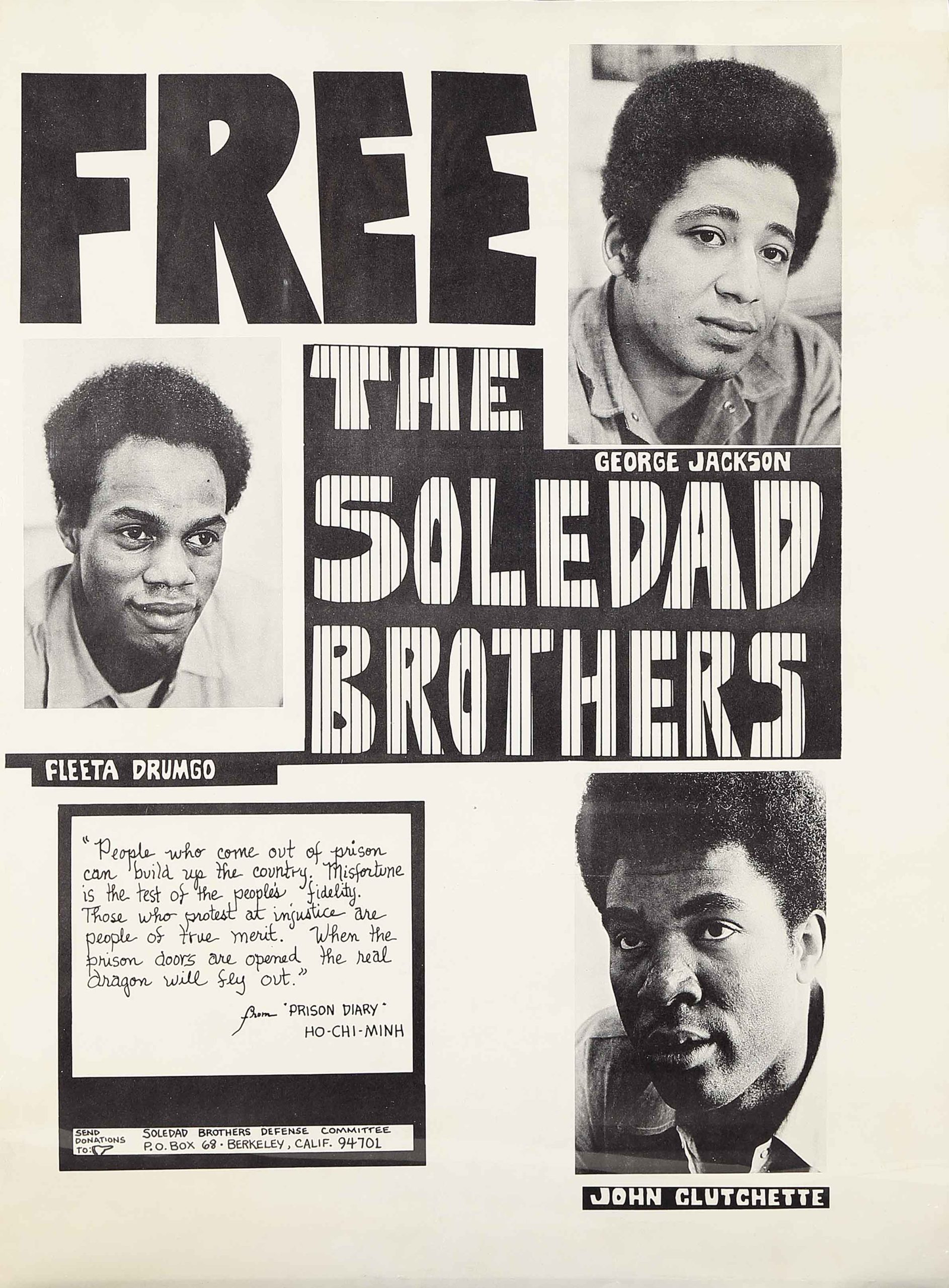
A xerox poster of 3 images of 3 Black men and text stating:

Free The Soledad Brothers, 1970

Designer Unknown

The Merrill C. Berman Collection

  • In January 1970, three inmates of California’s Soledad State Prison—George Jackson, Fleeta Drumgo, and John Clutchette—were charged with the murder of a white prison guard. The men were known as the Soledad Brothers, a name often used on Black Panther Party (BPP) printed materials and posters to encourage support for their case.
  • In August of the same year, Jackson’s younger brother, Jonathan, held up a courtroom at gunpoint in an attempt to free the group. This led to a shoot-out at the courthouse and the deaths of four people, including Jonathan Jackson.
  • This poster again reflects the BPP’s efforts to present humanizing images of those they believed had been subject to injustice. A box at the lower left contains a quote from the Vietnamese Communist leader Ho-Chi-Minh’s “Prison Diary.” During the 1920s, Ho-Chi-Minh was inspired by Marcus Garvey’s Black nationalist platform and published a pamphlet titled “The Black Race.” In it he explained that Black people were the most oppressed in the world but should not be disillusioned by the false promise of democracy in America.

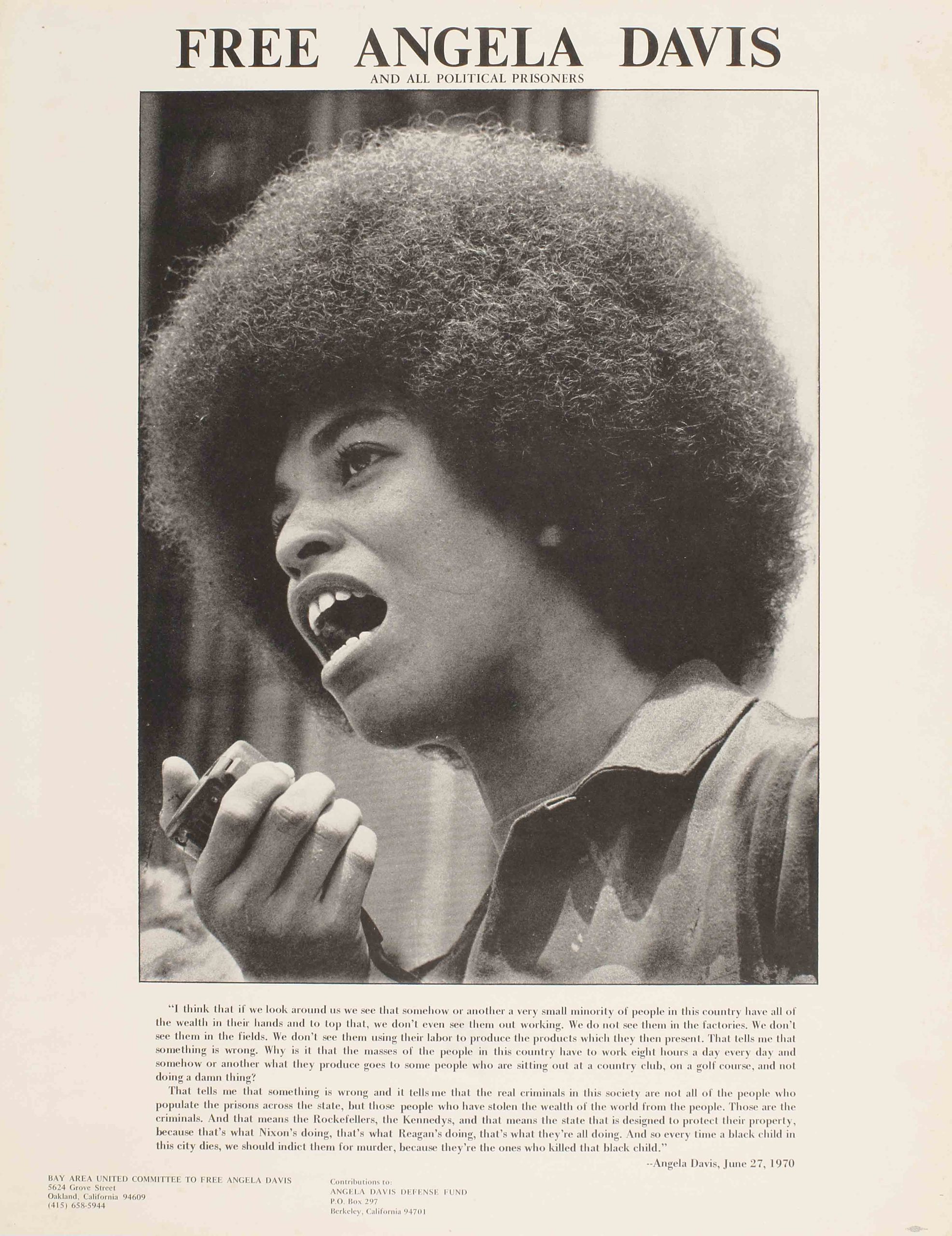
A photo offset poster of Angela Davis, a Black woman, speaking into a megaphone.

Free Angela Davis, 1970

Designer Unknown

The Merrill C. Berman Collection

  • While Angela Davis had not been present, she was alleged to have purchased the guns used by the Soledad Brothers. She was charged with murder, kidnapping, and criminal conspiracy—charges that drew international attention to the case. She went into hiding and was subsequently placed on the FBI’s Most Wanted Fugitives list. She was eventually caught and spent more than a year in jail. Davis was acquitted on all charges before an all-white jury in 1972.
  • The “Free Angela Davis” movement printed posters to create awareness of Davis’s position as a political prisoner. Many posters during this time feature her iconic Afro hairstyle and show her speaking into a microphone, referencing her notable oratorical skills.

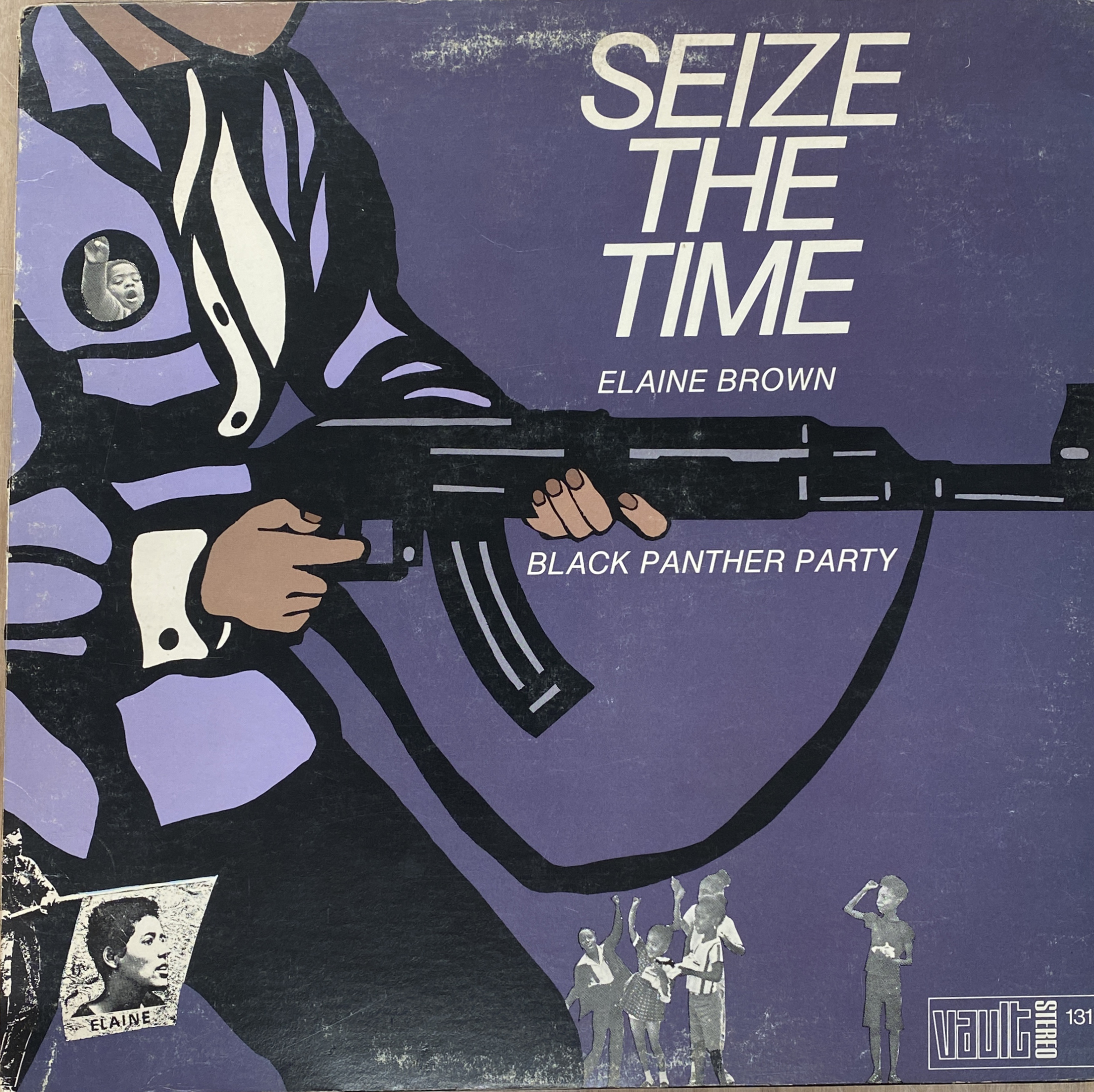
“I think Huey Newton liked my music because its classical quality gave dignity to our movement…I just wanted to make the most beautiful sound I could make and do the most beautiful thing I could do to honor our people.”—Elaine Brown, Black Panther Party chairwoman

An illustrational album cover of a medium dark skinned person from the neck down holding a rifle.

Seize the Time/Elaine Brown, 1969

Emory Douglas (b. 1943)

Private Collection, NYC

Elaine Brown’s album is currently being played on loop in the gallery. Please see the laminated cards to read the complete lyrics.

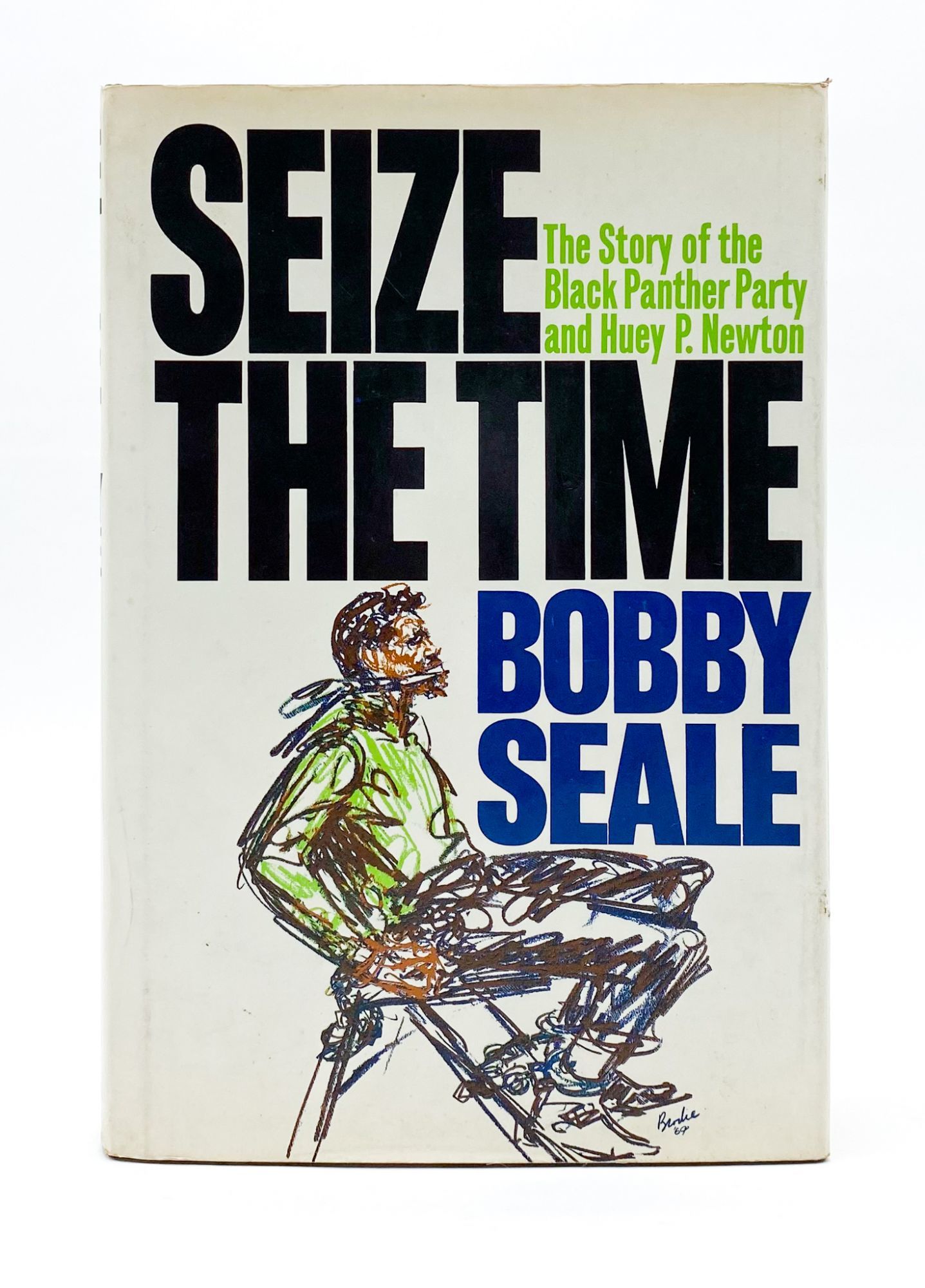
A book with a Black man handcuffed to a chair and gagged on the cover.

Seize the Time: The Story of the Black Panther Party and Huey P. Newton, 1970

Author: Bobby Seale (b. 1936)
Illustrator: Howard Brodie (1915–2010)

Private Collection, NYC

  • The phrase “Seize the Time” served as a rallying cry for the Black Panther Party. It is used here on both a popular record album and a book to promote the party’s agenda. 
  • The album by Elaine Brown features songs expressing Black resistance, community, and revolution, and was created partly in response to a campus shooting at UCLA, after which members of the BPP gathered to mourn. The song “The Meeting” would go on to become the official anthem of the BPP, with The Black Panther describing the collection as “the first songs of the American Revolution.”
  • Bobby Seale’s book comprises recordings he made while imprisoned that detail his experiences within the BPP. In it he dispels many misconceptions about the organization and explains that such revolutionary groups are necessary to the fight against oppression. Similar to Mao’s Little Red Book, this text became essential for all BPP members and they were required to carry it at all times.

“The people saw themselves in the artwork. They became the heroes…They could see their fathers or their brothers and sisters in the art.”—Emory Douglas

Conclusion

By the 1980s, membership of the Black Panther Party had dwindled significantly. The dissolution of the party has been attributed to a number of factors, among them discrimination against Black women, drug abuse, embezzlement of party funds, and targeted aggression from the government (including imprisonment and murder). Nevertheless, the BPP’s unique identity created a powerful legacy that has influenced Black-led organizations in subsequent decades and generations.

In 2013, #BlackLivesMatter sparked an international movement that used imagery mirroring the Black Panther Party’s branding of the 1960s and ‘70s. The movement started as a hashtag created by Opal Tometi, Alicia Garza, and Patrisse Kahn-Cullors in response to the murder of Michael Brown by a police officer. The movement evolved over time to embrace intersectional activism, inclusive of gendered violence specific to Black women and Black LGBTQIA+ people. Posters displayed during protests for the Movement for Black Lives often contain the same level of explicit and straightforward language to expose police and state-sanctioned violence. The movement also incorporates such symbols of Black pride and culture as the raised fist into the imagery of the greater revolution; it remains one of the most rousing icons of Black empowerment and solidarity.

Contemporary media, including social media and news outlets, play an important role in the interpretation of symbols, logos, and icons of the mobilizing efforts of the current movement. Nevertheless, each generation has its own form of protest, and one of the most effective ways to understand their distinctions is through the visual language that reaches and activates the greatest number of people.

Curation
Es-pranza Humphrey

Exhibition Design
KASA Collective

Production & Installation
Ola Baldych
John F. Lynch
Rob Leonardi

Graphic Installation
Keith Immediato

Special Thanks
Michele Y. Washington, design critic/historian
Dr. Ashley D. Farmer, historian
Cyril “Bullwhip” Innis, Jr., Black Panther Party veteran
Dr. Rosemari Mealy, educator/writer/international human rights specialist
Emory Douglas, Black Panther Party veteran

Mural
TK

Woodwork
Henry Pedestals

Metalwork
Nikki Romanello

Printers
Full Point Graphics
XDFour
The Standard Group